 Foto: Miguelazo84 · CC BY-SA 4.0 · Wikimedia Commons
Alavés-Osasuna 5-2: one box entry, five goals
The verdict, before the numbers
At Mendizorroza, Alavés beat Osasuna 5-2. Osasuna had not lost all season.
Lucas Boyé in the 26th, Mariano in the 35th, Boyé again in the 51st and the 68th, Pablo Ibáñez in the 90th. For Osasuna, Ante Budimir in the 46th and from the penalty spot in the 63rd.
A hat-trick for Boyé. A first defeat of the season for the Navarrese.
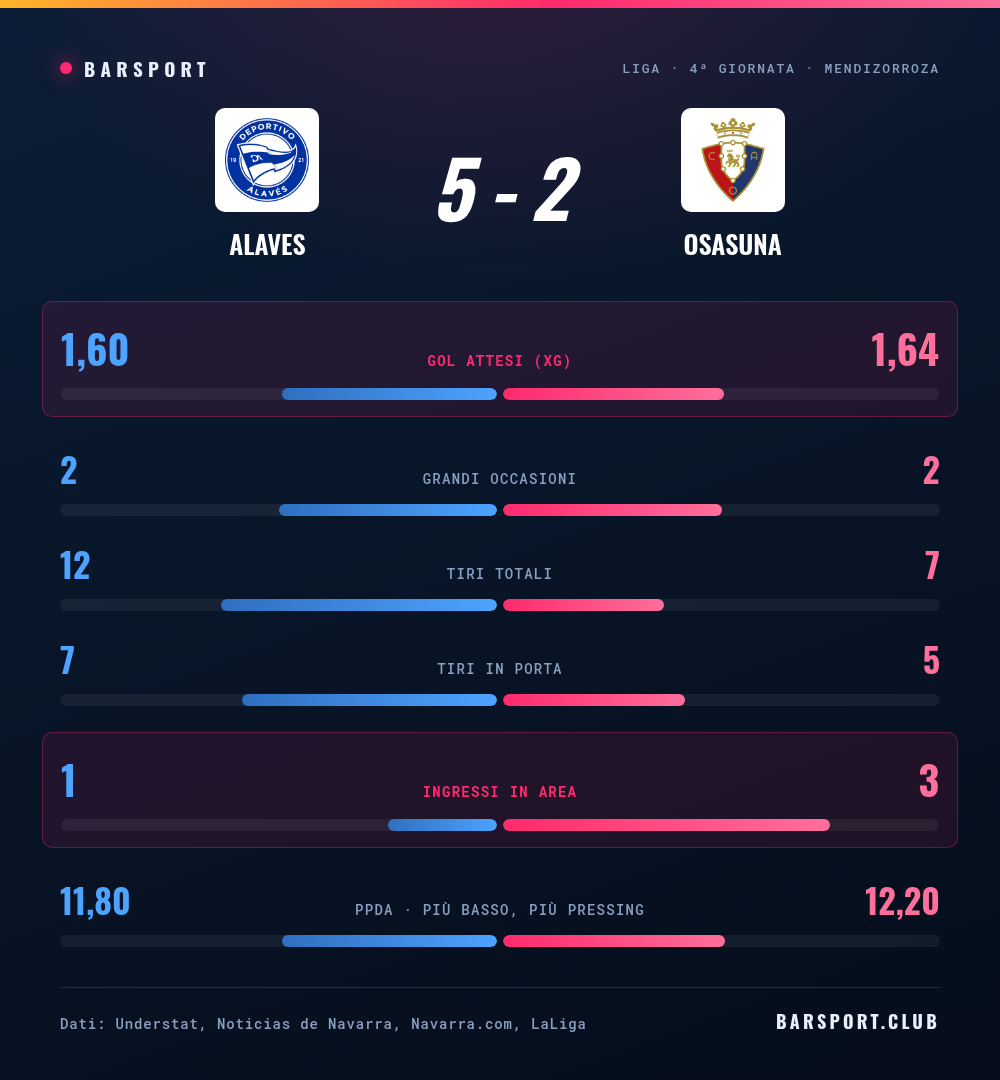
The number: 1
One is the number of times Alavés completed a pass into the final zone of the pitch. In the whole match. And they scored five goals.
The figure needs explaining, because on its own it looks impossible. The metric counts passes completed within roughly twenty yards of goal, and it does not count crosses. So it is not the number of times Alavés got near the goal: it is the number of times they got there by passing.
Once. And that is precisely the point: this team does not even try.
It is not a one-Sunday oddity. Alavés's box entries across the first four matchdays read two, two, two and one. On matchday three they beat Villarreal 1-0 while conceding seventeen and making two. It is a way of staying in a game, and it is consistent.
The result, though, came from somewhere else. Here are the five goals and what each was worth.
Boyé, 26th — a right-footed shot from outside the box, nobody near him, low and across to the far post: 0.037. Just under four hundredths.
Mariano, 35th — 0.171. It starts from a goal kick by keeper Antonio Sivera and a bad error by Alejandro Catena, who hands the ball to the striker.
Boyé, 51st — another drive from distance, almost into the top corner: 0.023. Two and a half hundredths.
Boyé, 68th — a header from an Ángel Pérez cross: 0.444.
Ibáñez, 90th — another header, another Ángel Pérez cross: 0.550.
Two shots from distance which, added together, are worth six hundredths of a goal and both went in. One goal from an error. And two headers that are the only two serious chances Alavés produced in ninety minutes.
Who created what, at each end
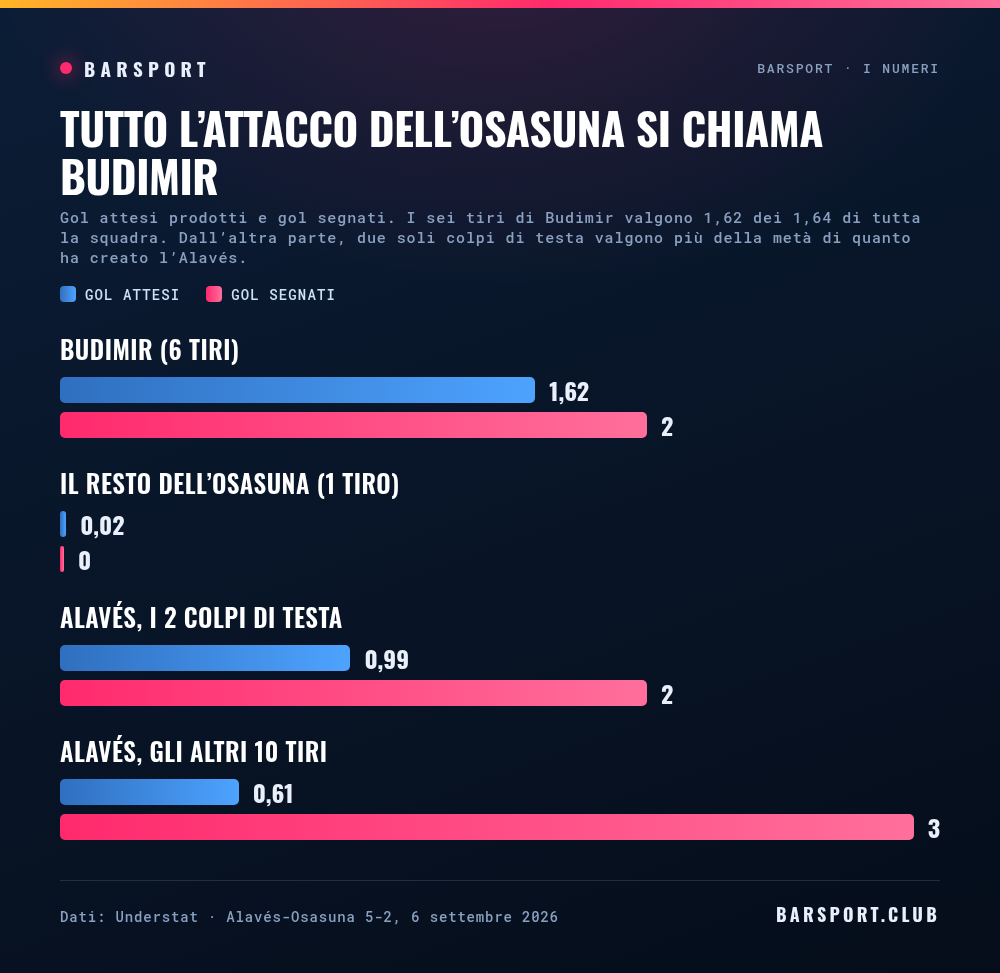
This is the chart that struck us most.
Ante Budimir took six of Osasuna's seven shots, and those six are worth 1.62 of the team's 1.64 expected goals. The only other Osasuna attempt, by Asier Osambela in the 87th, is worth two hundredths.
It is not a figure of speech: Osasuna's attack that evening was one man. Budimir opened with the biggest chance of the match in the 3rd — 0.458, the shot Sivera saved with an arm as he came out — and closed with two goals.
At the other end the concentration is different, but it is there. Ángel Pérez's two crosses are worth 0.99 on their own, more than half of everything Alavés produced. The other ten shots put together are worth 0.61 and brought three goals.
How the two teams moved
Luis Miguel Ramis's Osasuna is built around one striker, and makes no secret of it.
Ramis arrived in the summer from Burgos, replacing Alessio Lisci, wanting a recognisable, intense and balanced side. His shape is a 4-2-3-1 that becomes a 4-4-2 with barely a change, and a Spanish sports outlet's season preview described the Croatian's role precisely: the beacon to look to when the team needs goals and results.
On Sunday the beacon did his job. Two goals, six shots out of seven, essentially the team's entire attacking output. And the team lost 5-2.
That is the limit of the design, and the match exposed it almost as a teaching exercise: if the only man shooting is the centre-forward, then once the opposition score three times there is nowhere else the goals to come back can come from.
Quique Sánchez Flores's Alavés, by contrast, is a side with no interest in the ball.
The Spanish news agency summed up the coming season in August like this: continuity, few changes, and only one real question — whether the coach would keep the 5-3-2 he had turned to as an emergency measure the previous year to straighten the team out, or switch to a 4-4-2 with more presence out wide.
The same piece flagged a problem that showed up on Sunday at the other end of the pitch: with one defender gone and Facundo Garcés suspended, Alavés have been fielding converted full-backs in the middle of their defence.
What actually happened on the pitch, though, is told better by the two Navarrese papers.
The Pamplona daily's analysis is withering about its own team, and goes straight to it: in the Spanish top flight you cannot concede two goals from two goal kicks. The first through an error by Enzo Boyomo, the second through Catena's. And above all: Osasuna cannot afford to lose aerial duels like that, nor to let opposing forwards impose themselves so easily.
The same piece adds a detail that reads like an anecdote and is not: Osasuna chose to play the first half looking into the sun. The analyst calls it a significant oversight, and links it to a passage in which goalkeeper Sergio Herrera nearly put the ball into his own net after misjudging a jump.
Our data matches that reading on the duels, and confirms it from the opposite side: the only two real chances Alavés built are two headers from crosses, 0.44 and 0.55, and both ended up in the net.
Where the sources disagree
Here there is a sharp contrast, and the numbers have something to say.
The season preview from early August described an Osasuna with a solid base, few changes needed from the previous year, a well-drilled side able to hold up physically to the end.
The Navarrese paper's analysis on Sunday evening argues the opposite: that the opening seven points had concealed shortcomings already visible in pre-season and in previous years, and that Alavés simply brought them to light one after another.
In our view, on this point, the numbers side with the first reading — and we say that having just watched a 5-2.
Osasuna arrived in Vitoria with seven points from three matches. The expected points from those same three matches are 7.13. In other words: that haul was not inflated by any luck, it was exactly what the performances were worth. At Balaídos they had won 2-1 while producing 1.90 expected goals to 0.11, one of the most emphatic away displays in the league so far.
And on Sunday Osasuna conceded 1.60 expected goals. That is not the figure of a defence overrun: it is an ordinary afternoon, in which five balls happened to go in.
Our reading is that the "seams" on show were not about the structure, but about duels and individual errors. Those are two different problems. The second is fixable in a week. The first is not.
The season context
Alavés have ten points from four matchdays, against 7.56 expected. They are taking more than they produce, and that is a margin that closes up at some point.
Osasuna have seven points from 7.13 expected, which is precisely where they deserve to be, and the defeat in Vitoria barely moved that judgement: the expected points for the match were 1.32 to 1.39, essentially a draw.
The 5-2 is the result most out of line with the performances in the entire La Liga round.
The honest point
The risk with a match like this is telling it as though Osasuna were robbed. That is not what happened.
Losing two balls that way from the opponent's goal kicks is a mistake that gets punished, and paying for it twice in the same match is not bad luck. Losing two headers from crosses inside your own box, and seeing them worth almost a full expected goal, is not bad luck. Alavés did few things, did them well, and did them all against the same opponent on the same afternoon.
What is unfair is the proportion. With the same shots, on any ordinary afternoon, this match finishes 2-2 or 2-1.
Our reading, which is an opinion. Osasuna's problem does not look to us like the defence, nor the formation. It looks like the absence of a second man who shoots. A team in which the centre-forward produces 99% of the expected goals wins when he scores and loses when he does not — and on Sunday he scored twice, which ought to be enough, and was not, because there was nobody behind him. If Ramis finds a second outlet, seven points from 7.13 becomes a serious foundation. If he does not, this team will depend on Budimir until May.
On Alavés we are cautious in the opposite direction. Two goals from outside the box worth six hundredths between them do not come back next week. But be careful about writing them off as pure luck: a team that enters the box once a game and sits on ten points is doing something expected goals do not measure well. It is worth watching them again before deciding.
One last note, which is not a number. The fifth goal was scored by Pablo Ibáñez, who came through the Osasuna academy. He did not celebrate it.
On the goal times the Navarrese paper's report and the official La Liga records agree. Our statistical source, as always, records them a minute earlier.
We keep the running tally between results and performances in the Meritometro. Anyone who wants the raw numbers, without the story around them, will find them in the Nerd Zone.