 Foto: Reinhard Kraasch · CC BY-SA 4.0 · Wikimedia Commons
Hamburg-Mainz 0-5: twenty-six hundredths of a goal in ninety minutes, at home
The verdict, before the numbers
At the Volksparkstadion, Hamburg lost 0-5 to Mainz.
Sheraldo Becker on 19 minutes, Philipp Mwene on 41, Phillip Tietz on 48 and 83, Ransford-Yeboah Königsdörffer on 90+1. Not one dangerous shot on target from Hamburg all match.
Königsdörffer played for Hamburg until last season and left in the summer on a free. He came back to the Volkspark as an opponent and closed the account.
The number: 0.26
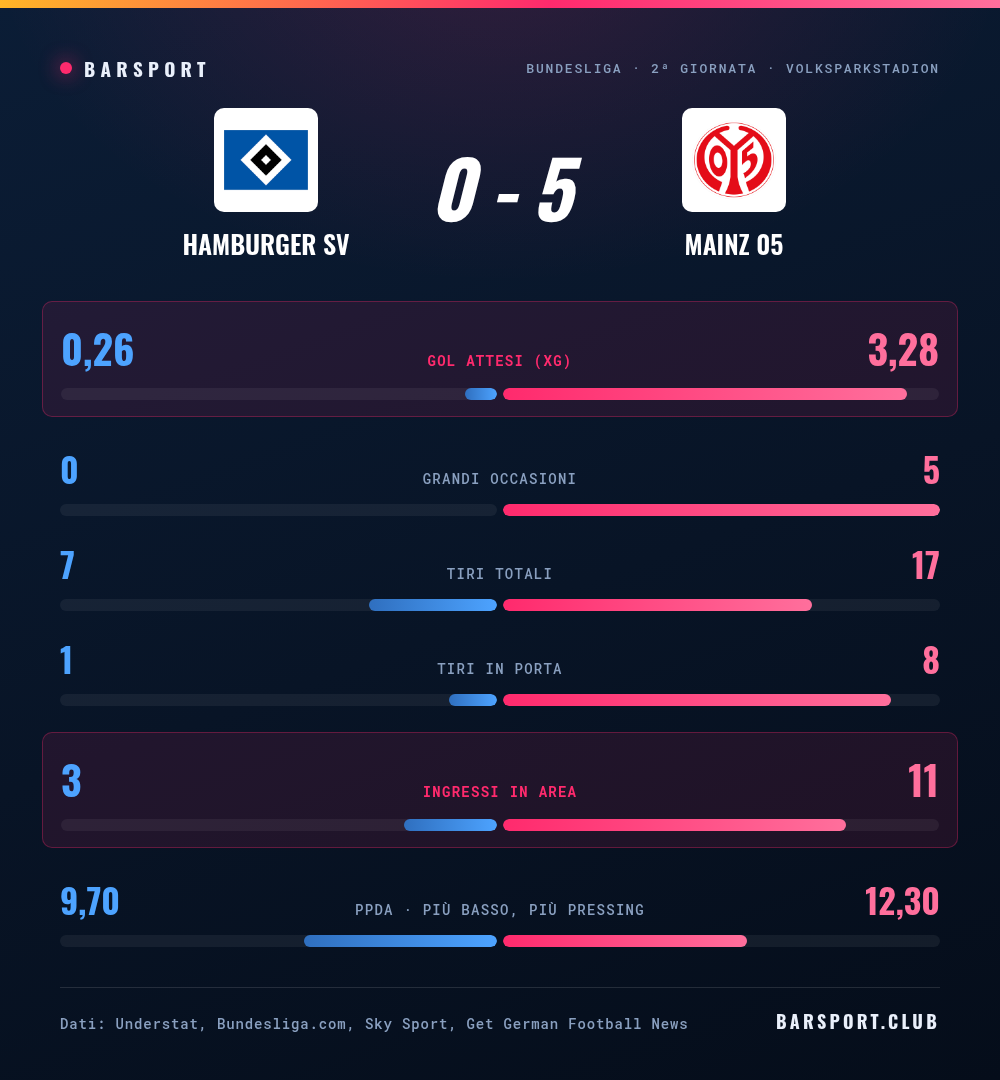
That is how many expected goals Hamburg produced in ninety minutes, at home.
To see how little that is: in this Bundesliga only Union Berlin (0.25) and Schalke (0.25) have done worse. Union were playing Bayer Leverkusen. Schalke were playing Bayern, and finished with zero box entries.
Hamburg were at home, against a side that only just avoided relegation last season.
Seven shots in all. The most dangerous is worth 0.074 — a David Møller Wolfe effort on 77 minutes, blocked. No Hamburg shot got past a tenth of an expected goal. In two Bundesliga matches Hamburg have created 1.36 expected goals in total: the lowest figure in the league.
How the two sides moved
Mainz scored five goals, and Sheraldo Becker is on all of the first three.
Becker opens on 19 from a Kaishu Sano pass, from a position worth 0.38. In the German ratings report on the match, the source of it is a midfield error by captain Nicolai Remberg. Mwene's 2-0 on 41 is the biggest chance of the ninety minutes — 0.92, effectively a penalty in open play — and the assist is Becker's. Tietz's 3-0 on 48, three minutes after the restart, comes from another Becker cross.
Becker went off on 67 and was named man of the match. The German source writes that he caused "huge problems for the Hamburg back line for the entirety of his 67 minutes". Our numbers confirm it from a different angle: Becker produced a goal and two assists in the first three, and his own four shots are worth half an expected goal by themselves.
What is surprising is how Mainz got there, because it was not by pressing.
Mainz's PPDA on Saturday was 12.35. Hamburg's was 9.68. In other words: the side that won 5-0 pressed less than the side that lost. And across the season Mainz have a PPDA of 13.18, eleventh of eighteen in the Bundesliga.
That cuts against what the Bundesliga has believed about Mainz for a decade. And it is precisely the point our sources argue over.
Total Football Analysis, in a piece written shortly after Urs Fischer took the Mainz job, was scathing. It described a positional game "designed to account for the long ball", with the midfielders pushed higher than the opposing forwards and the two half-space players squeezing inside to fight for second balls. The flaw, according to that piece: by condensing space, Mainz end up with their lone striker dropped into their own half and the two attacking midfielders busy with second balls, so "Mainz often lacks depth when they have the chance to launch counterattacks". And further: second-to-last in the Bundesliga for successful tackles, behind only Bayern. "The team lacks the intensity they had over the course of last season."
Get German Football News' season preview, dated 17 August, says almost the opposite. That Fischer's football "isn't the same wearisome, low-block junk associated with his Union days". That this team "appears unconcerned with parking the proverbial bus", that it "commits defensive errors all the time" but "aren't afraid to take risks". That in pre-season, against Kaiserslautern and Holstein Kiel, Mainz "turned aggressive ball recoveries into immediate vertical attacks", in the 3-3-2-2 Fischer brought with him from his Union years.
Who is right? In our view both, and Saturday's match explains how.
Mainz have not gone back to pressing high: the PPDA says so, and that is not up for debate. What has changed is what happens after the recovery. Mainz's box-entry difference this season is +15 — twenty-one made, six conceded — the second-best in the Bundesliga behind only Bayern. This is not a team that besieges the opposition box for ninety minutes. It is a team that, when it wins the ball in midfield, gets there in three passes.
Becker's goal off Remberg's error is that. So is the fifth, Königsdörffer's on 90+1: it starts from a dribble, the assist is Mwene's, and it is worth 0.37.
Hamburg, meanwhile, arrived at this match with a dismantled squad. The same German outlet's season preview lists the damage: Luka Vuskovic and Fábio Vieira, the two loanees who changed the level of the side last season, had gone back to their Premier League clubs — Vieira has since returned to Hamburg, and on Saturday he took a free kick on 85 minutes worth 0.032. Four forwards gone, Königsdörffer among them. The centre-forward role described as "the most pressing need on this roster". Patson Daka and Terem Moffi arriving with the season already under way.
On Saturday Terem Moffi had one shot, on 45 minutes, worth 0.023. Patson Daka did not shoot at all. Mainz scored their third three minutes after the interval, and from there the match was over.
The same preview, written a fortnight before the league started, used a line that now reads like a forecast: last season's team "weren't especially elegant and frequently weren't especially disciplined", but "became difficult to play against". On Saturday they were not.
The season context
Hamburg have zero points, zero goals scored and seven conceded in two matchdays. They have created 1.36 expected goals and conceded 4.59. Eight box entries made, twenty-one conceded.
The model is less brutal than the scoreboard — 1.25 expected points, nearly all of them from matchday one at Dortmund, lost 2-0 with a perfectly respectable 1.11 to 1.31 — but not enough to acquit.
Mainz have four points from 4.97 expected. They are among the Bundesliga sides taking less than they deserve: on matchday one they drew 0-0 at home to Paderborn producing 1.55 expected goals to 0.69, ten box entries to three. They won that match in everything but the result.
Five goals from 3.28 expected on Saturday: the tenth-biggest gap recorded so far in the big five leagues, so there is some above-average finishing in there. But the 5-0 is not stolen. Eleven box entries to three cannot be stolen.
The honest bit
Two matchdays are not a season, and for Mainz not even three. The +15 on box entries is the figure that looks most solid to us, because it does not depend on goals: it describes where the match was played. But it is built on two fixtures, one of them against a Hamburg side in this condition.
Our reading, and we are calling it a reading. Hamburg's problem does not look tactical to us. Seven shots, none above 0.08: this is not a side getting the movements wrong, it is a side with nobody to finish. The German preview wrote it in August — "the striker position nevertheless remains the most pressing need on this roster" — and so far it is the only sentence that explains everything we saw.
On Mainz we are more cautious. A PPDA of eleventh place and a box-entry difference of second place are two numbers that usually do not sit together. Either Mainz really are a transition machine, or they have played the two wrong opponents. We will know when they meet somebody who keeps the ball.
The minutes come from the German match reports — Sky Sport Deutschland, the Bundesliga's own site and the English-language outlet on German football agree on all five. Our statistical source, as always, has them a minute earlier.
On this match, for once, our data is complete: five goals in the shot table, five real goals.
We keep the running tally of results against performances in the Meritometro. Anyone who wants the raw numbers, without the story around them, will find them in the Nerd Zone.