On Sunday afternoon at the Raymond-Kopa it was so hot that the referee stopped the game in the first half so the teams could drink. When play resumed, Rennes were already 2 goals up.
After the match Stéphane Gilli said it plainly: until that break his Angers had been passive, deep, always late on the man with the ball. During the break he asked his players for one simple thing: to sit a little less deep.
From there Angers got back on their feet, pulled one back, and at 93' Usman Simbakoli had the ball for 2-2 on his head. Brice Samba got in the way, five minutes after the crossbar had already turned away another Simbakoli header.
It ends 1-2. Seen from the two sides, though, they are two different games.
The game Haise chose to play
Franck Haise's Rennes are a 4-3-3, and on Sunday they were one all the way: Samba in goal, Frankowski, Cresswell, Rouault and Merlin at the back, Rongier in front of the defence with Camara and Szymanski either side, Blas, Lepaul and Al-Tamari up front.
The idea on the ball is simple to describe and hard to stop. The holding midfielder drops between the centre-backs, the first phase of build-up becomes a back three and the two number eights are free to push up between the lines. On the flanks, rotating triangles form: the full-back, the eight and the winger swap places, the winger cuts inside to keep the centre-backs busy and a midfielder goes wide to cross.
Off the ball they are even more recognisable, because it is the same thing Haise did at Lens. The front 3 stay narrow and shut off the central passes, the opponent is forced to go wide, and as soon as the ball reaches the flank the full-back and the winger trap it against the touchline.
Gilli's Angers want to do exactly what that press punishes: play short out of the back, with the ball always going through Branco van den Boomen, the Dutch playmaker stationed in front of the centre-backs. On Sunday the ball almost never reached him cleanly in there.
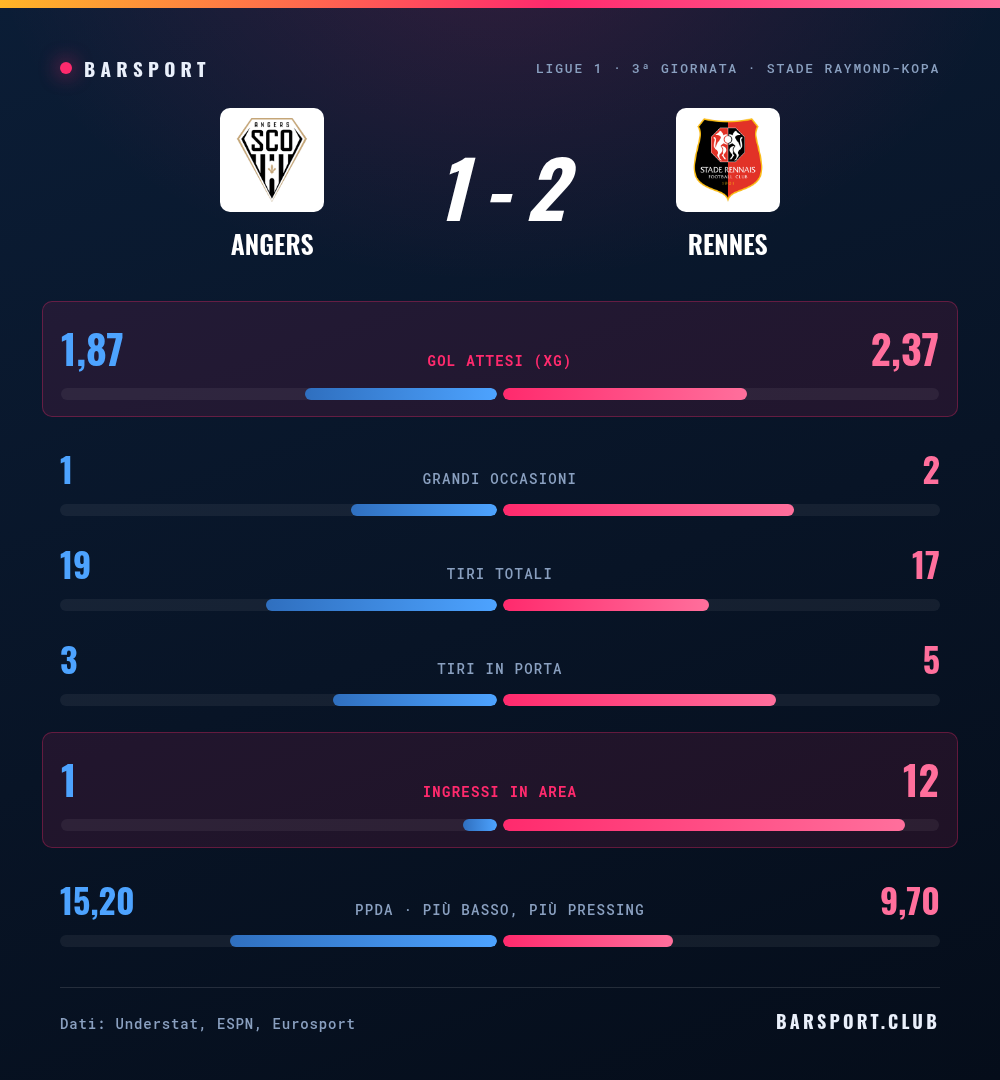
The number that tells the story of this game is in the middle of the graphic: 12 box entries for Rennes, 1 for Angers. By entry we mean a ball played close to the opponent's goal without going through a cross, in other words the team reaching the box with the ball on the ground, through the front door. In 90 minutes Angers managed it once.
The full-back Haise knows by heart
The first goal is the textbook version of all this. Al-Tamari and Szymanski combine, Szymanski gets the cross in, and inside the box, about fifteen metres from goal, there is Frankowski. The right-back. Control with the right, half-volley with the left, 0-1 at 9'.
Frankowski did not get there by chance. At Lens, under Haise, he spent years as the wing-back in a back three. Now the defence is a back four and on paper he is a full-back, but on Sunday he still looked to us like the Lens wing-back: when the ball is on the other side, he comes inside, and nobody follows him.
Eight minutes later the second comes from the opposite flank. Al-Tamari crosses from the left, Jordan Lefort tries to get there first and puts it into his own net.
Here is the first curious thing in the numbers. Rennes' 2 goals are worth 0.06 expected goals combined: Frankowski's shot, which the model rates as difficult, and an own goal, which by definition does not count. Rennes had real chances, and they missed them. Anthony Lopes stopped Lepaul 3 times, at 5', at 31' and in first-half stoppage time, and the first was a header from a few metres. In the end Rennes produced 2.37 expected goals and scored just one goal of their own, the hardest one.
The side door
If Rennes came in through the front door, Angers found another one.
Two thirds of their expected goals came from corners: 7 shots, almost all headers. From open play, in 90 minutes, Angers put together half an expected goal.
Carlens Arcus's goal came from there. Van den Boomen's corner, the right-back arriving at speed and heading it down, 1-2 at 35'. It came shortly after the break, just as Angers stopped sitting so deep and started gaining a few metres, and with the metres a few corners.
Sunday was no exception. In the first 3 matchdays almost half the danger Angers created came from a dead ball, and only Brest depend more on set pieces. At the same time Angers are the Ligue 1 team that gets into the box least from open play: 12 times in 3 games, nobody has done it fewer times.
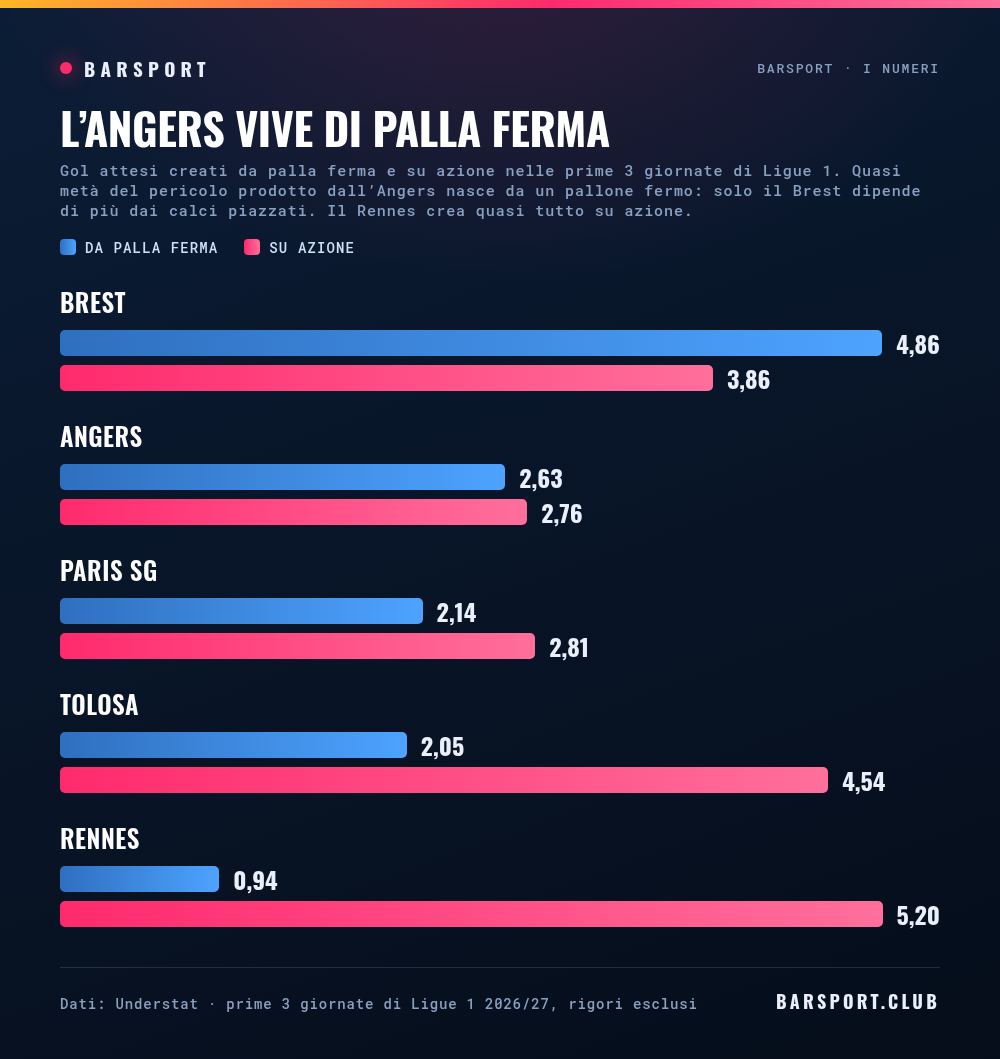
There is a logic to this too. Up front Gilli has three forwards who stand 1.88 metres tall, Amine El Ouazzani, Prosper Peter and Simbakoli, and van den Boomen to deliver. If the ball on the ground does not get through, the opponent's box becomes a place you reach another way.
Simbakoli's 10 minutes
At 83' Gilli takes off Amine Sbaï and sends on Simbakoli. The message is clear: the equaliser will not come with the ball on the ground, so inside the box you need someone to win it in the air.
In the 10 minutes that remain Simbakoli gets on the end of 3 balls, always with his head. At 88' from a corner, and he finds the crossbar. At 90'+3 from a corner again, and he finds Samba. At 90'+4 from a throw-in, and he finds Rouault getting in the way. Together they are worth 0.84 expected goals, almost as much as Angers had put together in the whole rest of the game.
This is where Rennes fall short. In the second half they never tested Lopes, and they spent the last quarter of an hour defending high balls in their own box.
And it is a problem they carry with them. In these first 3 matchdays Rennes are the fifth team in Ligue 1 for expected goals conceded from set pieces. Haise knows it, and after the game he put it this way: if Rennes can keep their technical level and their aggression even when they are ahead, they will have fewer difficult moments, "or in any case, we won't offer the opponent as much."
The honest bit
Our 2.37 for Rennes leans heavily on that Lepaul header at 5', which the model values at 0.77 on its own: a third of the total. Take it away and the two teams produced more or less the same. Rennes' dominance was real, but it lies more in control of the game than in the number of chances.
The 12 against 1 also needs careful reading. A box entry, as we count it, leaves out crosses, and Angers are a team that attack by crossing. The gap between the two sides was there, but that number exaggerates it a little.
And there is Gilli's reading, which should not be thrown away. Against Lille and Rennes, the two teams that have reached 7 points unbeaten, Angers created plenty of situations, and in his view what is missing is precision in both boxes. He is partly right: Angers have produced 5.50 expected goals in 3 matchdays and taken 3 points, one fewer than those numbers would have given them. But half of that danger comes from dead balls, and corners do not repeat on command.
Rennes reached the international break with 7 points, almost 2 more than their expected goals were worth. They are a real team, one that knows what to do with the ball. But so far they have reaped a little more than they have sown, and they close games out badly.
On Saturday Angers go to Le Havre, a defence that has conceded almost 7 expected goals in 3 games. There the front door should be open. We will see whether Angers still know where it is, or whether they will keep knocking at the side door.
T.L.
Want to see how much each team really deserves its league position? The Meritometro compares real points with expected points. For those who want the models rather than the headlines, there is the Nerd Zone.