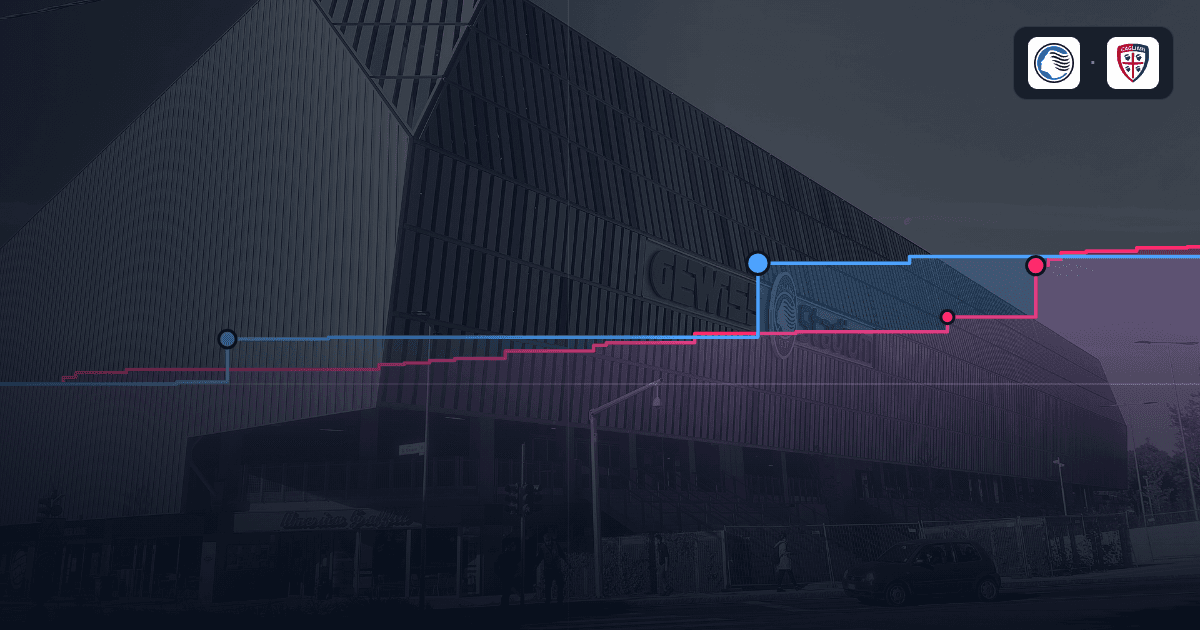
Three wins in the first four rounds had happened to Cagliari twice in their entire history: in 1969/70, Gigi Riva's title season, and in the season after. On Saturday night in Bergamo it became three times. In his press conference Pisacane said they are fighting to stay up, and that it is good to see Cagliari up there, above all for those who were around back then.
On the other side was an Atalanta that, for the first time this season, had the numbers of a winning team. And lost.
The verdict, before the numbers
Who deserved it? Less clear-cut than the scoreboard says, and less clear-cut than Sarri claimed after the game, when he spoke of a match his side dominated and a result that was partly down to bad luck.
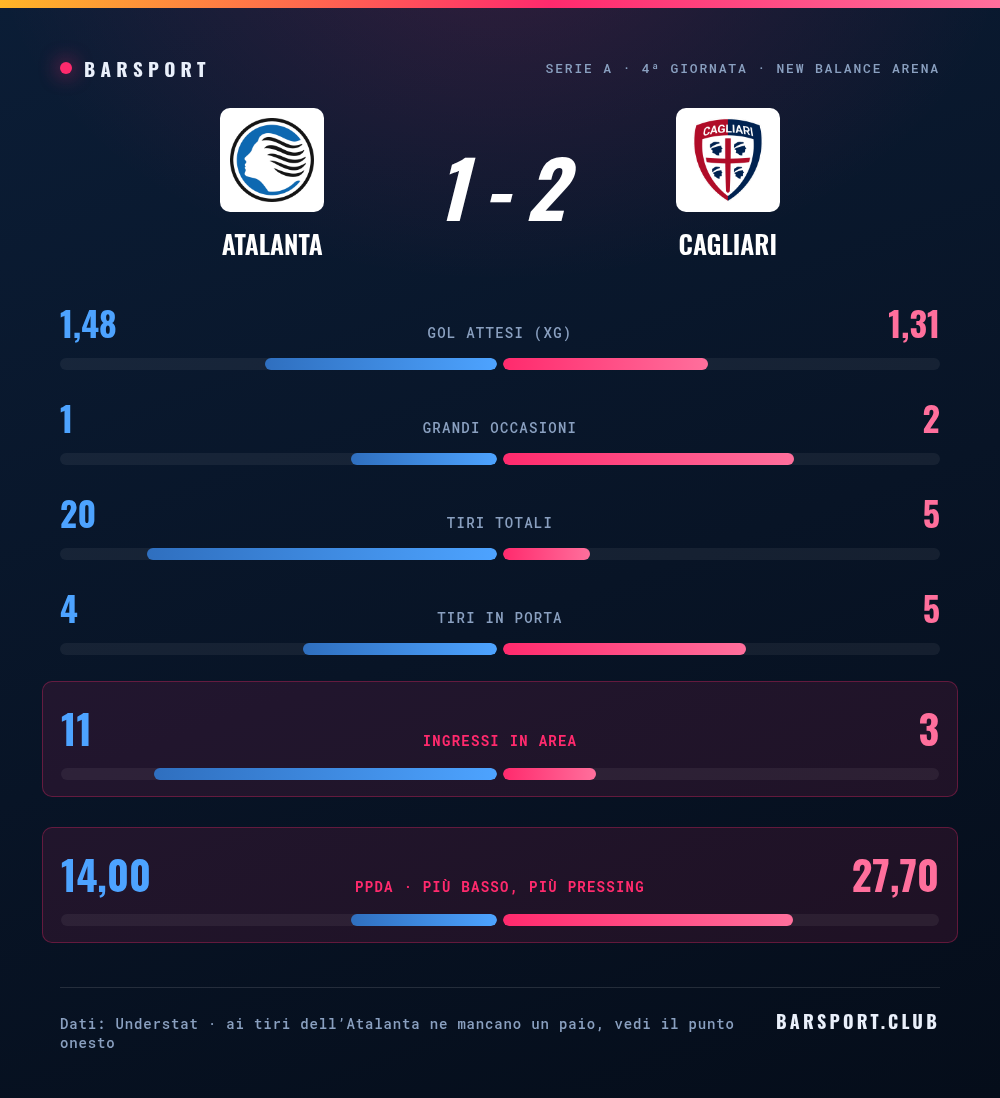
Expected goals read 1.48 against 1.31. Put like that it looks almost like a draw. But inside Cagliari's 1.31 there is a penalty worth 0.76 on its own: from open play the Sardinians produced 0.55 from 4 shots, Atalanta almost three times as much. Expected points, 1.43 to 1.27, give the home side a slight edge. This is a game Atalanta deserved not to lose, not one they deserved to win easily.
The number: 3
Cagliari entered the box 3 times in 90 minutes. They got 2 goals out of it and a third ruled out for offside. It is the figure that sums up their season: with 12 box entries in 4 games, 3 per match, no Serie A side reaches the box less often. And yet they have 9 points, the same as Roma, Inter and Lazio, who have a game in hand.
PPDA tells the same story from the other end of the pitch. It is the number of passes a team lets the opposition make before going to disturb them, and on Saturday Cagliari allowed 27.7. That means they almost never went to get Atalanta: they waited in their own half, in a low, narrow block, with a back line that prefers protecting the space behind to stepping up.
How the two teams moved
Sarri lined up his 4-3-3 with Kessié at the base of midfield, Samardzic and Ederson as the interiors, De Ketelaere, Scamacca and Rowe up front. Cagliari's plan for that midfield was explained by Pisacane himself: in the first half Kessié was to be man-marked, to take away Atalanta's first pass out of the back. The price was declared. With Fazzini tucking slightly inside to help in the centre, Bellanova's flank stayed open, and Cagliari accepted the risk there.
The result shows in the first-half numbers: Atalanta's shots came almost all from distance or from tight angles, for less than half an expected goal in total. The possession was there, the box was not. Sarri's build-up circled the block without finding the central corridor Cagliari had closed on purpose.
Then there is the other half of the plan, the one that decided the game. Cagliari's weapon was always the same: the long ball in behind the Atalanta back line. On 19 minutes Romano went long down the right for Adopo, who crossed for Paul Mendy, born in 2007, who got there first with his left foot: 0.44 expected goals, a real chance. Early in the second half another long ball cleared the defence and Mendy scored again, but he had set off a step beyond the line. On 61 minutes it was a long ball once more, a Romano free kick from distance: Deiola headed it, Kolasinac touched it with an arm held wide, and Maldini sent Carnesecchi the wrong way from the spot.
Three moves, three balls that went over the defence rather than through it. Pisacane put it almost technically: Atalanta's back four is not yet "Sarri-style", and his side tried to exploit that. After years of a back three and man-marking, Atalanta are learning to defend in a different way, with the line stepping up and squeezing together. When the movement is not yet in sync, one well-struck long ball is enough.
And Atalanta's goal is the confirmation in reverse. It did not come from patient possession: on 41 minutes Scalvini took a quick free kick in midfield, De Ketelaere drove through the middle with Cagliari still out of shape, Scamacca shot across goal and a deflection did the rest. The only time Atalanta caught the Sardinian block disorganised, they scored.
In the second half Pisacane changed the script again, moving Maldini and Adopo to screen Kessié. At that point Atalanta stopped circulating the ball and started chasing the result, and paradoxically became more dangerous: in the second half they produced more than one expected goal, with the biggest chance of the night falling to Kessié on 82 minutes, 0.49, saved by Caprile.
The season context
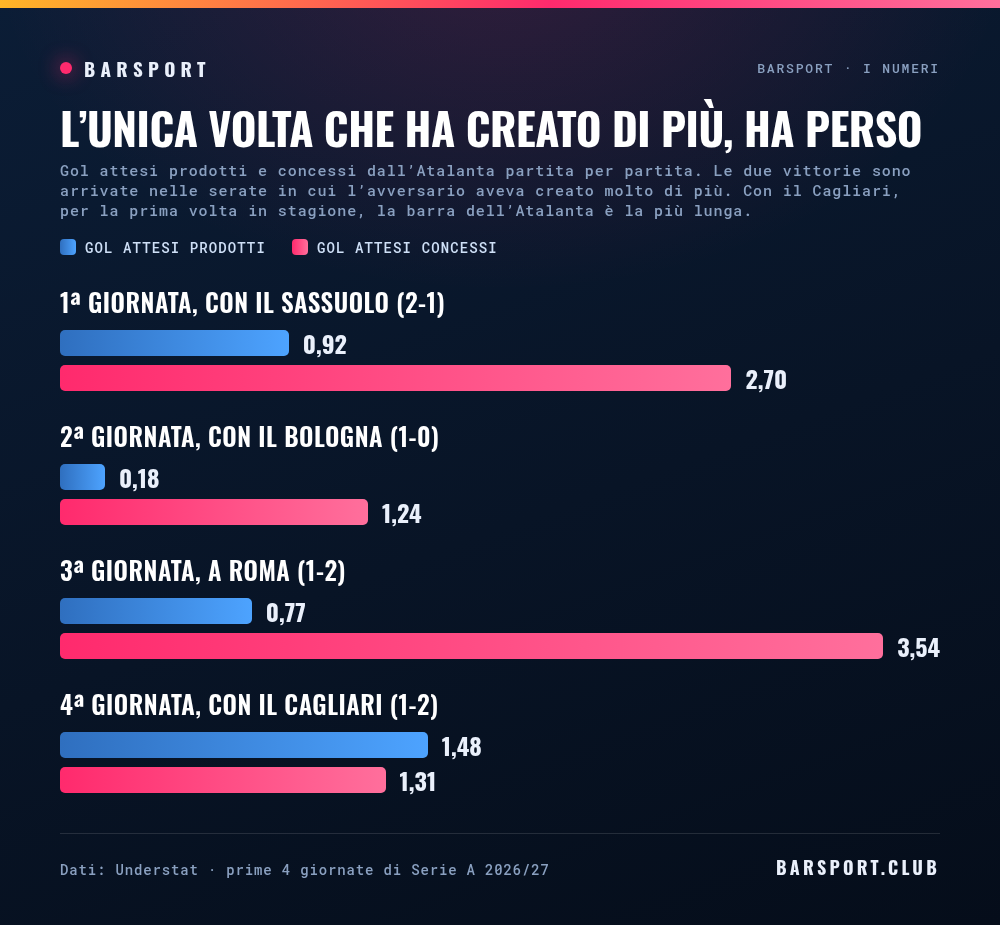
For Atalanta this defeat arrives the opposite way round from what you would expect. In the first three rounds they had collected 6 points from 0.90 expected points: they beat Sassuolo and Bologna in two games in which the opponents created far more. On Saturday, for the first time, they produced more expected goals than the opposition, entered the box more often than in any other game, 11 times, and pressed higher than ever, with a PPDA of 14.0 after three games above 18. And that is the night they lost.
Cagliari need careful reading too. 9 points from 5.29 expected, and a negative balance between expected goals for and against: 4.81 against 6.92. Of the four teams on 9 points they are the only one conceding more than they create. In 4 rounds they have allowed opponents 38 box entries, almost ten per game, and made 12.
The honest bit
First a limit in our data. A couple of Atalanta shots are missing from our list: the shots we have add up to 1.41 expected goals, while the match total is 1.48. That is why the counts in the first graphic are probably short, and why we only give the split between the two halves in rounded form. The match totals come from a different field and remain reliable, and all the goals are there.
Second, the reading opposite to ours, which is a serious one. You can argue that the bad luck Sarri talked about has nothing to do with it: a first half with less than half an expected goal, against a side sitting deep, is not bad luck but a lack of ideas in the final twenty metres. And Cagliari, with a goal ruled out by a step, could have scored three. In that reading the result is fair and the expected-goals figure is inflated by the late siege.
Third, Cagliari and sustainability. Winning while entering the box 3 times a game works as long as the few chances are good ones and your own box holds. Conceding almost 10 box entries a game costs you in the long run. Today the model says Cagliari have almost 4 more points than the numbers would give them.
Our view is that both things hold together. Cagliari are not lucky: they have a precise plan, prepared for the opponent and changed during the game, and they carried it out well. But that plan produces little, and 9 points from 5.29 expected is not a cruising speed. Atalanta, meanwhile, played their most convincing game and came away with nothing, which is the cruellest way of finding out you are on the right road.
On Saturday 19 Cagliari go to Udine, on Sunday 20 Atalanta travel to Turin to face Juventus. There is only one question: how long can a team that enters the box three times a game keep it up, and how long will it take a back four to become Sarri's.
T.L.
Want to see how much each team really deserves its league position? The Meritometro compares real points with expected points. For those who want the models rather than the headlines, there is the Nerd Zone.