 Foto: Fernandopascullo · CC BY-SA 4.0 · Wikimedia Commons
Five expected goals on one side, three shots on the other
A 4-0 at home is already a result that closes the discussion. In this case it is also the result that saves the opponent, because the match Atletico Madrid played against Osasuna was worth much more than four goals.
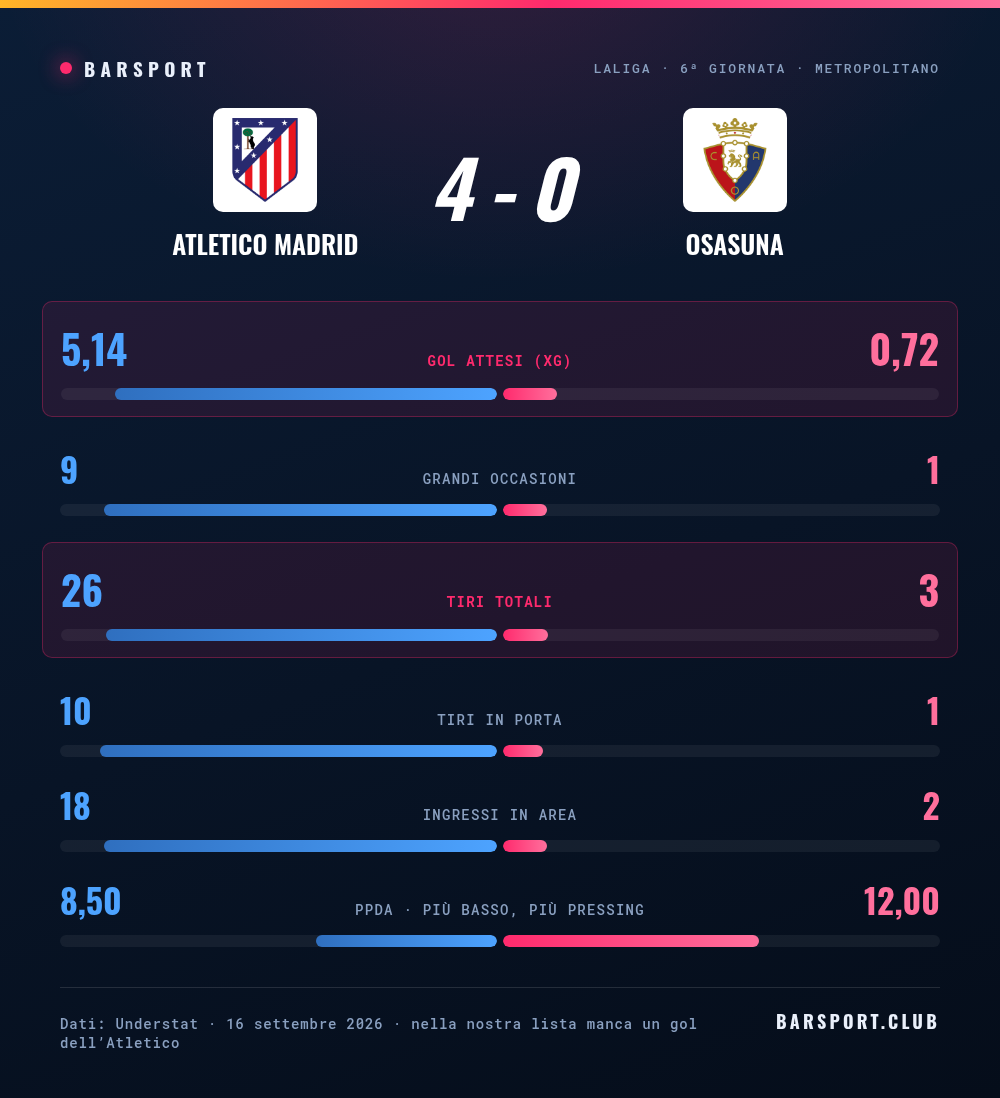
The expected goals say 5.14. It is the third-highest figure produced by a team in a single match this season, putting the five major leagues together.
The verdict, before the numbers
The attempts are 26 against 3, entries into the box 18 against 2, expected points 2.98 against 0.01. The model, when it sees numbers like these, leaves no room: that match ends with a win for the home team in 99 cases out of 100.
The only thing Osasuna did well was to turn up on the afternoon when Atletico could not put away their best chances.
The number: 6
Six is the number of chances worth more than 0.37 expected goals that Atletico missed.
In order: a header worth 0.579 in the first ten minutes, a right-footed shot worth 0.373 shortly after, an attempt worth 0.390 halfway through the first half, a right-footed shot worth 0.476, a shot from inside the box worth 0.522, and just before half time the biggest of all, 0.631, saved.
Added together, those six are worth 2.97 expected goals. On their own they would be the attacking performance of a very good day for any team in La Liga, and they are only the part that did not go in.
The first half ended 0-0 with Atletico on more than three expected goals. It is a number you see once or twice a season, and usually the ending is different: whoever produces that much without scoring usually ends up drawing.
How you build a first half like that
The method is a press at 8.5 PPDA, high but not extreme, and above all a team that attacks the box with four men inside and two arriving from the edge.
The eighteen entries into the box do not come from random crosses, they come from combinations out wide that always end with a ball pulled back from the byline. It is the most effective way of creating close-range chances and you can see it in the average quality of the attempts: 26 shots for 5.14 expected goals works out at 0.20 per attempt, which is double what a normal team produces.
The match was unlocked just after the hour mark with a right-footed shot worth 0.317, and it reached 4-0 without Osasuna ever having the ball for more than a few seconds. The three attempts from the visitors all fit on one line: a right-footed shot worth 0.573 in the opening minutes, the best shot of their match, and then two efforts worth less than 0.08 each.
That first chance deserves a note. With the score at 0-0, with Atletico already two missed chances to the good, Osasuna had a ball that goes in more than one time out of two. If it goes in, the match we would be describing is a different one, and the expected goals would stay identical.
What the numbers say and what they do not say
The 4-0 looks like the perfect story of a domination, and instead it is the moderate version. This happens more often than people think: between 5.14 expected goals and 4 goals scored there is a difference that makes no news because the result is already comfortable.
For a team that wants to win the league, though, the interesting question is another one: how often does a day like this happen and how many times does it end 1-1. In this match Atletico built the chances of two whole games. If the same chances came to them against a team that scores with its first shot, the story of this Sunday would be a crisis.
It is the reason we look at the production and not the scoresheet. A 4-0 with 1.80 expected goals would be a lucky evening; a 4-0 with 5.14 is a team doing a difficult thing well, that is, getting into the box again and again.
The honest point
First, a gap in the data, declared. Our list of attempts contains three of Atletico's four goals: the fourth is missing. The match totals, which come from a different source, remain reliable, and in fact the sum of the shots we have, 5.04, is very close to the team figure of 5.14. But the counts above should be read knowing that one attempt is missing, and for that goal you will not find a value.
Second, the opposite reading. You can say that a model which assigns 5.14 expected goals to a match that finished 4-0 is simply getting the measure wrong, because a goalkeeper on a good night and a defence that throws itself at every ball change the real probability of each attempt. That is partly true: xG does not know who is in goal.
Third, what we think. Osasuna left the Metropolitano with three attempts and a heavy defeat, and the most worrying thing for those who follow them is not the 4-0: it is that in ninety minutes they produced 0.72 expected goals, almost all of it in a single move. Atletico, on the other hand, played the kind of match that at the end of the season makes the difference between third and first place. Not because of the four goals, because of the eighteen entries into the box.
T.L.
Do you want to see how much each team really deserves its league position? The Meritometro compares real points and expected points. For those who want models and not headlines, there is the Nerd Zone.