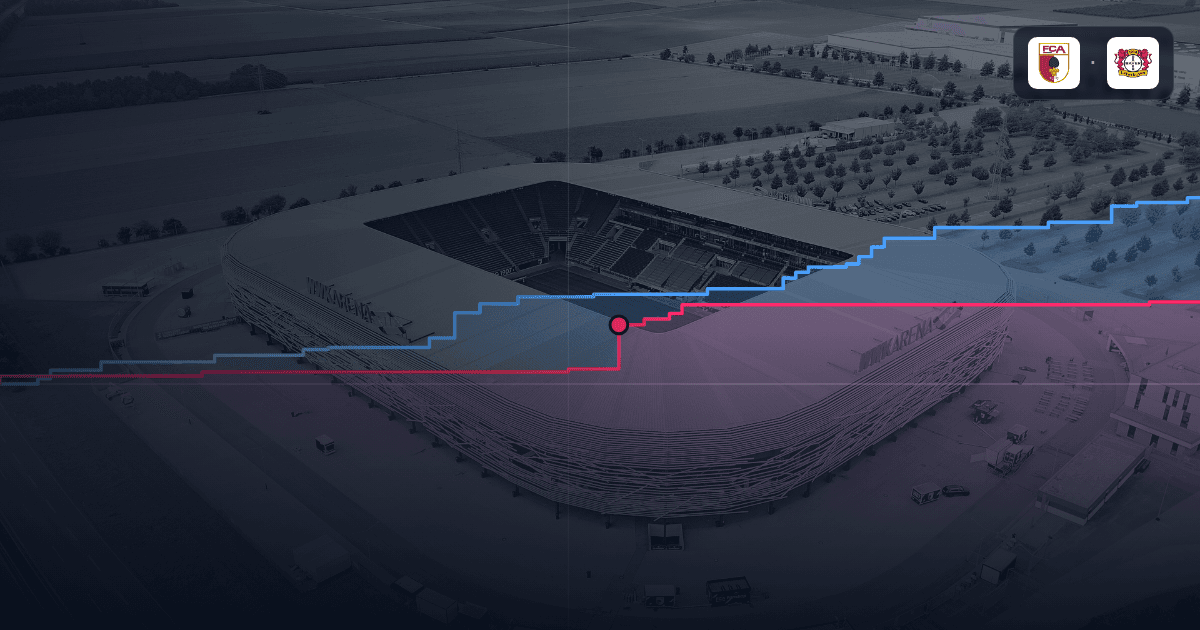
Augsburg reached the third round top of the table, with 2 wins from 2 and 7 goals scored. Leverkusen had lost on the opening day at Elversberg. On paper this was the game in which the table would put itself back in order.
Until the final minutes it went the other way. Then Patrik Schick, off the bench, flicked a Tillman shot in with his heel and took Augsburg's third win away from them.
The verdict, before the numbers
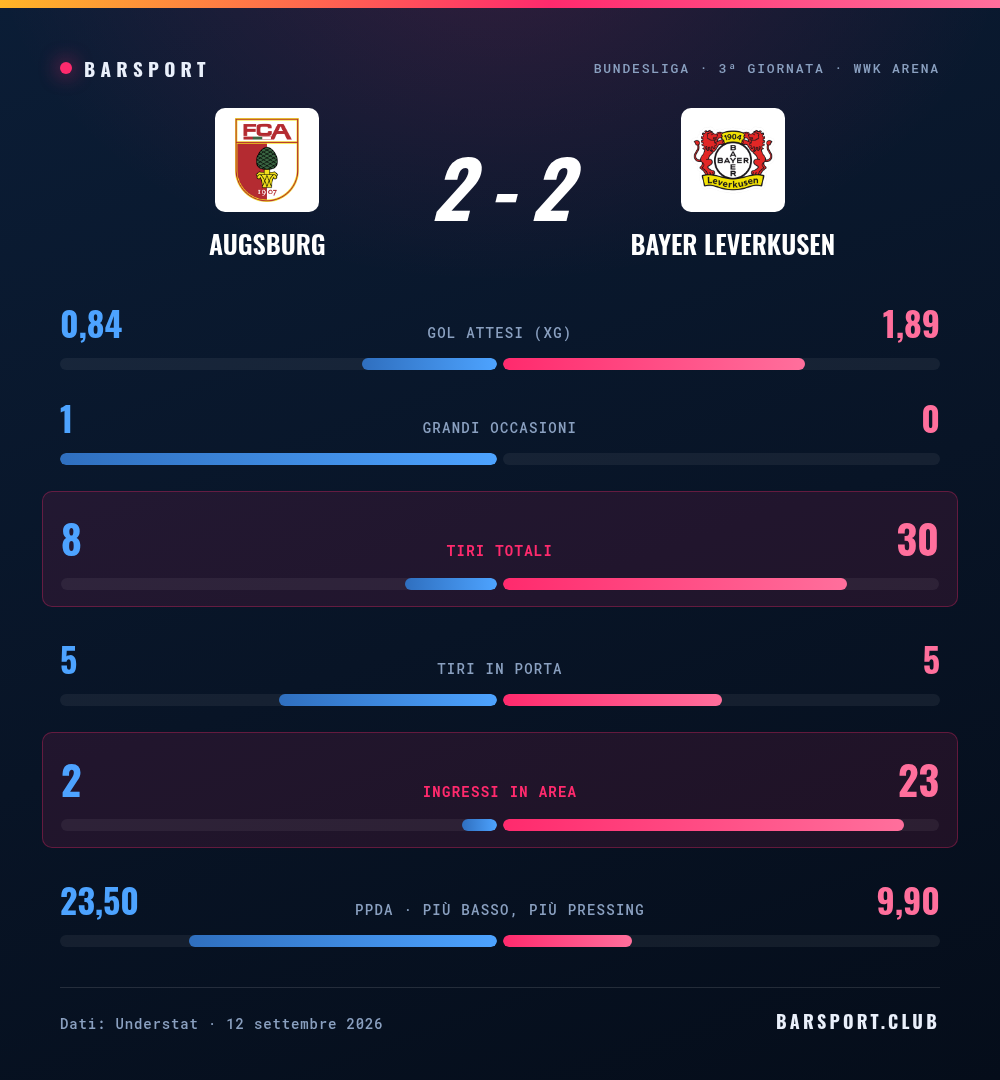
Leverkusen deserved more, and the numbers say so clearly. 1.89 expected goals against 0.84, expected points 2.10 to 0.67, box entries 23 to 2. And above all 30 shots against 8: no side in the big five leagues has shot that often this season without winning.
But thirty shots are not thirty chances. And that is exactly where Augsburg built their point.
The number: 0.13
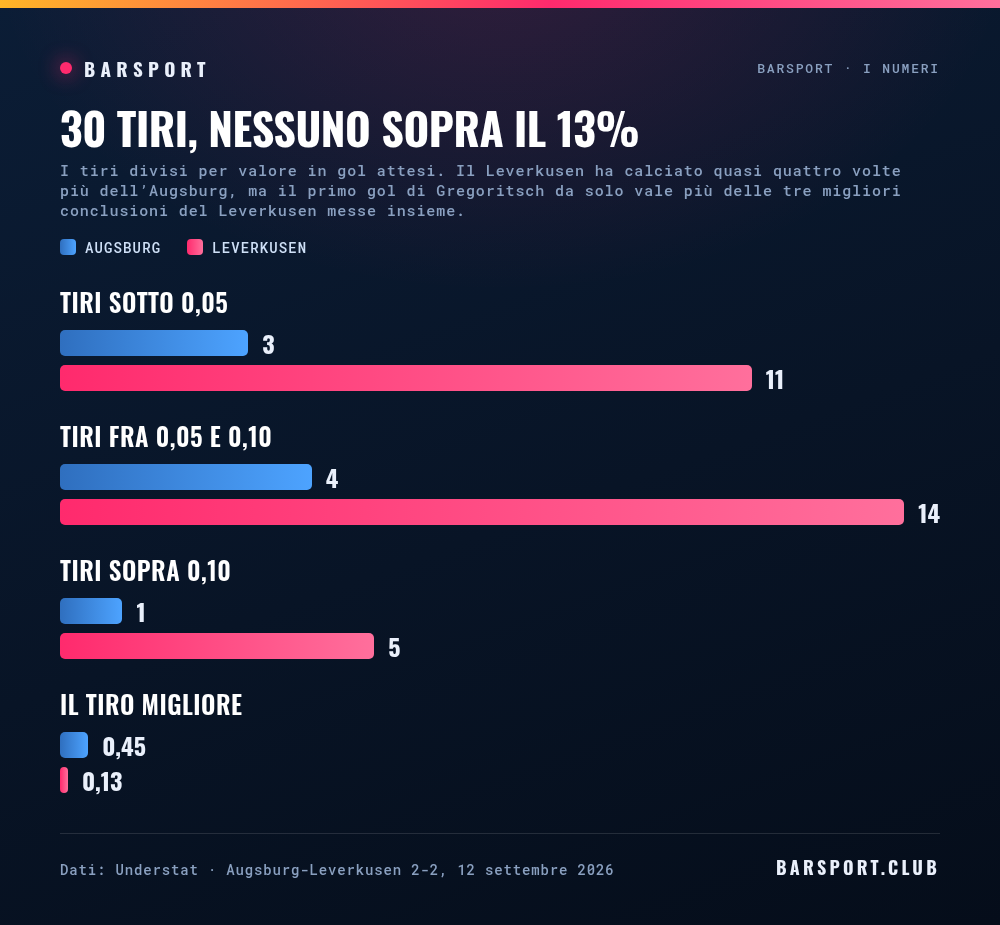
That is the value of Leverkusen's best shot in the whole match: Schick's heel flick for the equaliser. None of the 30 attempts went above that mark. On average each shot was worth 0.06 expected goals, roughly one chance in sixteen. 12 were blocked by a defender before reaching the goal.
At the other end Augsburg shot 8 times. But Michael Gregoritsch's first goal on its own is worth 0.45: more than Leverkusen's three best attempts put together.
How the two teams moved
Manuel Baum's Augsburg play a 3-4-2-1, and without the ball the wing-backs drop onto the defensive line to form a block of five, with Massengo and Rieder in front to close the middle. Augsburg's PPDA was 23.5: Leverkusen could play almost the whole time without pressure. Baum did not try to take the ball away. He tried to take away the space where that ball could become a chance.
Carles Martínez's Leverkusen, with Diaby and Kofane starting for the first time, got into the box constantly, but into a crowded box. The result shows in the type of shots: attempts from congested positions, balls charged down, efforts from the edge after a rebound. 11 of the 30 shots came from corners or free kicks. From a single corner, on 36 minutes, three different players shot within the same move.
Leverkusen's goal, tellingly, came in the only way Augsburg's defence was not packed. On 18 minutes Tapsoba lifted a long ball over the line, Kofane controlled it, beat Matsima with a feint and scored. A move that went beyond the block rather than into it.
Augsburg did the opposite: few balls, but in the right place. Gregoritsch is the centre forward a team like this needs, able to hold the ball up and keep defenders busy. On 50 minutes Behrens combined with Ibrahimović and slipped a through ball to the Austrian, who got there ahead of a hesitant Flekken. Five minutes later, from a Rieder corner, Gregoritsch headed in completely unmarked. Two goals from 0.54 expected goals in total.
Martínez responded with four attacking changes, Schick and Doué first, Tillman and Terrier later. The siege was real, but it remained a siege of small shots, and for long spells Dahmen and the Augsburg defenders were enough. The equaliser came from a rebound: Tillman shot low, Schick flicked it in with his heel. Afterwards Martínez said Leverkusen had deserved more, but that football is football and Augsburg had scored two goals.
The season context
Augsburg have 7 points from 4.27 expected, and the way they have collected them has changed from game to game. On the opening day they swept Schalke aside with 5.54 expected goals. At Frankfurt they won 4-1 while creating less than their opponent. On Saturday they defended for almost the entire game. The worrying figure is a different one: in 3 rounds they have conceded 45 box entries, and in the Bundesliga only Schalke have conceded more.
Leverkusen, on the other hand, have 4 points from 7.22 expected. That is the biggest gap in the Bundesliga between real and expected points. They have produced 7.89 expected goals and conceded 2.49, entered the box 54 times and allowed 12. Those are the numbers of a team that dominates and, for now, collects little.
The honest bit
First, a match's expected goals are a sum of shots, and the sum sometimes exaggerates. When three players shoot within the same move, the model counts three separate chances, but at most one goal can come of it. Part of Leverkusen's 1.89 is made up this way: scrambles and rebounds where each extra shot adds numbers without really adding probability.
Second, the reading opposite to ours, which is defensible. You can argue Augsburg did not have luck but a plan: concede the ball, concede the shots, do not concede the chances. It is the same bet made by anyone who defends deep knowing that a blocked shot does not hurt. In that reading 2-2 is the price of a single loose ball in the final minutes, and the fairest result would have been an Augsburg win.
Our view sits in between. Augsburg's plan was clear and worked almost entirely, but 30 shots and 23 box entries are too many to concede if you expect to win often, even when the shots are small. Leverkusen dominated without creating a single clear chance, and that is their problem, not bad luck.
On Saturday 19 Augsburg go to Bremen, on Sunday 20 Leverkusen host Leipzig. The question is whether Leverkusen will find a way into the box without finding it already full, and how long Augsburg can hold out conceding 15 box entries a game.
T.L.
Want to see how much each team really deserves its league position? The Meritometro compares real points with expected points. For those who want the models rather than the headlines, there is the Nerd Zone.