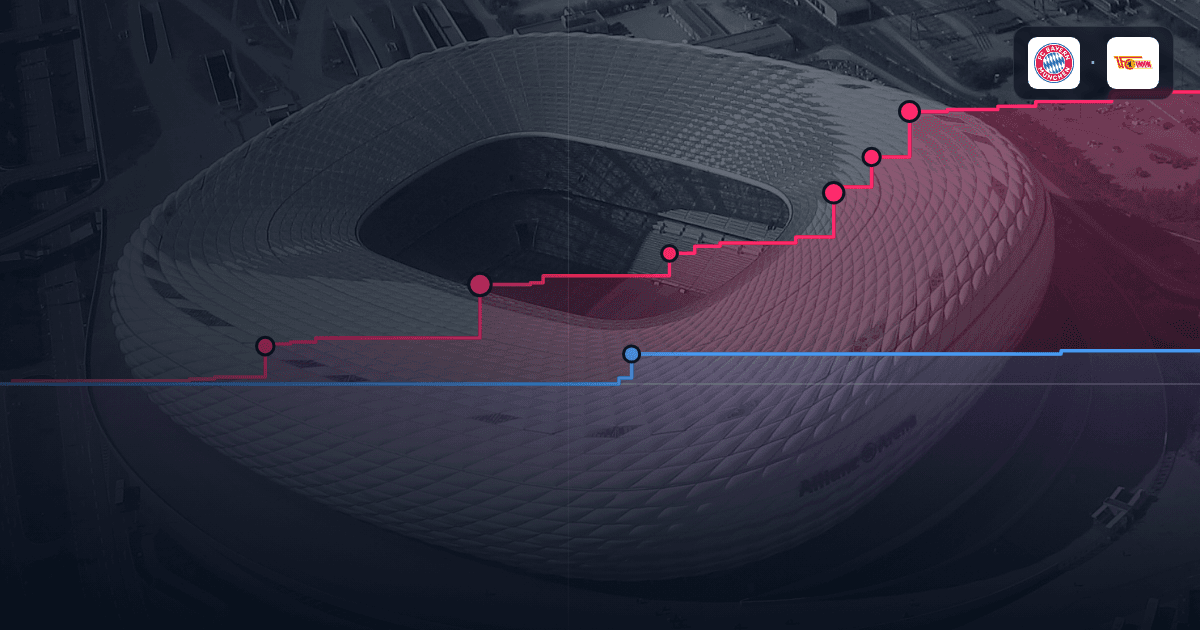
 Foto: Maximilian Dörrbecker (Chumwa) · CC BY-SA 2.5 · Wikimedia Commons
Twenty to one, and this time it ended 7-0
On 5 September we told the story of a match that seemed impossible: Bayern Munich at Gelsenkirchen, 22 entries into the box against zero, and the scoreboard stuck at 0-0. It was the proof that controlling the pitch, on its own, is not enough.
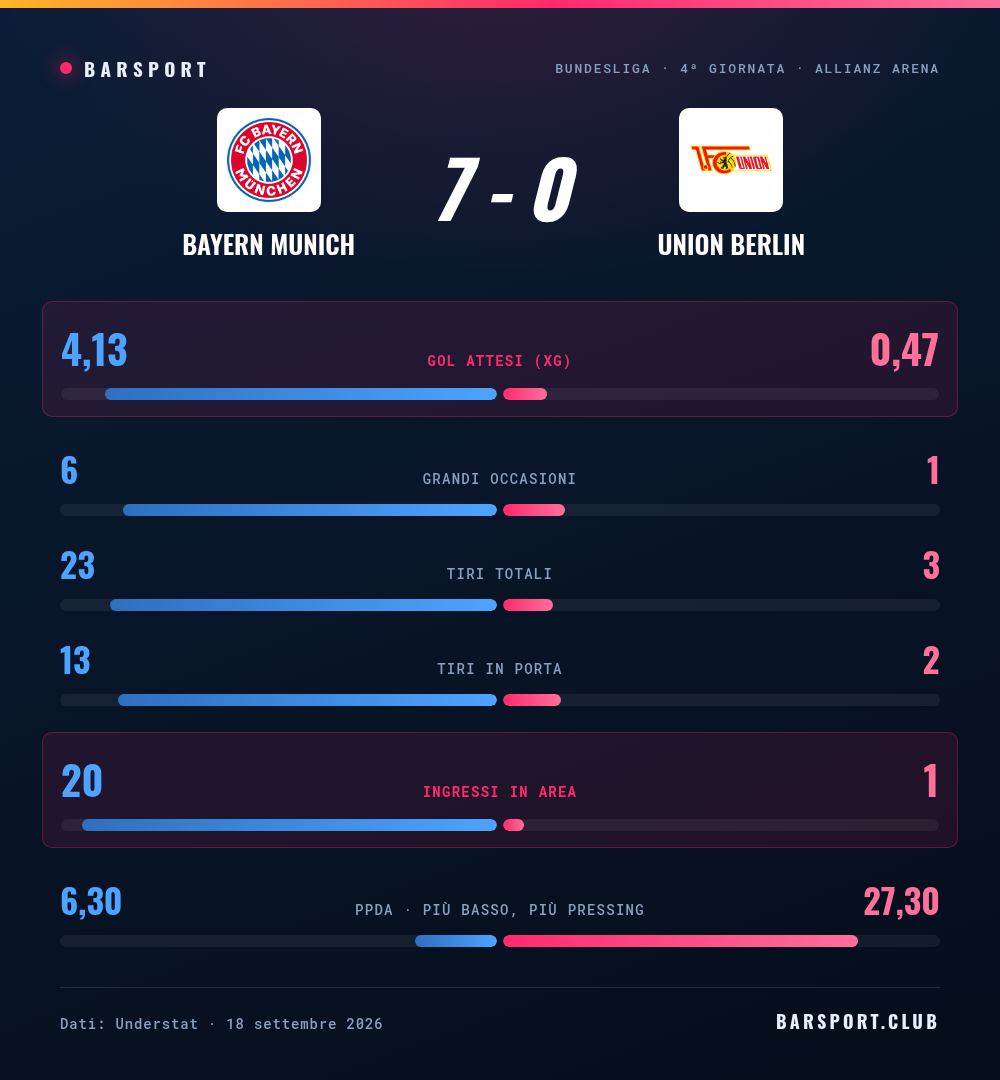
Two weeks later, against Union Berlin, the count of entries into the box was 20 to 1. And it finished 7-0.
They are the same photograph and two opposite results, and the explanation lies entirely in one number.
The verdict, before the numbers
Expected goals say 4.13 for Bayern and 0.47 for Union. Expected points 2.96 against 0.02, shots 23 against 3.
At Schalke, with 22 entries into the box, Bayern had produced 2.05 expected goals. Here, with two fewer entries, they produced double that. The difference between the two nights is not how much the ball entered the box: it is what was done with it inside.
The number: 2.18
Two point one eight is what the seven shots that ended up in the net are worth, added together.
The detail is instructive. The heaviest goal is a penalty, 0.758. Then there is a right-footed shot from inside the box at 0.598, a left-footed one at 0.425, a header at 0.318. The other three are worth 0.030, 0.025 and 0.023: that is, three shots that go in two or three times out of a hundred.
Seven goals in one match happen like this, almost always. You do not need to build seven textbook chances: three or four good balls are enough, and then a night when everything struck from twenty metres ends up inside. Bayern, it must be said, had also built enough to score two more: a header at 0.435 and a blocked shot at 0.626 stayed out.
Three of the seven goals, in any case, are Michael Olise's, and two of those three are worth less than five hundredths combined.
The pressing, and what it did to Union
PPDA tells the story of a one-way match: 6.3 for Bayern, 27.3 for Union.
The first number means the hosts went to press the visitors after six passes, that is practically straight away, inside the opposition half. The second means Union gave up entirely on disturbing Bayern's build-up.
The result is that Union Berlin shot three times in ninety minutes and carried a single ball into the opposition box. Their three shots are worth 0.47 combined, and the best of them, a header from a corner at 0.341 early in the second half, came when the match was already lost.
For Union this is a problem that did not begin on Saturday. In four matchdays they have conceded 17 goals from 12.86 expected goals conceded and have allowed their opponents 55 entries into the box: the worst defence in the Bundesliga for quantity of danger conceded, and the worst for goals conceded.
The Bayern that was not deceiving anyone even before
The comparison with the night at Gelsenkirchen remains the most interesting part.
Back then we wrote that 22 entries into the box without a goal were not a condemnation: they were a team doing the hard part of the job well and the easy part badly. The season numbers, now, say the first reading was right. In four matches Bayern have 78 entries into the box against 10 conceded, have scored 14 goals from 13.32 expected and have conceded 2 from 3.00.
Put bluntly: Bayern are not even overperforming wildly. They have 10 points from 10.96 expected, so in the table they have dropped something along the way, and that something is precisely the 0-0 at Schalke.
The only thing that changed between the two matches is the quality of the balls arriving in the box. Against Union the crosses became low passes from the byline and the shots came from inside, not from the edge.
The honest point
First, the data is clean: all seven goals are in our shots list, and the sum matches the match totals.
Second, the opposite reading. One can argue that a 7-0 does not need to be explained with expected goals and that reducing three goals to "0.03 of probability" takes credit away from those who struck them: if a player scores twice from an impossible position in the same match, maybe the model is measuring that kind of shot badly. It is a legitimate objection, and the way to test it is to see whether it happens again.
Third, what we think. What this match really says does not concern Bayern, who were already playing like this, but Union Berlin: three shots and one entry into the box in ninety minutes are the kind of performance that is not fixed with a change of formation. And it concerns the way we read results: the exact same match, at Gelsenkirchen, had finished 0-0.
T.L.
Do you want to see how much each team really deserves its league position? The Meritometro compares real points and expected points. For those who want models and not headlines, there is the Nerd Zone.