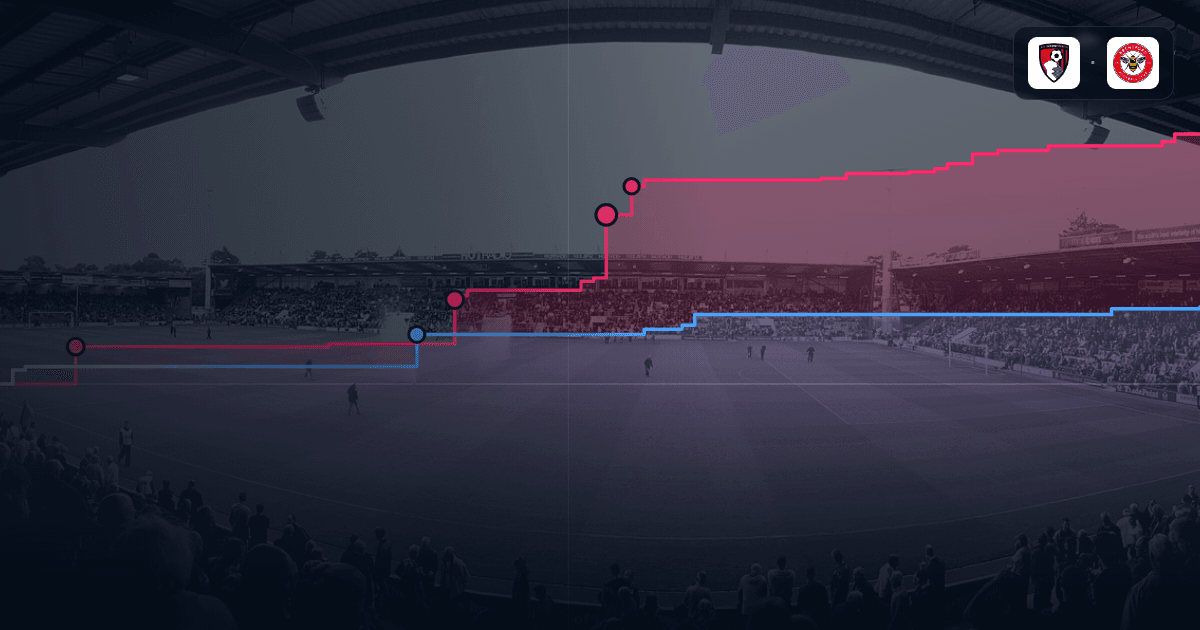
There are draws that look balanced and are not balanced at all. Bournemouth-Brentford finished 2-2 with twenty shots from one side and eight from the other, and anyone who read only the result thought of one of those English games that goes back and forth for ninety minutes.
That is not how it went. What happened is that one team played practically on its own for an hour and a half and ended the afternoon with a point, which is the quickest way to lose ground without anyone noticing.
The verdict, before the numbers
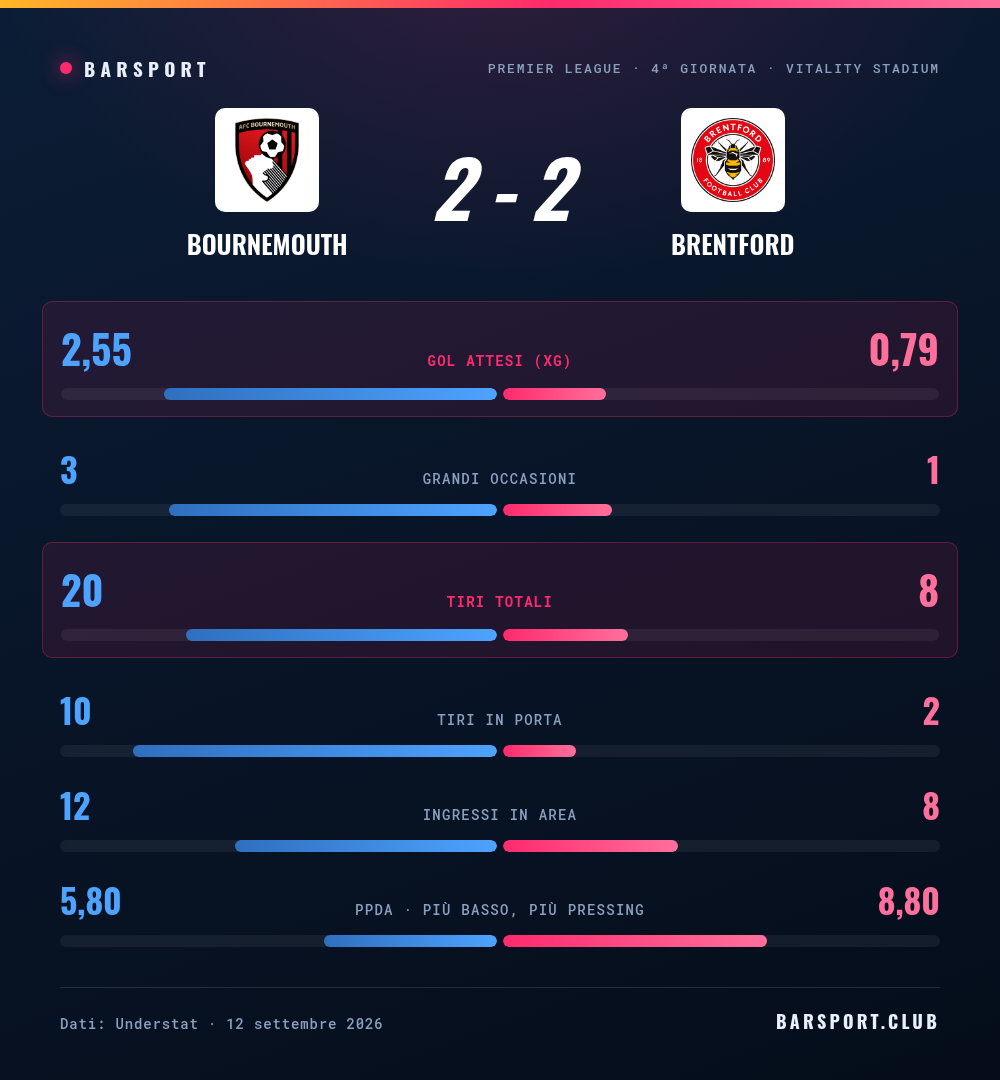
Expected goals say 2.55 for Bournemouth and 0.79 for Brentford. Expected points, which translate those chances into points, say 2.56 against 0.31.
So Bournemouth collected one point from a performance that, repeated a hundred times, would earn them two and a half. It is the biggest negative gap of the English matchday.
The number: 0.12
Zero point one two is what Bournemouth's two goals are worth put together.
The first is a left-footed shot from outside the box through three shirts, 0.055: five times out of a hundred it ends up in the net. The second comes at the start of the second half from a lay-off inside the box, 0.066. They are the two least dangerous shots of their entire match, or close to it, and they are the only two that went in.
In the same afternoon the real chances stayed out. A header from a corner three metres from goal, 0.649, meaning two times out of three it is a goal. A left-footed shot inside the box on a rebound, 0.457. A first header from the cross, 0.383. A right-footed shot from the heart of the box midway through the second half, 0.293.
Four chances worth 1.78 expected goals, all missed. And two goals from finishes that, added together, do not reach an eighth of a goal. This is not a match in which Bournemouth scored little: it is a match in which they scored the wrong things.
How Bournemouth played
The figure that tells the story of the choice is PPDA: 5.8. It is the number of passes a team allows its opponent before going to attack them, and below 7 you are in the territory of teams that press hard up the pitch. It is the most aggressive figure of the entire Premier League matchday.
The result is that Brentford never managed to build from the back. Eight shots in ninety minutes, almost all of them born from recovered balls or from transition situations, and 0.79 expected goals in total. Defending like this, against a team that waits for you twenty metres from your goal, works as long as the few times you come out you find the right play.
Brentford found it twice, and always with the same man. The first goal is a header from a cross worth 0.329, their only real chance of the first half. The second is a right-footed shot from inside the box on a recovered ball, 0.112, ten minutes after the hour. Kevin Schade this season has 3 goals from 1.14 personal expected goals: a player who is scoring three times what he creates, and it is the second biggest gap in the Premier League.
On the other side, Bournemouth's volume did not come from a final siege. They produced for all ninety minutes, with twelve entries into the box against eight and a constant rhythm. It is the kind of performance that usually brings three points, and here it brought one.
What this match really says
It is worth being precise, because this is the point where this kind of analysis is always misunderstood.
Bournemouth did not play badly. They did exactly what you need to win a Premier League match: they pressed high, they carried the ball into the box continuously, they built four clear chances. They got the final touch wrong, which is the part of football where chance weighs most.
Brentford stole nothing. They absorbed the match, they held firm, and they were clinical in the two moments when they came out. It is a strategy you can choose, and against a team that presses you at 5.8 it is often the only viable one.
The difference is that one thing repeats and the other does not. Pressing at 5.8 and twelve entries into the box are structure: they reproduce the following week and the week after that. Two goals from eight shots worth 0.79 in total are not structure, they are one evening.
The honest point
First, the limits of what we have. Expected goals do not know who is shooting: a header worth 0.65 missed by a defender and one missed by a centre-forward are worth the same in the model, and in reality they are not. In a match where the goals came from difficult finishes, this limit weighs more than usual.
Second, the opposite reading. You can say that Bournemouth built a lot but built badly, because two of their best chances are headers from set pieces and not worked moves, and that a team conceding two such clean transitions has a problem of balance, not of luck. It is a reading that holds up.
Third, our opinion. This is the match in which Bournemouth played their best football of the season and collected the least, and the thing to watch in the coming weeks is not whether they will keep missing headers, but whether they will keep getting into the box twelve times. If they do, the goals come back on their own. Brentford, on the other hand, would do well not to make a habit of it: 0.79 expected goals away from home is a way of staying in a match, not of winning it.
T.L.
Do you want to see how much each team really deserves its league position? The Meritometro compares real points and expected points. For those who want models and not headlines, there is the Nerd Zone.