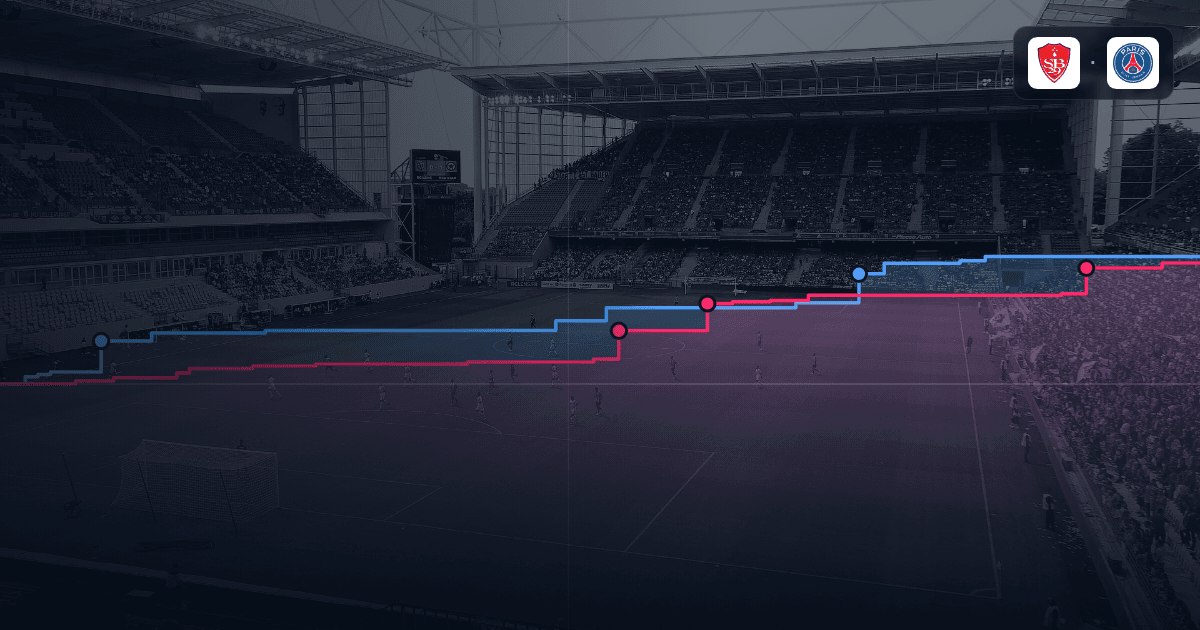
The goal that decided the match came after a few minutes, from a short clearance, with a right-footed shot from a tight angle that the model rates at 0.023 expected goals. Two times out of a hundred.
From that moment on Brest played eighty-five minutes against Paris Saint Germain, hit the post, built three more dangerous shots than the one that had decided the evening, and lost 1-0. It is the fourth match in a row in which something like this happens to them.
The verdict, before the numbers
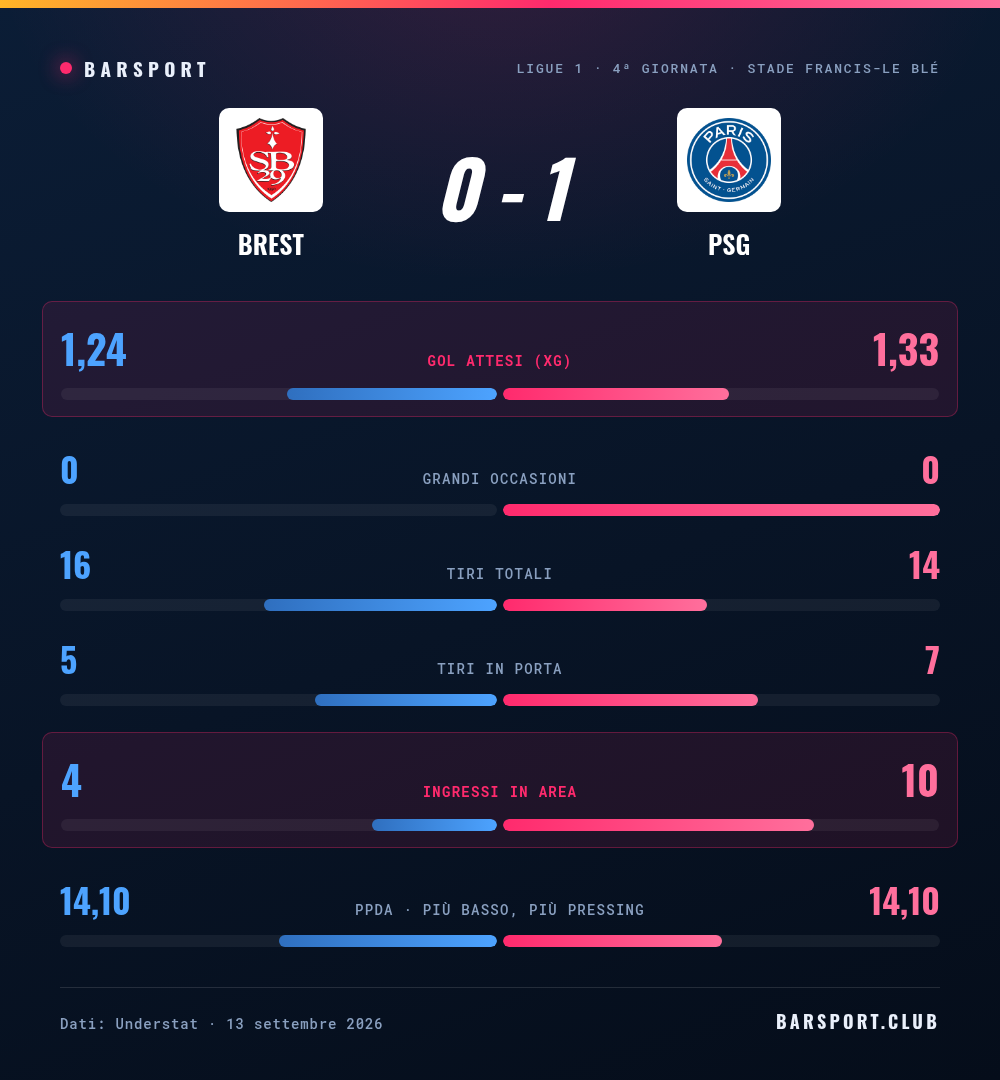
Expected goals say 1.24 for Brest and 1.33 for Paris. Expected points 1.32 against 1.40. With these numbers the most likely result was a draw, and neither team could have complained.
The entries into the box, though, tell a more lopsided story than that: 4 against 10 for the visitors. Brest built their danger with a few heavy shots, Paris with continuous possession and plenty of balls carried into the box without almost ever finishing well.
The number: 0.023
Two hundredths of an expected goal. That is the value of the goal that decided the match, and it is one of the lowest values we have recorded for a goal this season in the five leagues.
In the same match, far more dangerous shots stayed out. A left-footed effort from inside the box in the first ten minutes, 0.290. A Brest right-footed shot that hit the post early in the second half, 0.290 as well. A header worth 0.280 shortly after. A right-footed shot worth 0.264 in the final minutes, which would have been the equaliser.
Added together, the four chances that did not go in are worth 1.12 expected goals. The one that went in is worth 0.02. It is the kind of evening that happens to everyone once or twice in a season: Brest's problem is that it is happening to them every week.
How the two teams played
The most surprising figure is that neither team went to press. PPDA 14.1 on one side, 14.1 on the other: identical, and both high. It means they studied each other, that Brest accepted sitting deep and that Paris, after such a quick lead, chose to manage the ball instead of going to win it back.
Paris's plan shows in the ten entries into the box: the ball was going in, and often. What was missing was the clean shot. The visitors' best chances all come from quick combinations out wide, and the most dangerous one, a header in the second half, is worth 0.297. A team that carries ten balls into the box and produces 1.33 expected goals is a team that gets into the box but not into the right part of the box.
Brest did the opposite: only four entries into the box, but three of those four turned into real chances. In a match where they barely had the ball, they built enough to draw it twice.
Four matchdays, and a bill that keeps growing
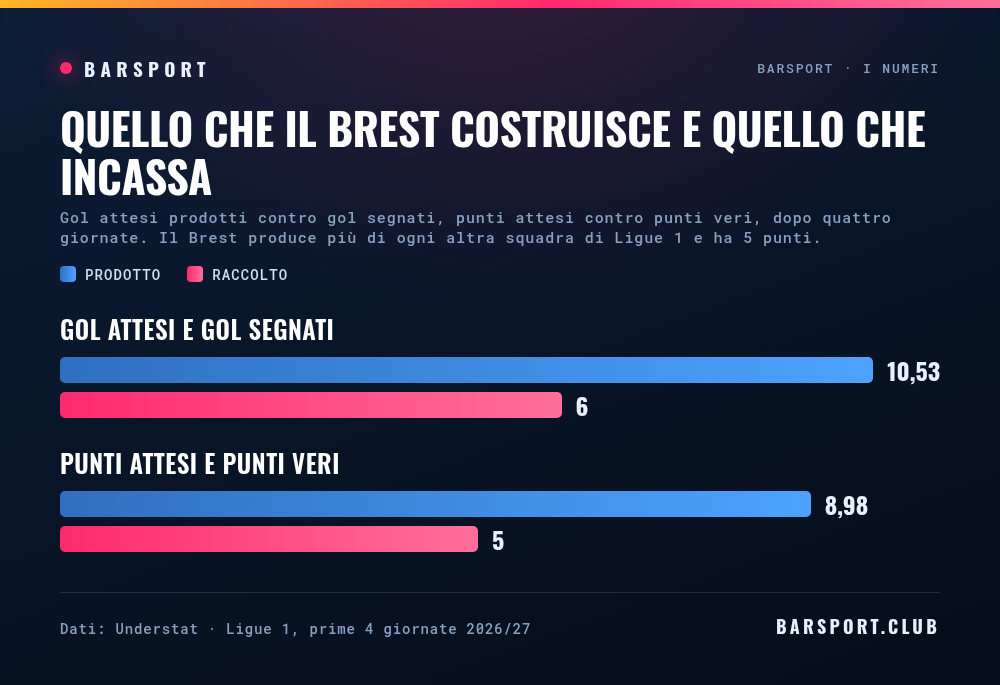
Brest have 5 points. Expected points over the four matches are 8.98, so the gap is almost 4 points on the negative side: the second worst in Ligue 1 after Toulouse's.
On goals it is even clearer. They have produced 10.53 expected goals in four matchdays, the highest value in the league, and they have scored 6. They have conceded 5.02 and have let in 6.
On the other side Paris have 5 points from 7.00 expected, so they are in the red too, but for a different reason: they have 47 entries into the box against 14 conceded, the clearest territorial dominance in the league, and they have scored 4 goals in four matches. They finish their moves badly. Against Brest they settled the evening with the worst shot of their match.
The honest point
First, the data. The sum of the shots we have matches the match totals for both teams, so the numbers here are solid. We deliberately keep the minutes loose: our source on shots does not separate first-half stoppage time well, and on a single move we would rather say "early in the second half" than be wrong by a minute.
Second, the opposite reading. Anyone looking at the table says Paris won the fourth match in which they conceded little and that Brest, quite simply, do not score: six goals from ten and a half worth of chances is not just bad luck, it is also a question of who is up front. It is a serious objection, and the way to test it is time: if in a month Brest are still on half of what they produce, then the problem has a name and it is called finishing.
Third, our opinion. A two-cent goal says nothing about who played better, and nothing about who will win the league. It does say one thing about Brest, though: they are building more than anyone in France and they have 5 points. If the way they create stays like this, the points will come. If the way they finish their moves stays like this too, only the table will come.
T.L.
Do you want to see how much each team really deserves its place in the table? The Meritometro compares real points and expected points. For those who want models and not headlines, there is the Nerd Zone.