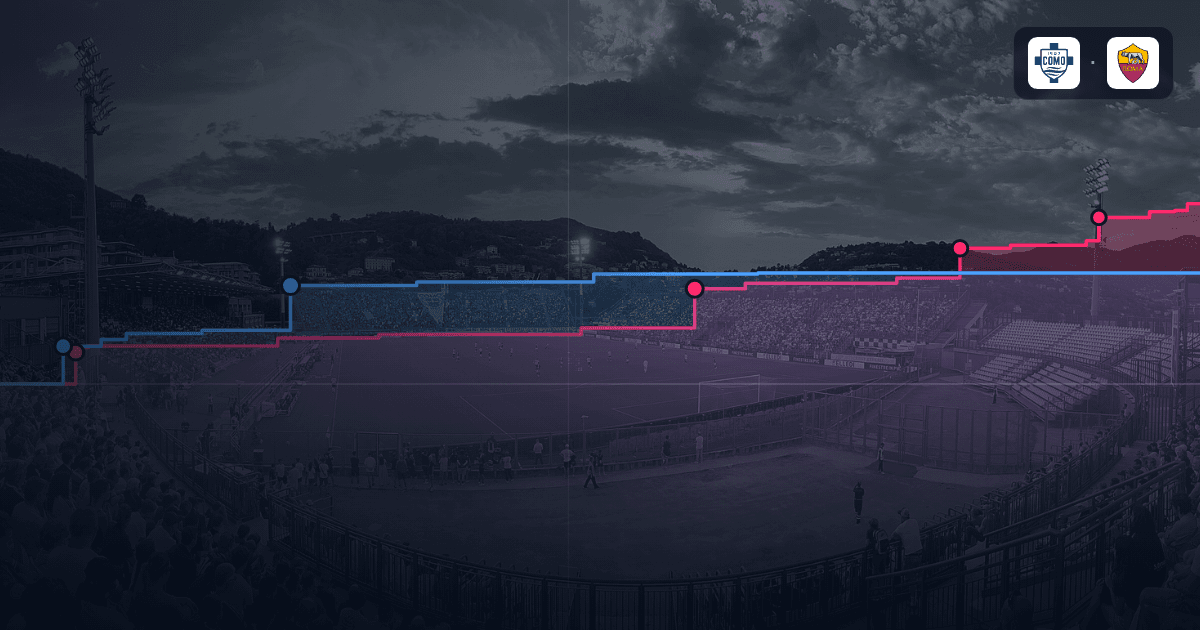
 Foto: Vale93b · CC BY-SA 4.0 · Wikimedia Commons
One hundredth of a goal in forty minutes: what Malen's red card really cost
Fifty-four league matches from August until yesterday, and in none of them had the two teams managed not to score. Then, Sunday at 12:30, the Sinigaglia.
And it didn't end 0-0 because the two teams cancelled each other out. It ended 0-0 because one match became two matches, and the border between the two is a high foot from Donyell Malen on Kaiki in the 53rd minute, a straight red from Fabbri without going through yellow.
Before the 53rd minute, Roma were winning
Not on the scoreboard, in chances, which is how we measure who is dictating the match.
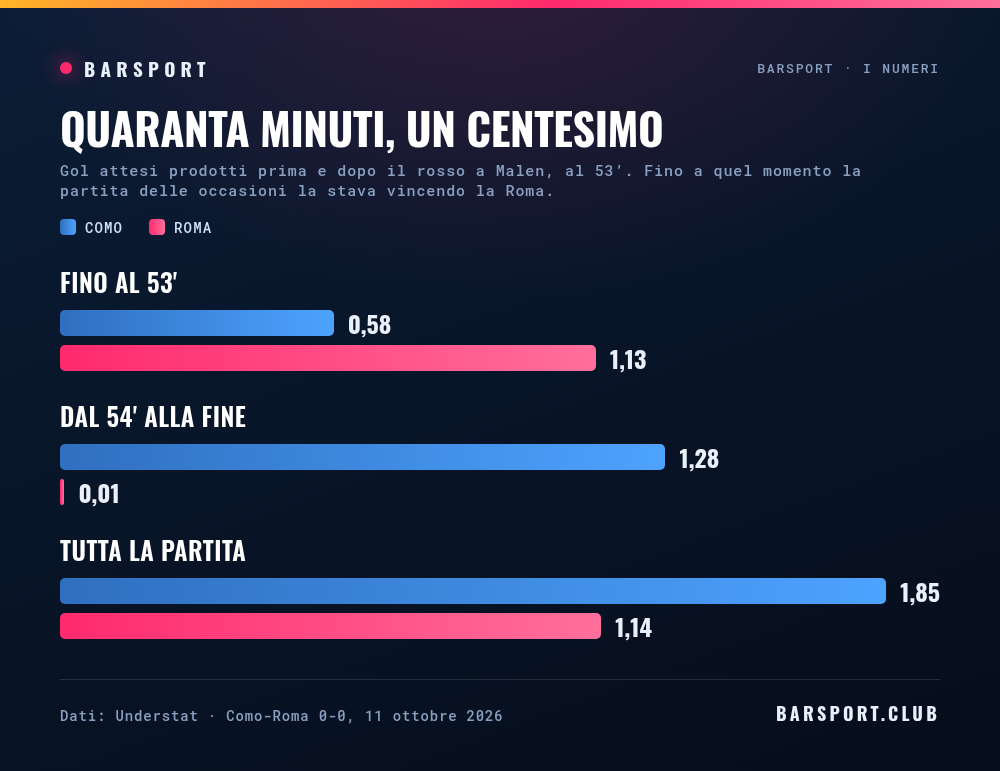
In the first fifty-three minutes Roma produced 1.13 expected goals, Como 0.58. Almost double, away from home, against the third-best team in Italy for balls carried into the box. Dybala had forced Butez into a save in the 5th minute on a ball worth 0.388, Pellegrini had hit the post in the 11th, and above all in the 23rd minute Malen had found himself in front of goal on a chance worth 0.460: the biggest of the entire match, for either side.
He missed it. Thirty minutes later he got himself sent off. The same man, the same half hour.
After, Roma stopped existing going forward
One shot. Just one, from Dybala in the 60th minute, worth 0.010 expected goals: one hundredth. Then nothing more for forty minutes, stoppage time included.
It isn't a drop-off, it's a decision. Gasperini took off Hermoso for Balerdi in the 60th minute and pushed the team into the box, and from that point on Roma didn't try to come out anymore. Nico Paz, after the match, put it better than any model could: they put a lot of players in the box, we did what we could.
So how much does that red card really count?
Here comes the part nobody talks about, and which the numbers instead state clearly.
Como, with an extra man for forty minutes, produced 1.28 expected goals. It seems like a lot because it's double what they had produced in the first fifty-three. But scaled to ninety minutes it works out to just under 1.9: the pace of a team that attacks well, not of a siege. Against ten men, at home, with five substitutions available.
And there's a detail that shifts the judgement even further. Como's biggest chance after the red card is Perrone's in the 55th minute: 0.402, that is, two minutes after the sending off, when Roma hadn't even reorganised yet. Take that one out, and in the thirty-five minutes that followed Como built 0.87 expected goals spread across ten attempts, only one of which was above three tenths: Nico Paz's effort in the 76th minute, saved by Gollini.
Gollini, who plays because Svilar isn't there, stopped Nico Paz twice. That's the second story of the match and it doesn't fit comfortably in a piece about numbers.
The final account
The sending off cost Roma the win, not the draw.
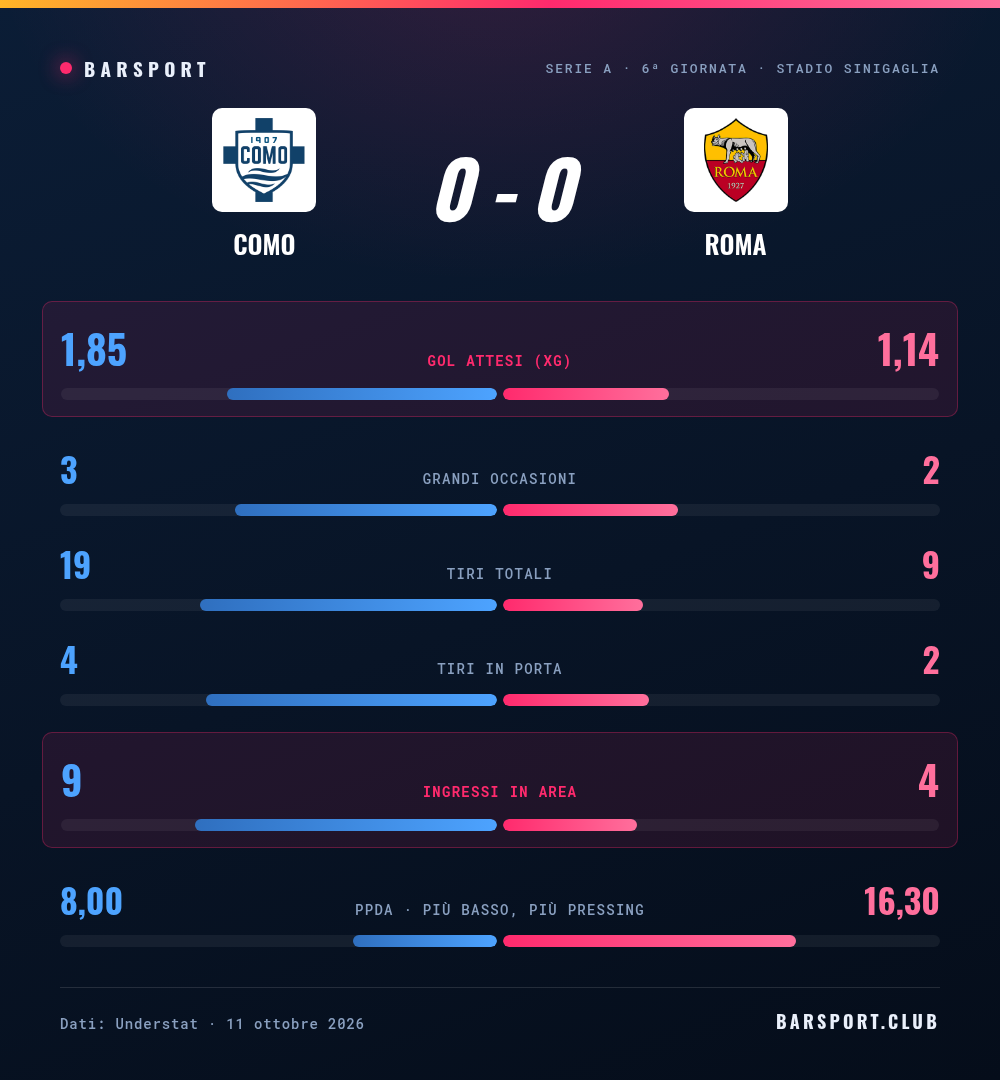
At the end of the ninety the account reads 1.87 expected points for Como and 0.87 for Roma. But that account weighs two different matches together, and the first one, the one played eleven against eleven, Roma were winning. A point each, and a Roma that remains unbeaten but slips to two points from the top, because Inter and Lazio won and are on 16. They still have the best defence in the tournament, level with Cagliari: 3 goals conceded in six matchdays, and on Sunday they conceded one point eight without conceding a single one.
Wednesday at the Olimpico, Real Madrid arrive, and Malen will be suspended in the league but available in the Champions League. Which is the most ironic possible way to close this story: the most expensive player in fantacalcio misses the match where you fielded him, and plays the one that doesn't count for your league.
T.L.
The match-by-match verdict is in the Meritometro. For those who want the models and not the headlines, there's the Nerd Zone.