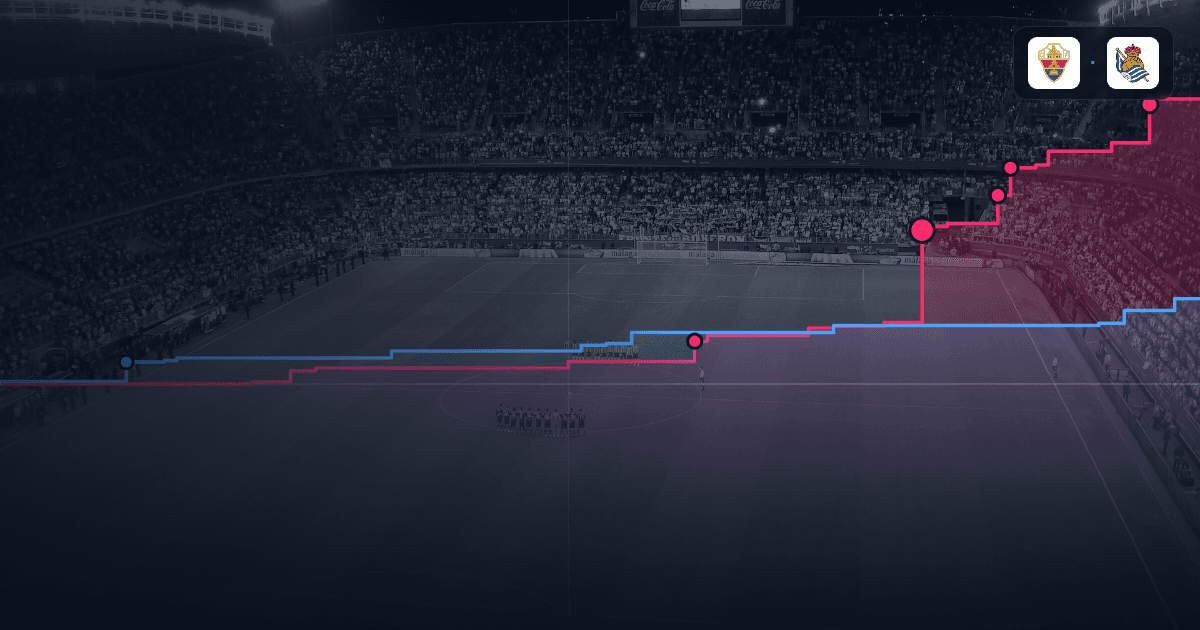
At the Martínez Valero on Monday night, Elche had 20 shots, produced 2.87 expected goals against 0.88, came back from 0-2 to 2-2 against a side down to ten men, and lost on 90 minutes. Four matchdays, one point, still no win.
With numbers like those the temptation is to write the easy piece, the one about bad luck and football being unfair. It is the wrong piece. Because if you take Elche's 2.87 expected goals and look at when they were produced, you find that for an hour this team had done almost nothing at all.
The match Elche chose to play
Martín Anselmi took over Elche in the summer and did not dismantle what he found. He added something of his own: a back three. Three centre-backs who start the move, wing-backs providing width very high up the pitch, a holding midfielder sustaining circulation and two attacking midfielders slipping between the lines around the striker.
The idea is the same one this club has had for a while: short passing to draw pressure onto yourself, find the free man, and accelerate at the exact moment you have beaten the opponent's first line. When it works it is beautiful. When it does not, you have three defenders high and wide and an entire pitch behind them.
On the other side was the team built precisely to live in that pitch.
Pellegrino Matarazzo's Real Sociedad have broken with the long possession of the previous cycle. They sit in a medium-high block that shifts from 4-2-3-1 to 4-4-2, wait for the mistake in the opponent's build-up and break, with the wingers attacking the gaps between defenders. When they win the ball back, the first choice is not to consolidate: it is to look immediately for the break into space, alternating the short support of a striker coming towards the ball with the runs of the wingers into the half-spaces. They are not trying to have more of the ball than you. They are trying to hurt you more than you hurt them.
These were two teams built to bother each other. In pre-season Elche had already shown the price they pay: long spells of control, then suffering every time an opponent attacked the space behind the high line. That is exactly the situation Real Sociedad train for every week.
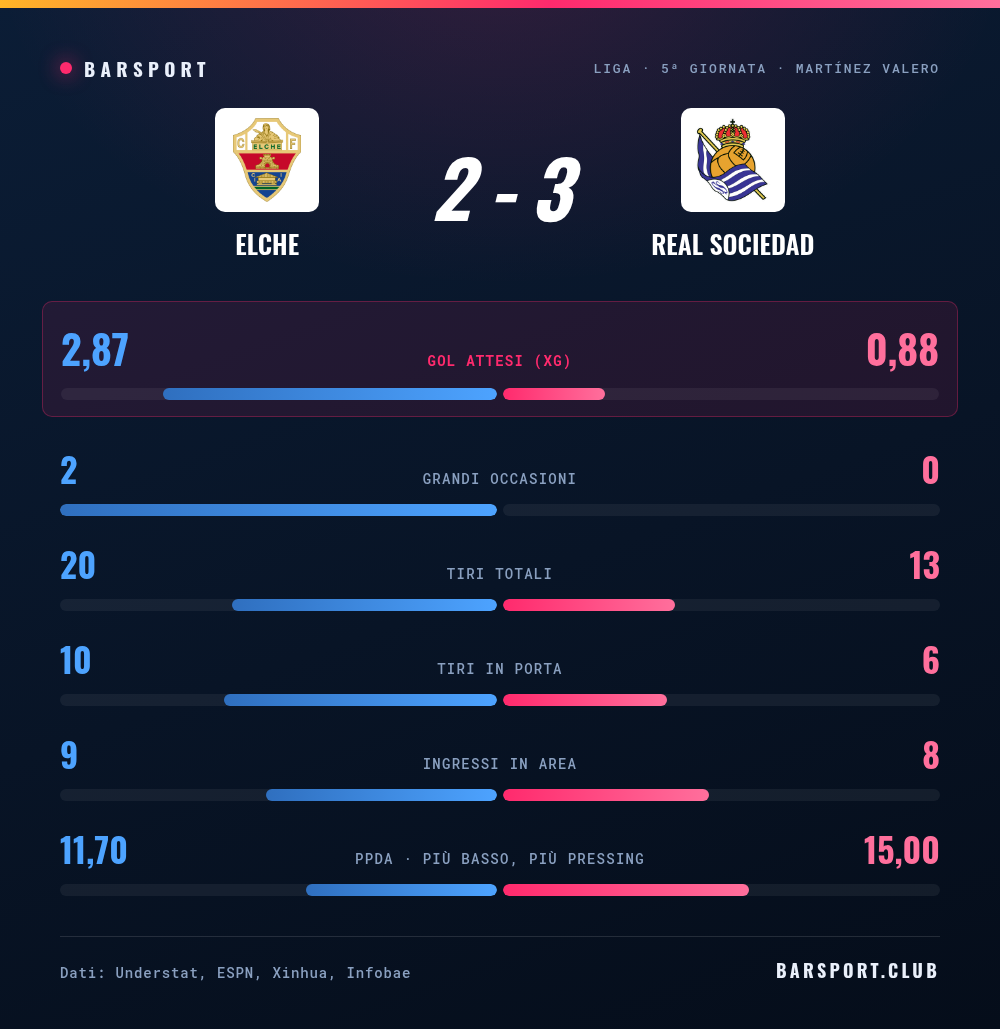
Elche did have the ball, and in the end the shots too. Real Sociedad took the 3 goals.
The first 61 minutes, the ones nobody remembers
This is the point of the whole match.
In the first 61 minutes, eleven against eleven, Elche had 6 shots for 0.50 expected goals. Real Sociedad had 9 shots for 0.53. Those are the same numbers. Neither side was creating anything, and the game was in perfect balance.
Except the scoreboard said 0-2.
The first goal came on 11 minutes from a corner: Job Ochieng turned it in, 0.18 expected goals. The second on 31, in open play, and it is barely a shot at all: Yangel Herrera struck from a position worth 0.07, seven hundredths, set up again by Ochieng. Two efforts that in a normal match almost never go in, and both went in.
Ochieng is the winger Matarazzo has promoted this year, and he is the human translation of the model: energy and speed inside the spaces. By the end of the night he had 1 goal and 2 assists, which is to say his name was on all 3 of his team's goals.
It is worth pausing on what a 0.07 goal actually means. It does not mean Real Sociedad stole something: it means they scored from a position where, 93 times out of 100, nobody scores. Once is an incident. Twice in the same hour, and the opponent has stopped playing the match they had in mind and is playing yours.
That is what happened to Elche. With two goals to claw back, the back three began to push up, the wing-backs went higher still, and the team stretched itself in exactly the way that suits Real Sociedad. For an hour, though, Elche could make nothing of it: the build-up reached the edge of the box and stopped there, against a block that narrowed and happily conceded the shot from distance.
Then VAR changed the game twice in the same moment
On 62 minutes Sucic finished a counterattack for 0-3. The match was over.
VAR went back, though, and found a handball in the build-up. The goal was ruled out, and the man who had touched the ball with his hand, defender Jon Martín, was sent off.
In a single decision Real Sociedad lost a goal and lost a man. From 0-3 to 0-2, from eleven to ten, with almost half an hour to play.
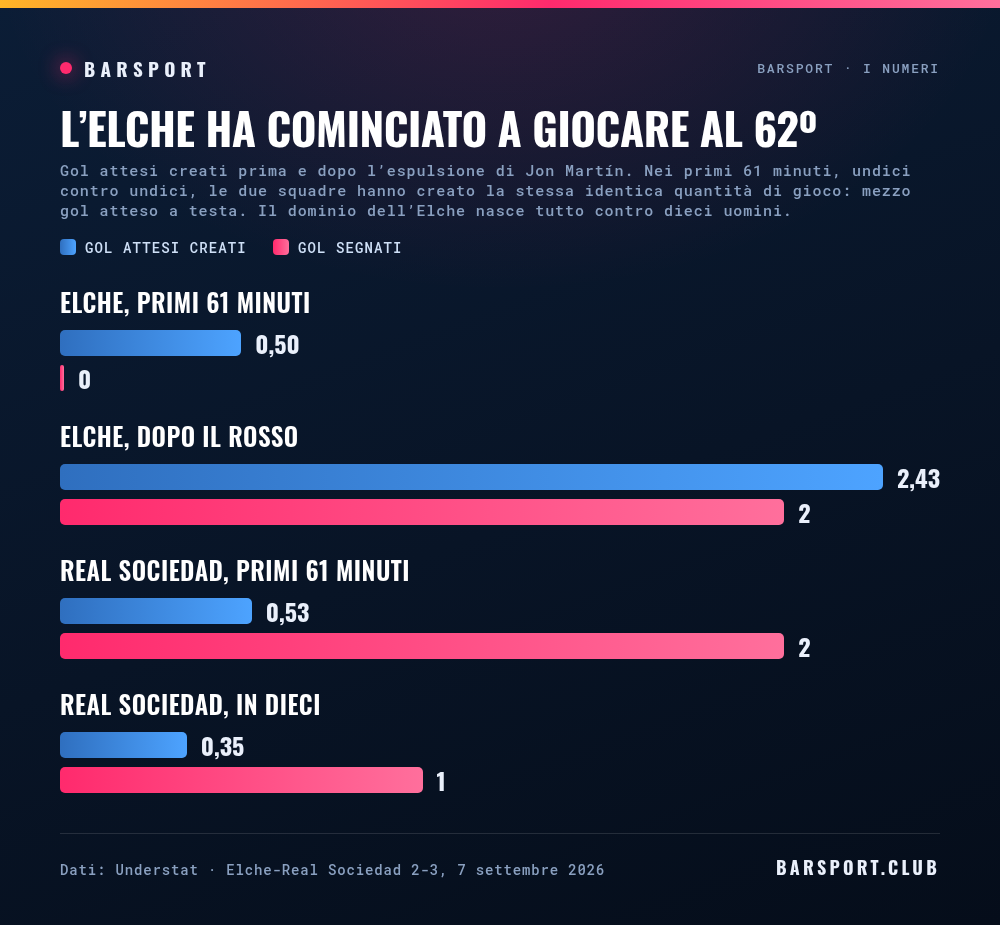
From there the match that appears in the final statistics finally began. In a little under half an hour Elche had 14 shots and produced 2.43 expected goals. Which means 83% of everything they created across 95 minutes came against a team a man short.
Thomas Lemar pulled one back on 67 with a shot worth 0.02, the kind of goal Elche had never found. On 74 Fer Niño converted the rebound for his side's only real chance, 0.95 expected goals, essentially an open goal. 2-2, and now with an extra man and twenty minutes to win it.
They did not win it. On 90 minutes Sucic collected the ball, beat his man and put it where it cannot be saved: 0.13 expected goals, the third cheap goal of the night for a team that scored 3 of them for a combined 0.39.
What still does not work
Against ten men, for half an hour, with 14 shots, Elche built exactly one clean chance. Everything else was efforts from distance, headers from tight angles, shots inside traffic: Víctor Chust with his head, Abiel Osorio twice, Roy Revivo on 91 from a rebound, 0.39 expected goals thrown away with the last breath of the match.
It is the problem they have carried since August. In 4 matches Elche have collected 1 point from 5.72 expected points. In the whole of La Liga only Villarreal are doing worse. This is not a team playing badly: it is a team that reaches the box and does not decide.
Real Sociedad, with 7 points from 5.61 expected, sit at exactly the other end of the same table.
The honest bit
Now the opposite reading, which is just as legitimate.
A team that wins away from home with 0.88 expected goals has not simply been lucky. Real Sociedad arrived at Elche having made 6 changes to their side, played almost half an hour with ten men, and in that half hour still produced 4 shots and found the winner. In goal was the understudy, an academy product who plays when Remiro rests, and he made 8 saves: exactly as many as were needed, given that Elche hit the target 10 times and scored 2. If a game model is built to hurt rather than to hold the ball, this match is its successful portrait, not an accident.
Then there are two things that need saying because they are true. The first is that 4 matchdays are not a diagnosis: the gap between Elche's real and expected points is a curiosity today, and we will look at it again in ten matches. The second is that expected goals models do not agree with one another: ours gives Elche 2.87, others stop at 2.39. The story does not change, the decimals do.
And the question Elche carry to Bilbao after the international break remains: if half an hour against ten men produces one real chance, is the problem the person saving them or the people not creating them?
T.L.
We keep the running account between results and performances in the Meritometro. Anyone who wants the raw numbers, without the story around them, will find them in the Nerd Zone.