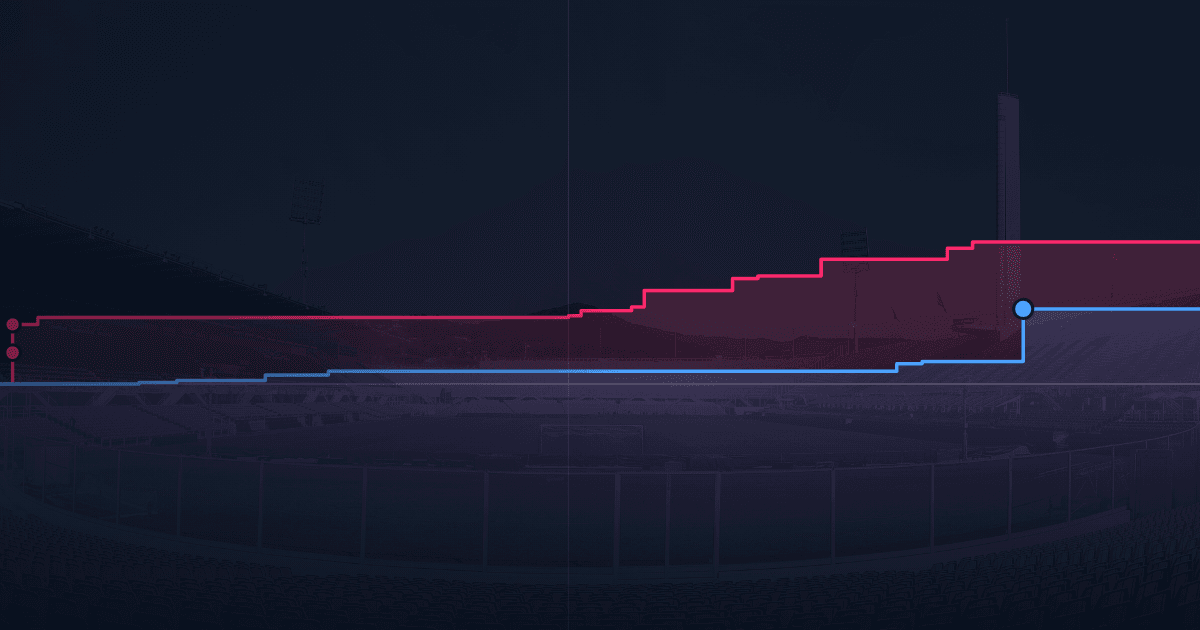
 Foto: Sailko · CC BY 3.0 · Wikimedia Commons
Fiorentina-Torino 1-2: Torino created one chance, and scored it
The verdict, before the numbers
At the Franchi, in front of 21,785 spectators, Fiorentina lost 1-2 to Torino. Pellegrino had scored early in the second half; Mandragora, a former Fiorentina player, equalised on 74 minutes with a shot from twenty-five metres; Che Adams turned it around on 82.
It is a third defeat in three matchdays. Fiorentina had not managed that since 1935-36 — and that side of ninety-one years ago conceded seven goals in three games. This one has conceded nine.
The result tells a story of crisis. The numbers from this single match tell something more precise, and more uncomfortable.
One single chance
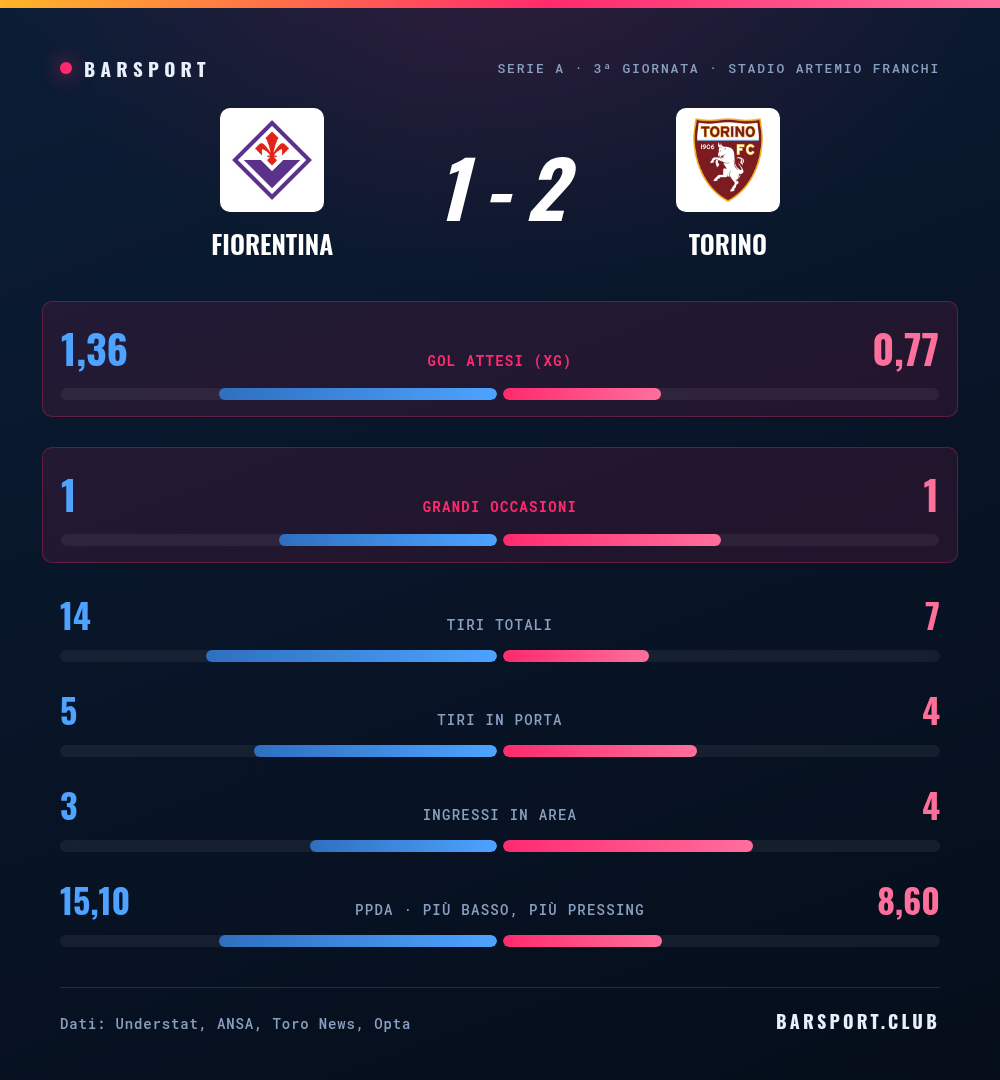
Torino had seven shots in the whole match, worth 0.77 expected goals.
Of that 0.77, 0.54 sits in one effort: Adams' goal on 82 minutes. Seventy per cent of the danger Torino produced in ninety minutes lives in a single move.
Their other six efforts are worth 0.23 between them. The heaviest is Mandragora's goal: 0.024. Just over two hundredths. A shot from twenty-five metres that, on average, goes in twice in a hundred attempts — and the match reports agree on how it happened: Comert won the ball off Pellegrino, Mandragora controlled it and struck from distance, beating De Gea.
Torino, in other words, built one real chance and scored it. Then they added another that was not a chance and went in anyway.
Fiorentina's best minute was the first
On the other side the count is different, and worse than it looks.
Fiorentina had fourteen shots for 1.36 expected goals. But their two best efforts both come inside the opening minute: Mastantuono's right-footed shot pushed away by Perri (0.32) and Njie's follow-up (0.29). Together they make 0.61 — 45% of everything Fiorentina produced in ninety minutes.
After the third minute, Fiorentina's most dangerous shot is worth 0.123. Twelve hundredths: Atta's effort on 58 minutes. Not a chance, an attempt.
Pellegrino's goal, the one that looked like it had unlocked the afternoon, is worth 0.051. That too, like Mandragora's equaliser, is a shot that usually stays out.
Three goals in this match, and not one of them is a "normal" goal: two are improbable finishes, the third is the only chance anybody genuinely built.
How the two sides moved
We read four tactical analyses. They disagree on almost everything, and the reason is interesting.
Grosso, according to those who have studied him, is a cautious coach out of possession. Tactical Football Analysis, in a late-April piece on his Sassuolo, describes a side alternating between 4-3-3 and 4-4-2 depending on the height of the block, defending zonally, protecting the central corridors and — their words — content to concede the space in front of their structure rather than engaging high up the pitch. The pressing is selective, not constant: players step out only when a trigger fires, typically the ball going wide.
On Sunday Fiorentina posted a PPDA of 15.1: one defensive action for every fifteen opposition passes. Consistent with that portrait. The problem is that on matchday two, against Frosinone, the PPDA was 4.4 — a frantic press — and on matchday one, in Rome, 19.1. Three matches, three different teams.
And here the second source explains why. Daniele Manusia, writing on L'Ultimo Uomo the day before this match, said Grosso had "not only failed to find a way to make his many talents play together, but has looked confused": Atta moved from left wing to central midfield between matchdays one and two, two thirds of the midfield changed between Roma and Frosinone. And he isolated a detail worth more than a statistic: Mastantuono playing a ball in behind for Pellegrino, who stands still because he is not a striker who attacks depth. Two new signings who do not speak the same language.
Torino, by contrast, do have a recognisable structure — just not the one that was advertised. The season previews described Abate as a coach of "intensity and full-pitch pressing". The tactical analysis of Torino-Milan on matchday one says the opposite: they defended in a 5-4-1 mid block, with the pass out wide acting as the pressing trigger and five men against two around the ball, aiming to trap the opponent on the touchline.
Sunday's PPDA of 8.6 does not contradict that portrait, as you might assume. PPDA counts defensive actions per opposition pass: a mid block that dumps five men onto the ball carrier every time produces a great many of them without pressing high. Pressing a lot and pressing high are not the same thing, and this match is a good illustration of the difference.
Our reading, which is an opinion and not a fact. Fiorentina did not lose because they were overrun: box entries were three to four, neither side lived in the other's area. They lost because in eighty-seven minutes they could not build a single chance worth more than twelve hundredths, while Torino, who built one, took it. When a team has fourteen shots without ever arriving in front of goal, the problem is not courage: it is that nobody knows where to go.
Season context
Across the three matchdays, Fiorentina have earned 3.13 expected points and have zero. Torino have earned 3.12 and have three. Two sides that, according to the model, have played almost identically badly: one is bottom and being jeered, the other has "got their season going".
There is something that needs saying straight away, though, because it dismantles the comfortable reading. Fiorentina are not the most robbed team in Serie A. We checked all twenty: Bologna have zero points from 4.69 expected in two matches, Monza one from 5.60, Venezia zero from 3.80. Fiorentina are fourth, not first.
And above all: the failure in front of goal is not new. In his August guide for L'Ultimo Uomo, Dario Saltari wrote that last season "only relegated Pisa scored less than Fiorentina relative to the xG they created": 35 goals from 45.29 expected, Hudl Statsbomb data, penalties excluded. This year it is one goal from 3.46 in three matches. It is the same flaw, with eleven different players and a different coach.
The honest bit
Three matchdays are not a season. Expected points over three games carry an enormous margin of error, and we say so while using them. If you read "they deserved three points", read also "off a sample of nothing".
We cannot tell you what formation they played. The Opta data published by ANSA gives Fiorentina 4-3-3 and Torino 3-1-4-2. Toro News, at full time, writes 4-3-2-1 and 3-5-1-1. Those are different readings of the same twenty-two men. Formations are labels, and anyone handing them to you as facts is making your life simpler than it is.
The minute of the first goal. ANSA places it in the 2nd minute of the second half, other sources on 48. With no agreement, we have written "early in the second half". Mandragora's minute (74) and Adams' (82) are confirmed by several sources; Understat, as always, lists them a minute earlier.
We keep the running tally of results against performances in the Meritometro. Anyone who wants the raw numbers, without the story around them, will find them in the Nerd Zone.