 Foto: Arne Müseler · CC BY-SA 3.0 de · Wikimedia Commons
Frankfurt-Augsburg 1-4: twenty-six seconds, and the game changed hands
The verdict, before the numbers
At the Deutsche Bank Park, Eintracht Frankfurt lost 1-4 to Augsburg.
Jonathan Burkardt headed them in front after six minutes, from a Younes Ebnoutalib cross to the back post. For forty minutes nothing happened except Frankfurt.
Then half-time. Twenty-six seconds after the restart, a Marius Wolf cross travelled across the box, Arijon Ibrahimović got on the end of it, the ball nicked off Elias Baum and went in. A minute later Noah Atubolu spilled a low shot from the same Ibrahimović and Robin Fellhauer turned it home. Alexis Claude-Maurice, on from the bench, curled in the third midway through the half. Fabian Rieder added a free kick on 88 minutes.
Augsburg are top of the Bundesliga.
The number: 0.13
That is what Augsburg produced, in expected goals, across the entire first half.
It is not a figure you comment on, it is one you take apart. In forty-five minutes Augsburg had three shots: one from Hennes Behrens on 23 minutes, blocked. One from Robin Fellhauer on 43, blocked. A Rieder free kick just before the break, narrowly wide. That is all of it.
In the same forty-five minutes Frankfurt shot eleven times for 1.83 expected goals, and Finn Dahmen had to rescue the scoreline more than once: Can Uzun's effort on 10 minutes was worth 0.31, Ebnoutalib's on 38 was worth 0.33.
Then Frankfurt shot eleven more times after the break. Eleven before, eleven after. But the second-half eleven were worth 0.69 in total: none above 0.33, most of them under a tenth.
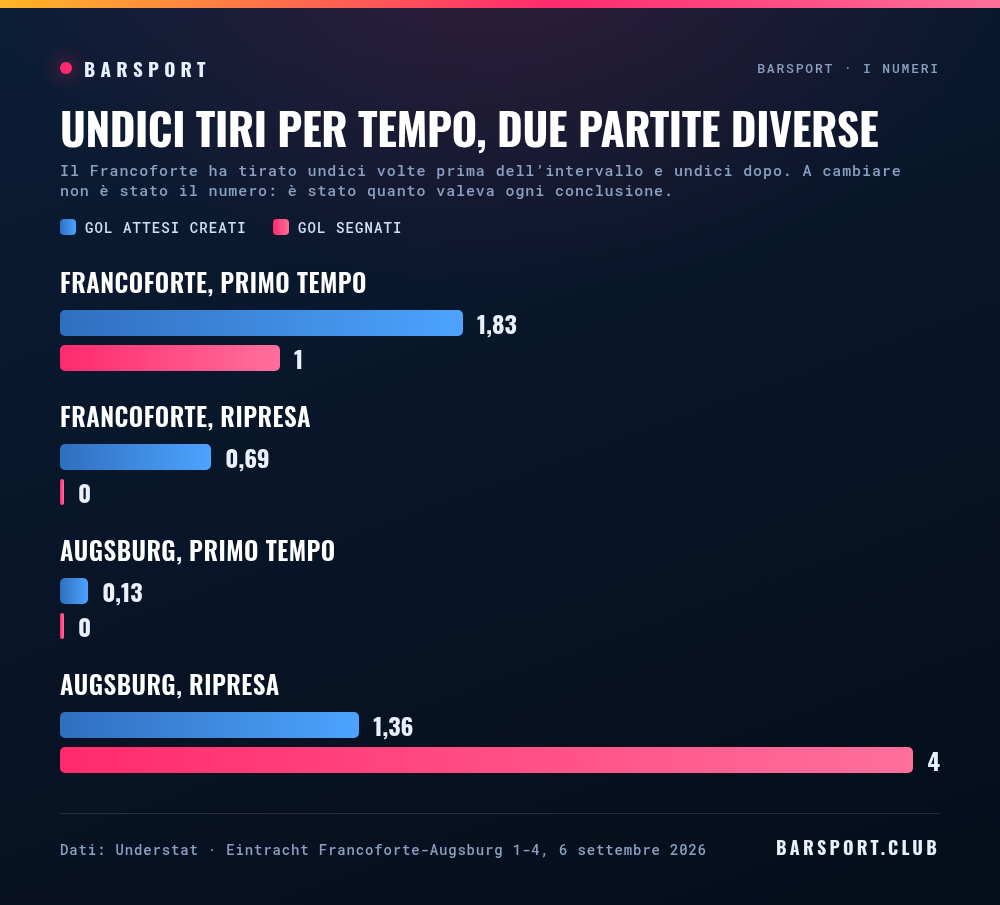
This is the fact that holds up everything else: what changed was not how often Frankfurt shot. It was from where.
How the two sides moved
Manuel Baum's Augsburg play a 3-4-2-1, and it is a stated choice. Get German Football News' season preview, written by Peter Weis in mid-August, describes it without varnish: Baum was kept on for continuity, the transfer window was uniformly "safe", Han-Noah Massengo and Fabian Rieder are the first-choice double pivot, Michael Gregoritsch is the target man "capable of occupying defenders and holding the ball up", and Claude-Maurice is the difference-maker. The club's stated aim, that piece notes with some irony, is a seventeenth consecutive season in the top flight. Nothing more.
On Sunday Augsburg lined up exactly like that: Dahmen in goal, Banks-Matsima-Brackelmann behind, Wolf and Behrens as wing-backs, Massengo and Rieder in the middle, Ibrahimović and Fellhauer behind Gregoritsch.
Adi Hütter's Frankfurt play a 4-2-2-2, and what has changed from the past is where the width comes from.
Here the sources part company, and that is the interesting bit.
In his masterclass for Coaches' Voice, Hütter explains in his own words how he beat Bayern in 2021, when he was already Frankfurt's coach: press high to win the ball back as close to the opponent's goal as possible, two number 10s behind a single striker, and two wide players given deliberately different jobs from one another. Those wide players were wing-backs, and behind them stood three central defenders.
The same outlet's 2026/27 preview describes a different Frankfurt. The principle is unchanged — high pressure, verticality, a compressed pitch — but the structure is not: two strikers instead of one, the attacking midfielders tucked inside, and the width handed to the full-backs. Behind those full-backs there are not three centre-backs. There are two.
On Sunday those two full-backs were Elias Baum and Keita Kosugi, both very young, both projects Hütter defended publicly even after the match. The two centre-backs were captain Robin Koch and Lilian Brassier, signed from Rennes for €8.5m days earlier and making his debut.
That same August preview had already flagged the risk: when the first press is beaten, that system leaks an enormous amount of space. Its evidence was the 0-7 pre-season defeat at Brentford.
That is precisely where the match broke. Augsburg's first goal comes from a cross by right wing-back Wolf that crosses the whole box and is deflected by the left-back. The second comes from a goalkeeping spill: that rebound is the biggest chance of Augsburg's ninety minutes, 0.60, and the only one above a tenth they produced in open play.
Hütter put it in his own words afterwards: "Augsburg defended well in a deep block. We couldn't re-establish our game." And: "we were far too vulnerable to counterattacks", "the first two goals were gifts handed out by our side", the third and fourth "world class".
On the third and fourth goals, the numbers back him up. Claude-Maurice's curling finish was worth 0.07. Rieder's free kick was worth 0.07. These are shots that, statistically, almost never go in. When both land inside the same half-hour, that is not a trend. It is an evening.
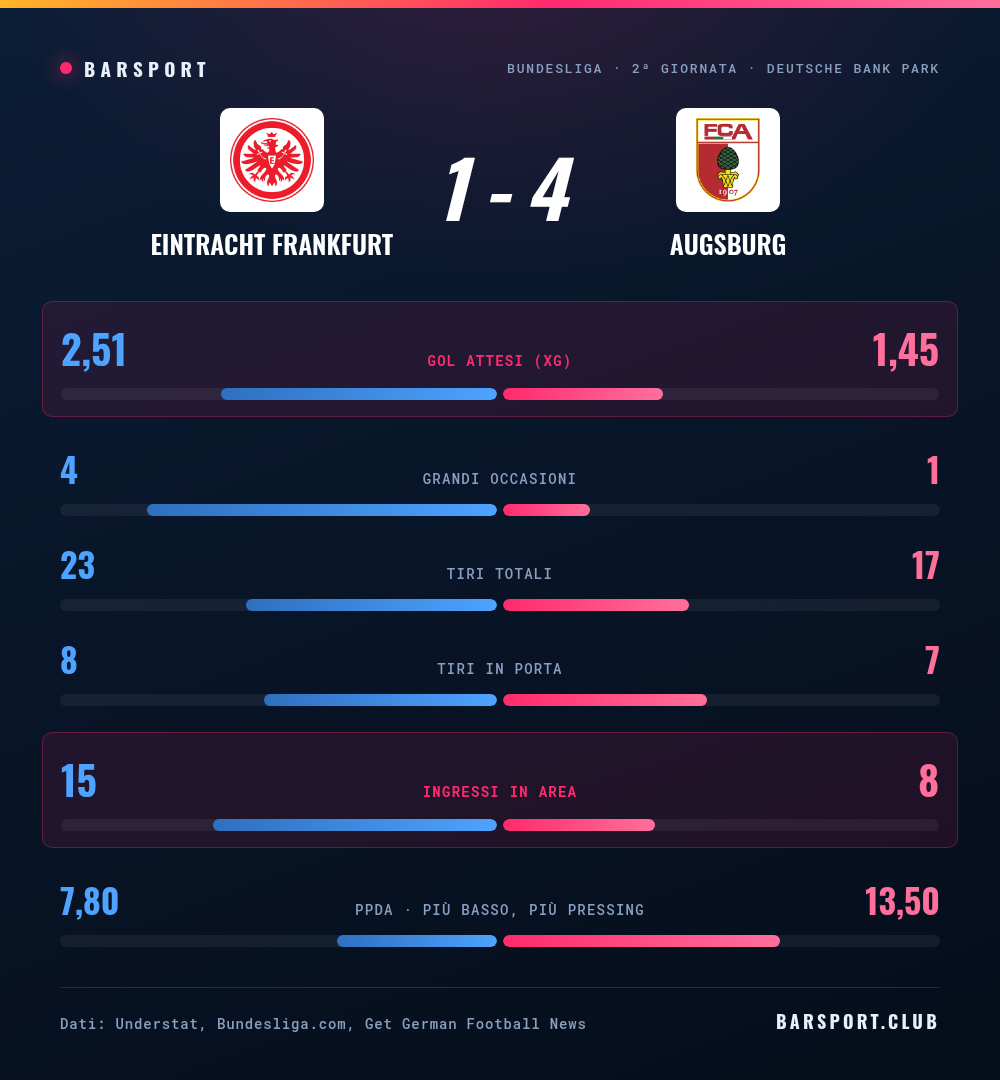
On one point, though, our archive contradicts the coach. Hütter said: "we had too few shots on goal." Frankfurt shot eleven times in each half, made fifteen box entries to eight, and pressed almost twice as hard (PPDA 7.8 against 13.5). The volume was there. What was missing was the value of each individual shot, which is a different thing: the team kept arriving, but from distance and in a hurry.
There is one point, on the other hand, where coach and model agree almost embarrassingly closely. Hütter said that in the first half, apart from one good cross, he had not seen "a single goalscoring opportunity" from Augsburg. Our data says 0.13 from three attempts, two of them blocked. No argument there.
The season context
Augsburg are top with six points, and not because they create more than anyone else.
In two matchdays they have made twenty box entries and conceded twenty-two. They have scored seven goals from 6.98 expected: almost exactly the going rate. Augsburg's attack, so far, is worth what it scores.
The anomaly is entirely at the other end: they have conceded 4.35 expected goals and let in one. On matchday one they beat Schalke 3-0 while conceding 1.84. On Sunday they won 4-1 while conceding 2.51. Dahmen was named man of the match by the outlet that rated the game, on the grounds that he kept his side in it during a half in which they were "clearly second best".
Frankfurt have one point from two matchdays, and their problem is not creating. They have produced 4.63 expected goals and scored four: normal. They have made twenty-six box entries and conceded thirteen: double their opponents.
But they have conceded seven goals from 3.73 expected. On matchday one they led Union Berlin 3-1 away and finished 3-3. On Sunday they led 1-0 and finished 1-4. Two matches, two leads thrown away.
One figure we counted before writing it down: this season, across the five major leagues, Frankfurt are the only side to lose by three goals in a match where expected points had them winning (2.08 to 0.72). The only comparable case is Toulouse, beaten 0-2 by Lyon with 2.39 expected points. By two goals, though, not three.
The honest part
Be careful how you read Augsburg's first goal. In our statistical source it appears as an own goal, valued at 0.00. That zero does not mean Augsburg had created nothing: it is a convention. Wolf's cross and Ibrahimović's header are worth 0.08, and it was Baum's deflection that sent it in. The sources themselves disagree on who to credit: some give the goal to Ibrahimović, ours records it as a Baum own goal. We have described it for what it was, a deflected cross, without picking one.
Two matchdays are not a season, and for the Bundesliga they are even less. Augsburg's lead at the top rests on one goal conceded from 4.35 expected. No goalkeeper sustains that rate. If we had to bet on what changes first, we would bet on that.
Our reading, which is an opinion. We are not saying Frankfurt were robbed. A shot parried badly by the goalkeeper that turns into a 0.60 chance, and two goals conceded in a hundred and twenty seconds, are not bad luck: they are the thing this team had already done seven days earlier in Berlin. What the numbers defend is the first half, not the ninety minutes.
And there is one thing that convinces us less than all the rest. Hütter said he will consider changing his formation to make the side more stable. The August preview had already written that, with a full squad, he might switch to a back three with Burkardt as the lone striker — which is, in practice, a return to the structure he beat Bayern with in 2021, the one he describes in detail in his own masterclass. The adjustment the coach is now reaching for was described three weeks ago by the people watching from outside.
The goal times come from the match reports, not from our statistical archive, which as always logs them a minute early. On Burkardt's opener, for instance, the reports say the sixth minute and our data says the fifth.
We keep the running account between results and performances in the Meritometro. Anyone who wants the raw numbers, without the story around them, will find them in the Nerd Zone.