 Foto: Arne Müseler · CC BY-SA 3.0 de · Wikimedia Commons
Gladbach-Elversberg 3-4: the first win the numbers actually give Elversberg
The verdict, before the numbers
At the Borussia-Park, Mönchengladbach lost 3-4 to Elversberg after leading 3-1 just past the hour.
Bolin had opened the scoring after ten minutes from a goalkeeper's parry, Mokwa levelled around the half-hour, Bolin completed his brace shortly before the interval, Scally made it 3-1 early in the second half. Then Krattenmacher on 66 minutes, Keidel's direct free kick ten minutes from time, and Krattenmacher again in stoppage time.
In between, the scene that defines the match: Elversberg coach Vincent Wagner was sent off at half-time. He had protested a throw-in wrongly awarded, from which Gladbach's second goal came; he was booked, went back to speak to the referee after the whistle and stepped onto the pitch. Second yellow. His team played the second half — and the comeback — without him on the touchline.
Six points from 2.11 — but not all alike
Elversberg have six points from two matches. The expected points from those two matches add up to 2.11. The gap is +3.89: we checked all eighteen Bundesliga sides, and it is the largest in the league.
Put like that, it sounds like the story of a lucky team. But the two matches are nothing like each other, and that is the point.
On matchday one, against reigning champions Bayer Leverkusen, Elversberg won 3-2 while playing badly. Expected goals 1.40 to 2.62. Box entries seven to seventeen. Expected points 0.61 to 2.19. That is the definition of a stolen win: Leverkusen lived inside the newcomers' area and lost anyway.
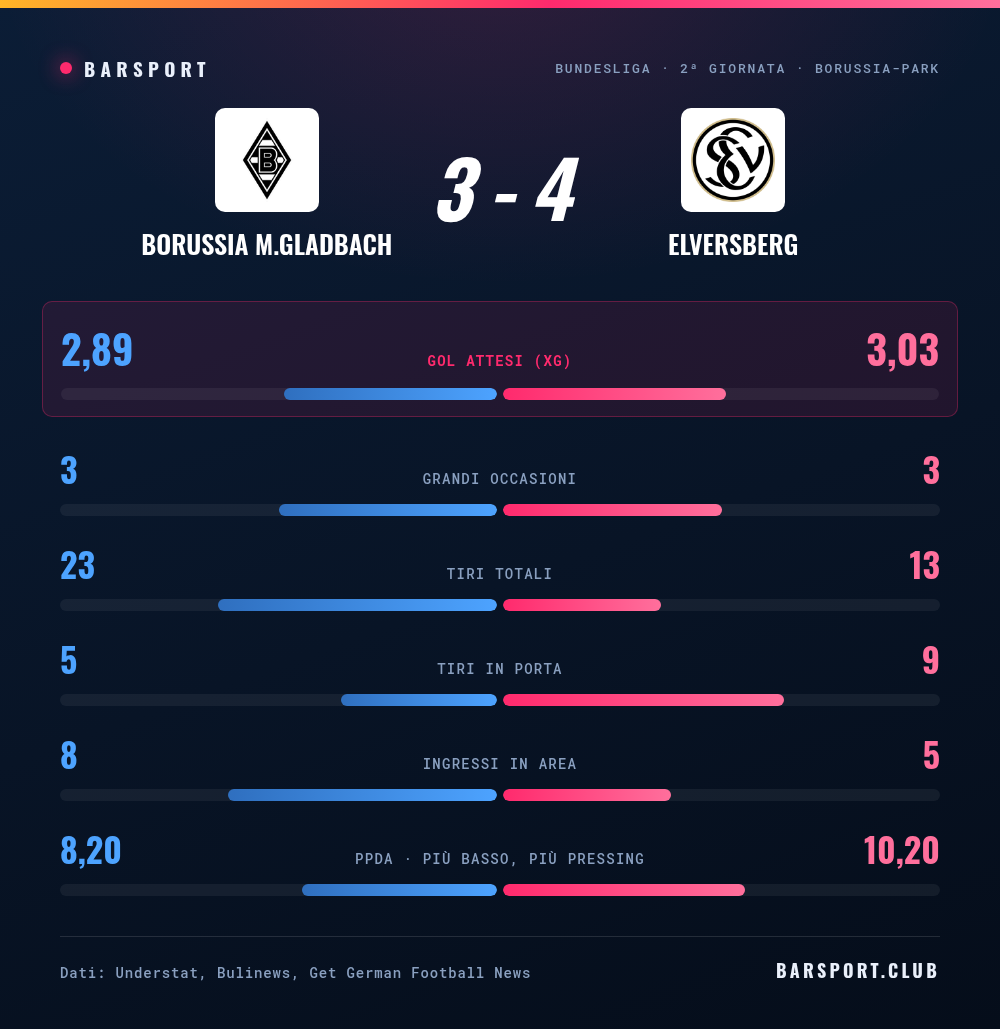
At Mönchengladbach, no. Expected goals 2.89 for Gladbach, 3.03 for Elversberg. Box entries 8-5 to the hosts, PPDA 8.2 against 10.2. Expected points 1.29 to 1.50. Neither side dominated: 5.92 expected goals in total, seven real ones, and a model that for once agrees with the scoreboard.
That is the difference between a match that ended badly and a match that was lost. Gladbach lost it.
How the two sides moved
Elversberg build from the back, which is the least "newly promoted" thing there is. Total Football Analysis, in a piece from last October — when the club was still in the second division — describes Wagner's 4-2-3-1: a wide back four, full-backs near the touchline, the two centre-backs on the edge of the box, the goalkeeper used as the first distributor, and above all a very narrow double pivot glued to the centre-backs. Wide full-backs plus narrow midfielders means one thing: the half-spaces stay open for the attackers, and in build-up there are six men plus the goalkeeper against the opposition's first line of pressure. Numerical superiority by design.
That piece is eleven months old and describes 2. Bundesliga football: take it as a portrait of principles, not as Saturday's team sheet.
Get German Football News' season preview, from 19 August, adds the two things that actually happened at the Borussia-Park. First: Elversberg's summer spending went almost entirely on young attackers — Campbell, Krattenmacher, Onyeka, Darvich, Futkeu on loan. On Saturday two of them produced the comeback: Krattenmacher came on in the 65th minute and scored in the 66th, then again in stoppage time; the assist for the winner came from Futkeu, also a substitute.
The second is subtler, and it concerns the sending-off. In the Strasbourg friendly, the same source writes, Wagner changed virtually the entire team at half-time and the mechanisms did not collapse: different names in the same lanes, recognisable spacing. A team built that way is a team that can play forty-five minutes without its coach on the bench.
Polanski's Gladbach, by contrast, is a building site with a mandate. The same outlet's preview reports that the front office ordered a return to a back four, and that the intended 4-2-3-1 might become a 4-3-3 because of Castrop's injury. Bolin, a summer arrival, had been tried as a number ten in pre-season: on Saturday he scored twice.
Our reading, which is an opinion and not a fact. Gladbach did not lose to some exotic tactical fragility: they lost duels and gave the ball away in the twenty minutes when Elversberg raised the tempo. Wagner effectively says as much himself: "a little luck belongs in the equation, the game could have ended up differently, Gladbach's keeper made a mistake on the 3-2." What does look true to us is that Elversberg have a structure that does not depend on individuals — not on the players, given who decided it off the bench, and not on the coach, given where he spent the second half.
Season context — two matchdays, not a season
Gladbach have zero points and seven goals conceded in two matches. The model is kinder than the table: 0.19 expected points in Leipzig (where they deservedly lost 3-0) and 1.29 on Saturday, which is a draw-level performance.
Elversberg have six points from six, and next up is Bayern at home. Without Wagner on the bench, who is suspended.
The honest bit
There is a hole in our data on this match, and we are telling you before anything else. Our shots table contains three Elversberg goals; Elversberg scored four. The missing one is Krattenmacher's 3-2 on 66 minutes: our source recorded the shot that hit the woodwork a moment earlier, rated 0.669, but not the rebound that went in. The match totals — the 2.89 and 3.03 this article is built on — come from a different field of the same archive and do not appear to be affected. But it is the reason you will not find the expected-goal value of every individual goal above, as we usually give: for this match we do not have them all. And for the same reason the shot counts in the graphic above are one short for Elversberg: thirteen instead of fourteen, nine on target instead of ten.
Our automated check did not catch it. The radar that picks the matches worth covering compares the fixture's expected goals with the sum of the shots and discards the match if the gap exceeds 0.4. Here the gaps were 0.22 and 0.30: inside the threshold. The check compares totals; it does not count goals. That is a flaw we now know about.
Two matchdays are not a season, and Elversberg's +3.89 is, for now, a statistical curiosity over two games. We will look at it again when it means something.
The minutes. Where the match reports give us an exact minute (Krattenmacher's 66th) we write it; where the sources do not agree we have preferred to name the phase of the match. Understat, as always, lists every minute one earlier.
We keep the running tally of results against performances in the Meritometro. Anyone who wants the raw numbers, without the story around them, will find them in the Nerd Zone.