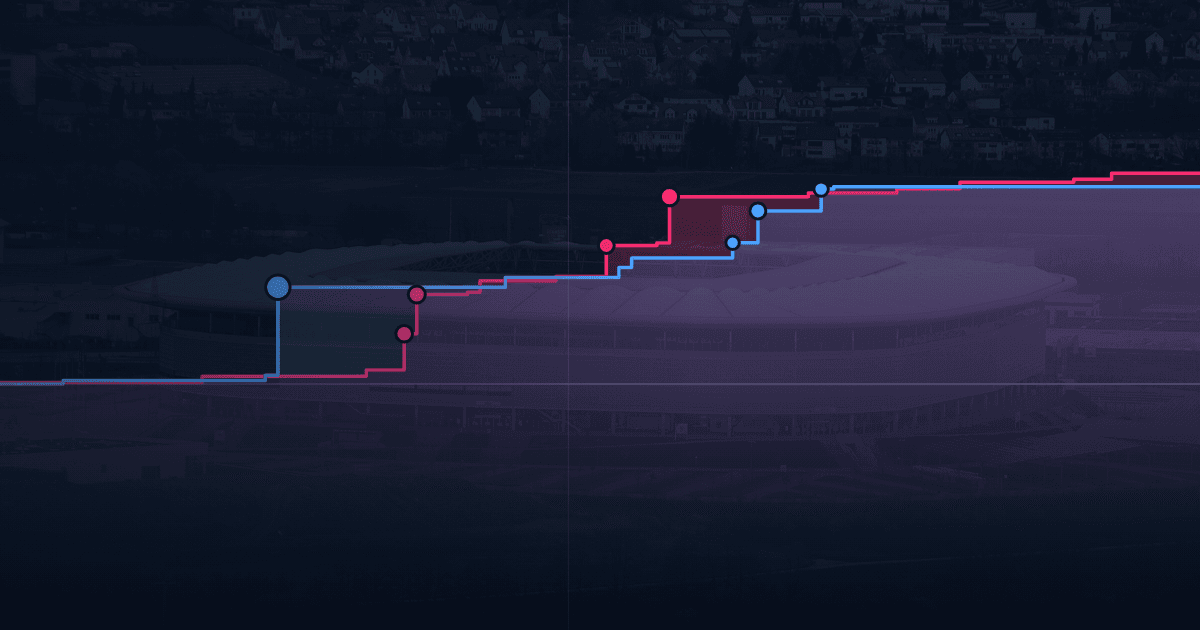
 Foto: Photographs by Radosław Drożdżewski (Use… · CC BY-SA 4.0 · Wikimedia Commons
Hoffenheim-Dortmund 2-3: an hour in control, five minutes to lose it
The verdict, before the numbers
At the PreZero Arena in Sinsheim, Hoffenheim lost 3-2 to Borussia Dortmund after leading by two goals on 54 minutes.
Avdullahu opened the scoring on 45 minutes, Lemperle made it two on 54. Then Guirassy on 61, Fábio Silva on 66, and on 86 the Hajdari own goal. Five minutes to be pegged back, twenty to lose.
The scoreline says comeback. The territorial data says something much stranger: Dortmund won without ever getting into the box.
Thirteen to one
A box entry, in the data, is a completed pass inside the final twenty metres of the opposition half. Not a shot: a ball carried in there and handed to a teammate.
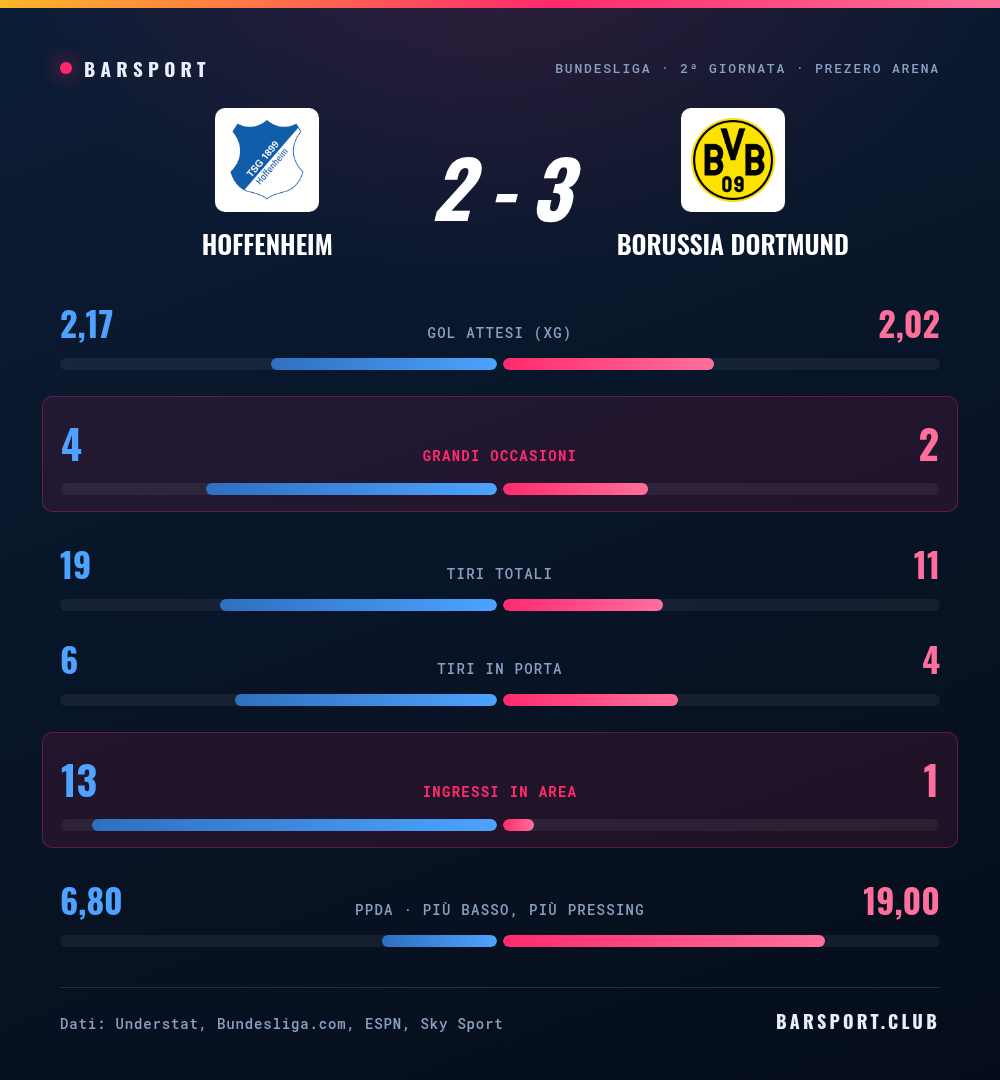
Hoffenheim thirteen. Dortmund one.
One. In ninety minutes, with 40% of possession and 250 completed passes to Hoffenheim's 394, Dortmund put the ball inside Baumann's final twenty metres exactly once.
And that is precisely the kind of move that decided the match: on 86 minutes Fábio Silva played Nwaneri in behind — the debutant had come on in the first half — and his low shot forced the own goal off Hajdari.
We cannot prove that this pass is exactly the one the data counted. But it is the only Dortmund move of the match that looks anything like a box entry, and it is the one worth three points.
How rare is it? We counted. Our archive holds 22,476 team performances with box-entry data. The ones where a team completed at most one pass in the final twenty metres and still won while producing at least 2 expected goals number forty-three. Fewer than two in a thousand.
Half a goal for two goals
Dortmund's two open-play goals are worth 0.55 expected goals between them: 0.33 for Guirassy's right-footed finish on 61, 0.22 for Silva's left-footed finish on 66. The third, the own goal, counts as zero in the xG model.
Hoffenheim did the opposite. Nineteen shots, four of them from positions worth more than 30%: 0.48 for Lemperle's goal, then 0.40, 0.37 and 0.32 thrown away. Avdullahu's goal, by contrast, was worth two hundredths.
Ten corners to three. Sixty per cent of the ball. Thirteen box entries. Two goals.
How the two sides moved
This is where the numbers stop and the reading begins. We compared four tactical analyses, and on one point they disagree with each other.
Ilzer's Hoffenheim press man-to-man, through the middle. Tactical Football Analysis, in a piece from May, sets out three principles: tight central access, pressing connections around the ball, and defensive cover behind every aggressive jump. The central midfielders stay glued to their direct opponents; the wide players and the striker keep their reference on the back line. Whoever has the ball cannot find the central passing lane, so they go wide or they go long — and long is where Hoffenheim win, because the squad was built for it: Kabak, the same analysis notes, contested 9.21 aerial duels per ninety minutes last season, winning 58.71% of them. Get German Football News, in its August season preview, calls Lemperle Ilzer's Chefanläufer: the chief chaser, the striker who triggers everything.
On Sunday it worked. Hoffenheim's PPDA was 6.8: one defensive action for every seven opposition passes. Dortmund finished on 76% passing accuracy and one ball delivered into the box.
Dortmund refused the duel. PPDA 19.0: one action every nineteen passes. Translated: they did not press. They gave up the ball and the pitch, defended deep and broke vertically. Both open-play goals came from a pass, not from a build-up.
And this is where the sources part company. Total Football Analysis, explaining the birth of Kovač's 3-4-2-1 back in July 2025, described the third centre-back as protection against transitions and the wing-backs as players finally free to push forward, which is what they are good at. Get German Football News, a year later, describes the exact opposite: Kovač has started using inverted wing-backs who attack inside the pitch, to overload the centre and open up switches of play — and he did it, in his own words as reported by that outlet, because Dortmund do not have natural wing-backs and he stopped pretending they did. Same role, opposite instruction. The first analysis is a year older: it may simply have aged, or Kovač may change it opponent by opponent. We do not know, and anyone who tells you they do is guessing.
Our reading, which is an opinion and not a fact. Ilzer's press asks everybody to jump onto a man. The third principle in his own analysis — the cover behind those jumps — is what holds the scaffolding up: when it arrives, the press is a machine; when it does not, a single through ball leaves you exposed in the middle. Dortmund never tried to play through that press: they waited for it to open. Fábio Silva, who according to the August preview moves more than Guirassy and looks for different spaces rather than copying his profile, came on in the second half and within twenty minutes scored the equaliser and played Nwaneri in.
There is a precedent that makes all of this look less accidental. The same source recounts that Dortmund won 3-2 at the Emirates against Arsenal in pre-season while creating considerably less than their opponents, and sums up Kovač's side in three words: compactness, intensity, efficiency. On Sunday it happened again, by the same scoreline.
Season context — two matchdays, not a season
Mind the unit of measurement: this is matchday two. Any trend read into it is fragile.
That said, Hoffenheim already have a problem that repeats. On matchday one they lost 3-2 at Cologne, and there too they carried the ball into the box more than their opponents: twelve to five. Across the two games: twenty-five box entries made, six conceded, zero points.
Dortmund have six points from six. But on matchday one they beat Hamburg 2-0 while running the game, ten box entries to five, with a PPDA of 9.1. Sunday's 19.0 is a different team. Either it was a decision taken for this fixture, or it is the same efficiency seen against Arsenal, carried into the league.
The honest bit
Three things that weaken what you have just read, and that need saying.
The two expected-goals models do not agree, and not by a little. Our data comes from Understat, which gives Hoffenheim 2.17 and Dortmund 2.02. The official Bundesliga live feed, using the league's own model, showed 1.06 against 1.14 on 85 minutes. Those are two different readings of the same match: the official model sees far fewer chances for both sides. We use Understat for every article and will carry on using it, but when two models drift this far apart you deserve to know.
Dortmund's 2.02 rests almost entirely on one moment. Beier's header on 22 minutes is worth 0.905 to Understat: 45% of their expected goals for the whole match. The official live feed tells that moment far less spectacularly, as a scrappy Baumann parry under pressure that a defender cleared. If that shot is worth less than ninety hundredths, Dortmund won creating even less than we write here. Which makes the story truer, not weaker.
The minutes. The scorers and timings above are those of the official Bundesliga site and the German press. Understat lists all of them a minute earlier. It is not a trivial detail: it is a mistake we have made before.
We keep the running tally of results against performances in the Meritometro. Anyone who wants the raw numbers, without the story around them, will find them in the Nerd Zone.