 Foto: SonoGrazy · CC BY-SA 4.0 · Wikimedia Commons
Mantova and Palermo produced the same expected goals. It finished 0-2, and the reason is two shots
There were 11,163 people at the Martelli, the scarf display in the curva Te, the away end full of rosanero. Second against first, and the feeling, for a whole half, that the afternoon could end badly.
Seven days earlier, closing the piece on the Castellani, we had left a question: with the full-backs that high and two centre-backs alone behind them, will Inzaghi accept conceding again what he conceded at Empoli?
The answer came, and it is the opposite of what we expected. He did not concede more. He stopped playing that way altogether.
1.98 against 1.98
Let us start with the number that overturns almost every report of the following day, ours included in part.
The expected goals of this match are 1.98 for Mantova and 1.98 for Palermo. That is not a kind rounding: the two sides built exactly the same amount of danger. Serie B does not run through our engine, so we do not calculate these numbers ourselves, they come from FotMob's model, the same one we used for Empoli.
It changes a good deal, because the common story is of a Mantova side in charge punished by somebody else's ruthlessness. The first forty-five minutes say so, and they are true. The full ninety do not.
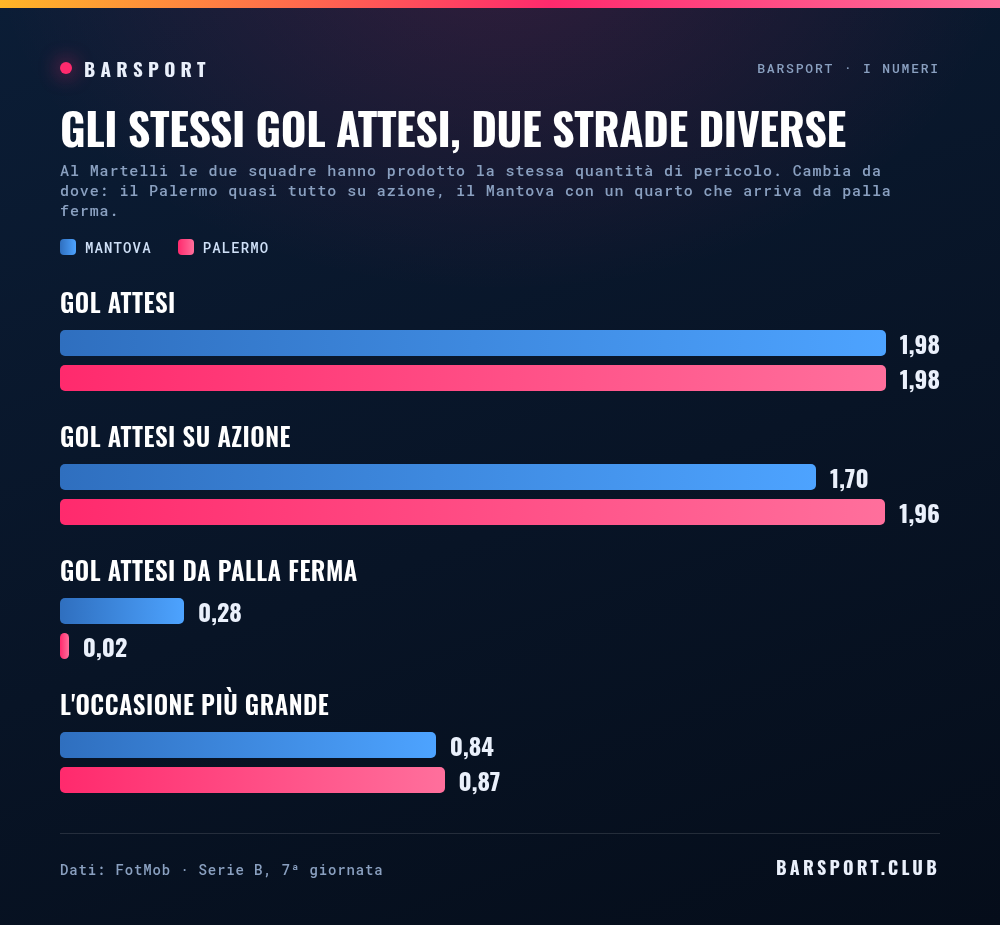
The difference lies in where the two sides built that danger. Mantova shot 15 times, 8 from inside the box and 7 from outside. Palermo shot 13 times, but 11 from inside and only 2 from outside. Same total, different positions, and indeed the big chances are 2 for Mantova and 4 for Palermo.
The two shots that decided everything
Inside that draw on expected goals there are two balls worth almost the same, and each is the mirror image of the other.
In the 41st minute Trimboli launches Bragantini, the ball crosses the whole box and reaches Ruocco in front of an open goal. That shot is worth 0.845 expected goals: it goes in more than eight times out of ten. Ruocco puts it wide.
In the 62nd Pohjanpalo flicks it on in the middle, Palumbo carries in open space behind the defence and shoots across goal, Bardi parries and Segre arrives on the rebound after moving in from deep without the ball. That shot is worth 0.866. It goes in.
They are the two biggest chances of the match, and two hundredths separate them. Take each side's away and what is left is 1.13 against 1.11: two identical teams, divided by two goals.
Anyone saying Palermo won thanks to their ruthlessness is saying one thing without knowing it: that Segre scored his 0.866 and Ruocco missed his 0.845. It is true, and it is also the only real difference between the two sides across those ninety minutes.
Forty-four per cent, and it is no accident
The rest, though, is a choice, and it is worth telling because it is the new thing of the season.
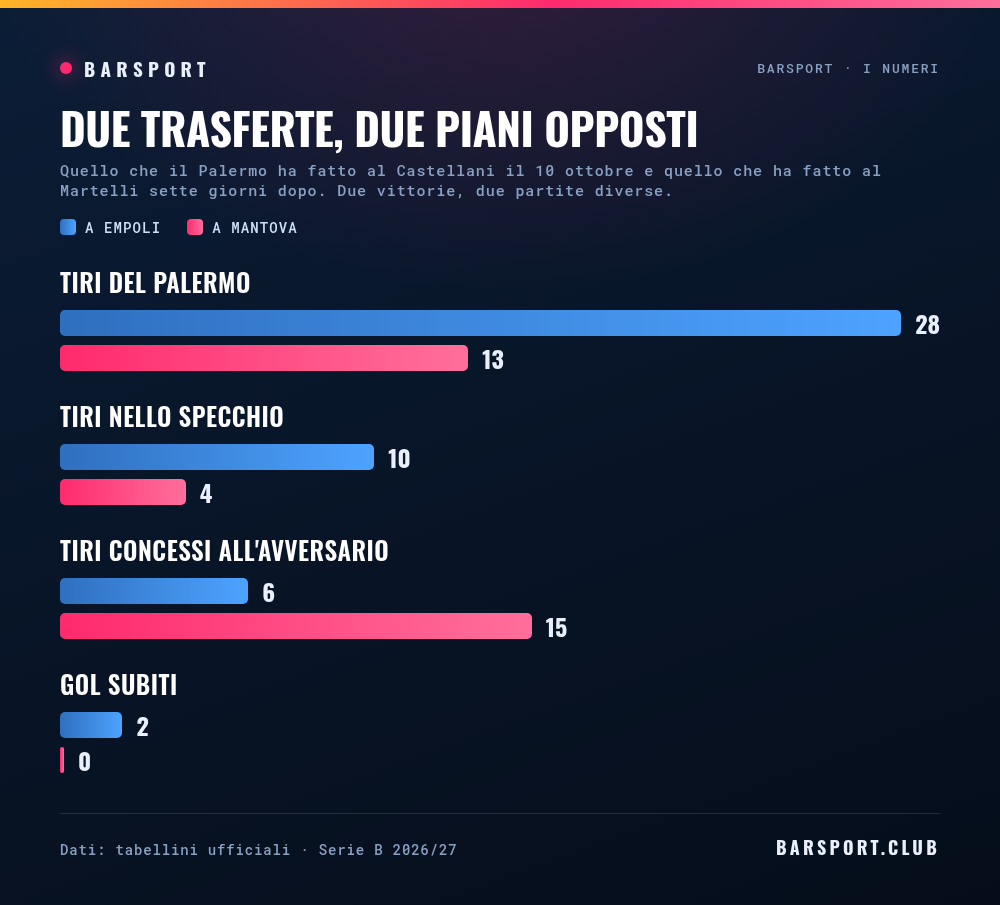
At Empoli, Palermo had shot 28 times and held their opponent to 6 attempts. At the Martelli they shot 13 and allowed 15, with 44% of the ball against Mantova's 56%. The passes completed in the opposition half tell the same story even more bluntly: 263 for Mantova, 111 for Palermo.
This is not a dip, it is a plan, and the manager said so before anyone asked: in the first half it was a very even game, we knew their strength, we had to hold out and then strike.
Out of possession the team slid from a 4-2-3-1 to a back five, with four in front and Pohjanpalo alone up top. The full-backs, who at the Castellani were the source of the width and also of the two penalties conceded, stayed inside the line. Augello played a game of defensive diagonals, not of overlaps.
The defensive numbers confirm it without needing comment: 19 tackles against 8, 12 interceptions against 6. Palermo did not endure the match, they defended it.
Whoever writes these pages has spent a month explaining that the width was both the engine and the bill to be paid. Seeing it switched off by choice, in the hardest fixture, is the most important technical fact of the afternoon.
How Mantova took the pitch
It needs saying, because the first half was theirs and not by chance.
Francesco Modesto builds from a back three, with Tomašević, Cella and Castellini, and drops one of the two central midfielders between them so as to always have an extra man against the opponent's first pressing line. From there the ball goes wide, to the wing-backs fixed high and wide, while Ilie moves inside behind Ruocco and Bragantini looking for the space between the lines.
It is a mechanism that works, and for forty-five minutes it worked. Mantova kept the side high and compact, suffocated Ranocchia and Segre in the centre circle and counter-pressed every loose ball. The 28 touches inside the opposition box, against the 19 of the rosanero, are the mark of a team that had prepared the game well.
And then there is the 41st minute, which at that point of the afternoon looked like a regret and was in fact the final score.
Palermo's plan, and the price it carried
Here is the part worth telling, because it is the third episode of the same story.
Against Padova, in September, the opponent man-marked Ranocchia and Palermo seized up. At Empoli the answer had been Palumbo dropping to take the ball himself in a zone where nobody followed him. At the Martelli, Mantova did the same thing with the variation of squeezing the pitch onto both central midfielders, and the answer was the third one available: do not go through midfield at all. Long ball to Pohjanpalo, flick on, and an immediate vertical pass to whoever arrives from deep.
Now let us look at what it cost, because this is where the numbers say something the eye does not see. Palermo won 9 aerial duels out of 38, which is 24%, against Mantova's 29. And of the long balls they attempted, they completed 33%, against the hosts' 54%.
Put plainly: the flick-on plan, for most of the match, did not work. Pohjanpalo was losing almost three aerial balls out of four. It worked at the moment it was needed, in the 62nd, and that moment is worth three points, but anyone describing it as a well-oiled mechanism is reading the result and not the game.
Inzaghi, for his part, never pretended otherwise: sometimes you have to know how to play not with flicks and tricks but with a knife between your teeth, the team knew how to be dirty.
Perin, four saves and a goal that would not open
Of Mantova's 15 attempts, 4 finished on target, and Perin saved all four.
The most important one arrives just after the half-hour: Kouda drives forward, exchanges with Bragantini, aims for the far corner with a curled shot. Perin gets there. From the following corner Tomašević heads wide, then the goalkeeper also holds the same Kouda's low attempt.
There is a number that measures his afternoon exactly. The expected goals calculated on the shots that finished on target, the ones that account for where the ball goes and not only where it leaves from, say 1.55 for Mantova. Perin took them down to zero.
He had come back into the side that very evening, after Fortin's turn at Empoli. The ratings gave him between 6.5 and 7 across every outlet, and not for one save alone. Palermo had conceded in five consecutive matches: Mantova is the first clean sheet away from home and the second of the season, after the opening 1-0 against Juve Stabia.
The second goal, and what they say together
The 86th minute is another story again. Vavassori puts it back in, Cajazzo miscontrols on the edge of his own box, Hernani, on the pitch for nine minutes, steals the moment and lifts it over Bardi. It is worth 0.167, an ordinary shot that becomes decisive because it arrives with the game still open.
Looked at together, the two goals say the same thing. Mantova kept the line high to counter-press immediately, as their manager asked them to do all game, and on both occasions they lost the ball with nobody covering behind, with the defenders badly staggered in open field. It is no coincidence that the first comes on the counter and the second from an error playing out.
Whoever plays that way accepts that risk in exchange for everything else. For an hour Mantova had collected everything else. In the last thirty minutes they paid the risk, twice.
Inzaghi, immediately after taking the lead, took Ranocchia off for Estévez and dropped the block further still. It was not a substitution for fresh legs, it was a substitution to close the game.
What it cost, because here the accounts are done when you win too
15 shots allowed are two and a half times those allowed at Empoli seven days earlier. The first half was a long exercise in endurance: Ceccaroni struggled with Bragantini and got 5.5 from the Giornale di Sicilia, Ranocchia the same mark for failing to find passing lines.
And above all there is the 41st minute. If Ruocco hits the open goal, this article carries a different headline and everything you have read so far changes sign.
It needs saying, because a plan built on suffering works for as long as the opponent misses. Palermo won because they conceded a lot and conceded nothing Perin could not reach, and the difference between those two things, inside a single match, is partly luck.
What is not luck is the rest: 4 big chances built against 2, eleven shots out of thirteen from inside the box, 19 tackles won, no goals conceded.
Modesto's mea culpa
Something rare happened in the Martelli press room, and it deserves reporting.
Modesto did not talk about the referee, about bad luck or about moments. He said that in the first half his side had done almost everything perfectly, and then he took all the rest on himself: my communication was not good, I was the one who put my players in difficulty, usually when I have to tell someone off I do it in private and today I did it in public, some of them were put in roles that did not suit them, I got some judgements wrong.
A manager who loses the head-to-head and attributes the defeat to his own choices, in front of 11,000 people who had just applauded him, is something that does not happen often in Italian football.
Where we are
Nineteen points in seven matchdays, six wins and a draw, still no defeat, sixteen goals scored and seven conceded. Five points on Mantova in second and six on Pisa and Modena, level on 13: Modena lost at Carrara the same afternoon, Pisa won and caught them.
But the number that really counts, the way we see it, is not in the table. It is that in seven days this team has won away in two opposite ways: scoring 4 goals with 28 shots and scoring 2 with 13, keeping the ball and giving it away. The teams that go up are the ones that can do both, and until a month ago we only knew one of them in this side.
Inzaghi said it with his usual caution: we are only at the seventh match, the road is long and winding. He is right, and it is not superstition. A team that draws level on expected goals with the side in second is not a battleship yet: it is a good team that on that day had the better goalkeeper and the colder finisher, and those are two things that in May count as much as the football.
On Saturday, Carrarese come to the Barbera, having just beaten Modena. And the question for the next one flips compared to today's: now that we know this team can also wait, what will it do against one that does not want to take the ball off you, but leaves it all in front of a packed defence?
Because the knife-between-the-teeth plan works when the opponent comes to get you. At the Barbera, usually, nobody comes.
T.L.
Thanks to Giuseppe Stagno for the technical and tactical report on which this analysis is built. The expected goals and advanced match statistics come from FotMob's model.
Want to see how much each team really deserves its place in the table? The Meritometro compares real points and expected points. For those who want models and not headlines, there is the Nerd Zone.