Under the rain, with more than 29,000 people in the stands, the Barbera saw the most uncomfortable match of this start to the season. It ended with Palermo alone at the top: 13 points in five matchdays, four wins and a draw, which for the club is their best ever start at this point of the season.
A week ago, closing the piece on the Partenio, we had left ourselves with a question: at home, with the full-backs once again free to push forward, would Palermo find its left chain again, or would the first concern there too be not leaving the centre-backs alone?
The answer came twice, in the 44th minute and in the 83rd, and it always carries the same two names.
What Padova had prepared
Calabro arrived at the Barbera with a 3-5-2 and a clear idea: take away Palermo's first pass. Fusi went to man-mark Ranocchia, wherever he went, and for a full half it worked. Our playmaker never received the ball, and when he moved to shake off the marking he left an open corridor in front of Bani.
That corridor was the chance of the match, and we did not take it. All Bani had to do was carry the ball into that space to skip the first line of pressure from the two strikers and find himself with the whole pitch ahead, with his teammates suddenly free from the man-marking. It almost never happened. Palumbo tried to make up for it by dropping below the midfield line to offer one more option to whoever had to build, but the point stands: when the opponent man-marks your playmaker and the centre-back does not carry the ball, there is no way out.
From there comes the half hour everyone saw. Padova took the centre of the pitch, created numerical superiority in midfield and then moved it out to the flanks, and Palermo pressed in fits and starts, with stretched lines and wrong distances. In those conditions pressing is not pressure: it is a run that leaves holes. Inzaghi, after the match, said it in his own words: we did not start like we always do, we were disorganised and without the usual strength.
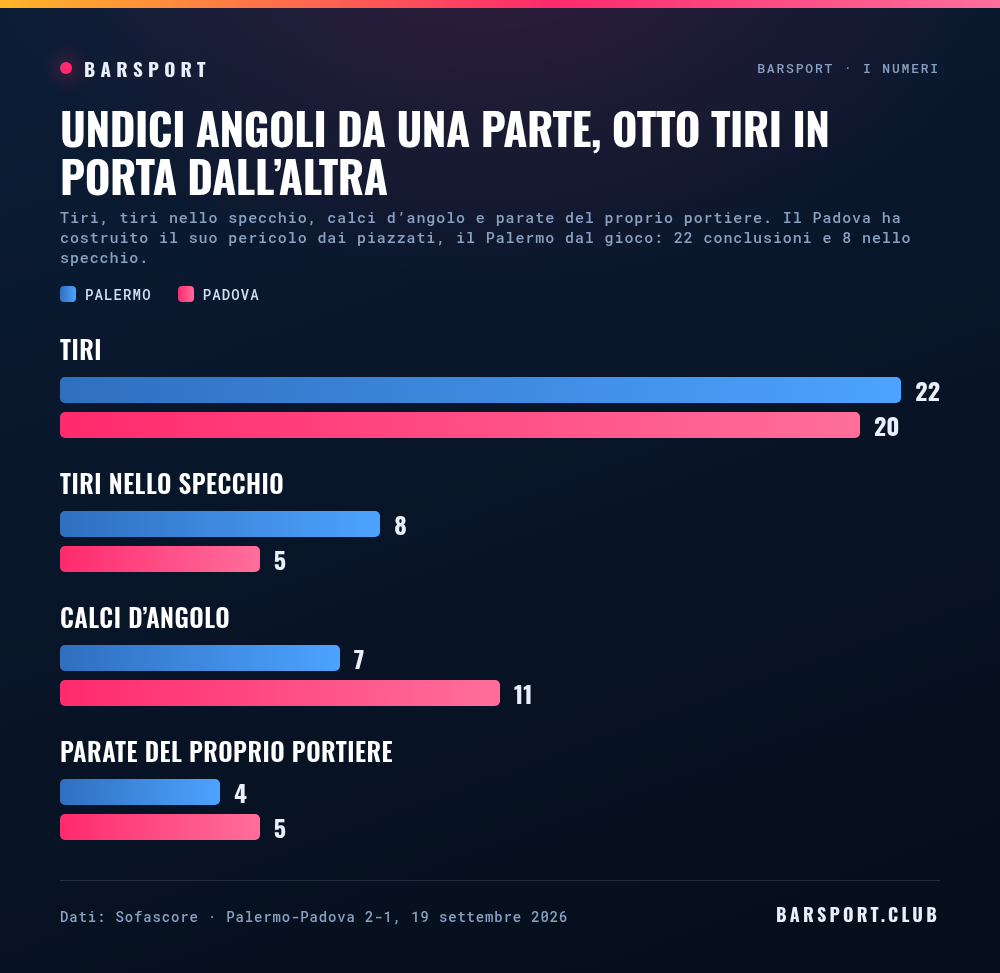
The biggest hole was between the two centre-backs. Padova's strikers came towards the ball, Bani and Ceccaroni followed them, and the line broke. Behind there was a chasm, and the visitors threaded quick combinations, crosses and through balls into it. They produced shots, chances and above all corners: eleven, against our seven.
The goal in the 7th minute, and all the ones that never came
The visitors' lead comes exactly from there. Corner, Pastina's jump, ball in. The referee initially disallows it, the VAR calls him back and the goal stands.
The thing that should worry us, though, is not that goal: it is what happened afterwards. From the other ten corners Padova created more goalscoring situations, and in all of them there was Fortin: on Giunti, on Seghetti, on a header by Dellavalle. For the second match in a row our goalkeeper keeps the result standing, and for the second match in a row the marking on set pieces does not convince.
There is a detail that points the same way and that almost nobody noticed, because it concerns something that was not seen. Our long throw-ins, which at the start of the season were a real weapon, have produced nothing for two matches now. The opponents have studied the mechanism and taken countermeasures. A weapon that works for three matchdays stops being a surprise in the fourth: that is normal, but it has to be replaced with something else.
And there is one last thing that says a lot about the evening, and it is on Padova's side. Their strikers have not scored for five matchdays: everything this team produces comes from set pieces and runs from deep, and indeed at the Barbera the goal was scored by a centre-back from a corner. Which makes the tally of eleven corners even less reassuring for us.
The other uncomfortable theme of the first hour was the runs of the Veneto side's mezzalas. They exploited timing and legs, and our midfield followed them badly, Ranocchia and Palumbo more than Segre. It is not a question of attitude: if the playmaker is man-marked and the opposing mezzalas run past you, someone has to decide who goes and who stays.
How Palermo still hurt them
Here comes the good part, because inside such a crooked first half the team still found a way to equalise, and it did so with its own game, not with a one-off moment.
The flow is always the same: the ball goes to the left, that flank is overloaded, Johnsen and Augello look for each other in the inside spaces between the wing-back and the opposing centre-back, and while those two exchange the ball someone attacks the depth. That someone, on Saturday, was Vavassori.
The first goal is a through ball from Johnsen for the run behind the line. The second, forty minutes later, is the exact same thing, with an even better read and an opponent skipped inside the area before the shot. Two passes, two goals, and it is the first brace in Serie B for a boy born in 2003 who moves in the area like a centre-forward with the feet of a number ten.
Calabro had noticed immediately and had put two men on Johnsen, the wing-back and the mezzala on that side. It is the biggest compliment a coach can pay an opponent, and it is also the reason why the spaces, in the long run, opened up elsewhere.
The changes that shifted the match
At half time Inzaghi touches the defence: Magnani on for Bani, Cassandro on for Pierozzi.
The first is the change that changes the match in our half of the pitch. Magnani marks better, does not get beaten, and above all reads the long balls Padova kept playing for their strikers: header clear when he could, recovery of depth when needed. The transitions that had cut us in two in the first half become sterile. It is the same flaw we had described after Avellino, a centre-back struggling in one-on-ones in open space, and this time it was fixed after forty-five minutes instead of after a goal.
The second comes a quarter of an hour from the end, and it is the one that decides it. Gomes comes on and changes the tempo in both phases: he wins the ball back, he offers himself, he carries the ball. It is from one of his runs down the left flank that the last through ball from Johnsen and the winning goal are born.
In between, around the hour mark, there is the moment when the match turns: Padova's pressure eases, the marking loosens, and Palermo finally starts playing in the opposition half. From there on it is almost all rosanero, with the wide attacks, the short exchanges, the balls played behind the line. In the 62nd minute Ranocchia has the chance to turn it around earlier, and wastes it. In stoppage time Carissoni stops Vavassori running towards goal and gets himself sent off.
What still does not work
The build-up from goal kicks, and it is not the first time. When Palermo tries to build from the back on the left side under pressure, it finds neither the rotations nor the right distances, and ends up making mistakes. It has been happening for three matches, and it is the only situation in which this team, which has good feet in every department, seems not to know where to go.
The defending of corners, with eleven conceded and more than one dangerous situation born from them.
And the management of the press when the opponent draws you into the middle. Palermo presses well when it can push up all together; when the opponent creates superiority in the centre, the lines stretch and the press becomes an invitation.
The honest point
Calabro said after the match that 17 shots and 11 corners at the Barbera say how good his Padova's performance was, and that they were punished by the quality of the opposing individuals on the few lapses in concentration. On the opening half hour he is right, and Inzaghi acknowledged it too. Over the ninety minutes, though, the numbers say something else, and it is worth setting it out clearly.
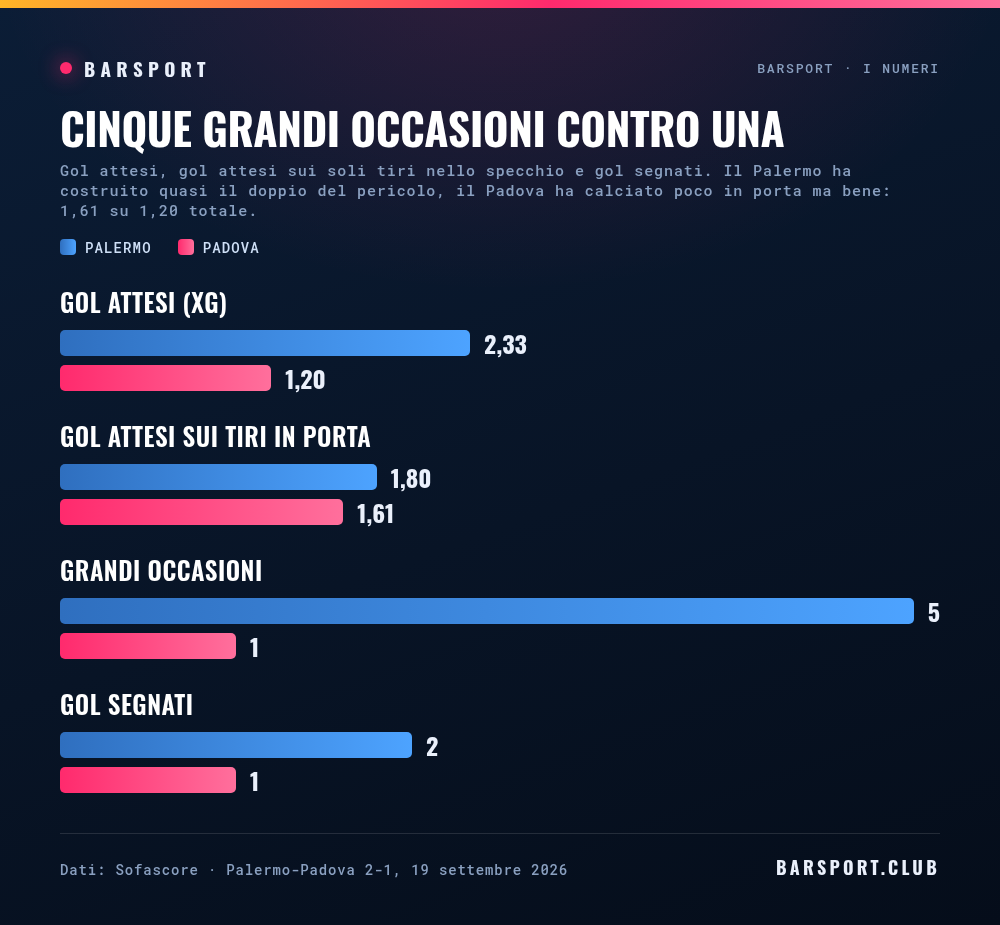
The expected goals of the match are 2.33 for Palermo and 1.20 for Padova. Big chances 5 against 1, shots 22 against 20, shots on target 8 against 5. On shots on target alone the count tightens, 1.80 against 1.61, and it is the most precise way of saying how it went: Padova shot little towards goal but shot well, Palermo built twice as much and was less clean in the final touch, with 3 big chances thrown away.
Then there is the number that explains why the match stayed in the balance until the 83rd minute. Fortin made 4 saves and, according to the model, prevented 0.61 goals more than any ordinary goalkeeper would have prevented in his place. Sorrentino, on the other side, made 5 and sits at minus 0.20. They are two goalkeepers who did their job, but only one of the two kept his team standing.
The reading opposite to ours remains serious and should be stated all the same: for half an hour Palermo did not exist, conceded eleven corners, and won thanks to two players capable of solving in ten seconds a situation that the other twenty-one do not solve in ninety minutes.
Our opinion is that both things are true, and that the second weighs more. The teams that go up are not the ones that dominate every Sunday: they are the ones that on off days do not lose their heads and have someone who changes the result with one pass. On Saturday Palermo played its worst match of the last three and won it, fixed on the fly a defensive problem it had been carrying for a week, and found the goal with the same mechanism twice. Inzaghi reminded everyone that winning the league will take 80 points, and that so far nothing has been done: it is the right way to read a table after five matchdays.
Now there is the international break, and it arrives at the right moment to work on the two things that come back every Sunday: the build-up from the back under pressure and the defending of set pieces.
On Saturday 10 October, at 15:00, we go to Empoli. The question for that day is whether Ranocchia, man-marked as he was on Saturday, will finally find someone to carry the ball in his place.
T.L.
Thanks to Giuseppe Stagno for the technical and tactical report on which this analysis is built.
Do you want to see how much each team really deserves its league position? The Meritometro compares real points and expected points. For those who want models and not headlines, there is the Nerd Zone.