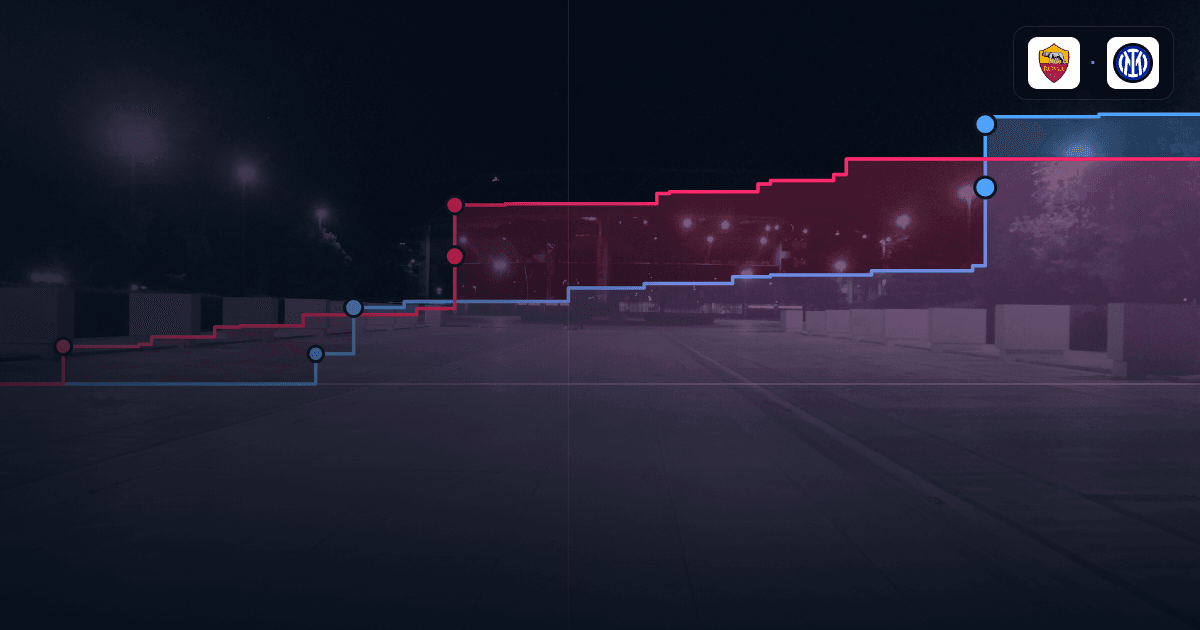
The number we had opened the preview with was 9: the entries into the box conceded by Roma in four matchdays, a little more than two per match, the most extreme defensive figure in the league. The question that came out of it was simple and measurable, and we had written it like this: the match is not decided by who scores, it is decided by who manages to get into the box.
Inter got there 9 times in a single evening.
The verdict, before the numbers
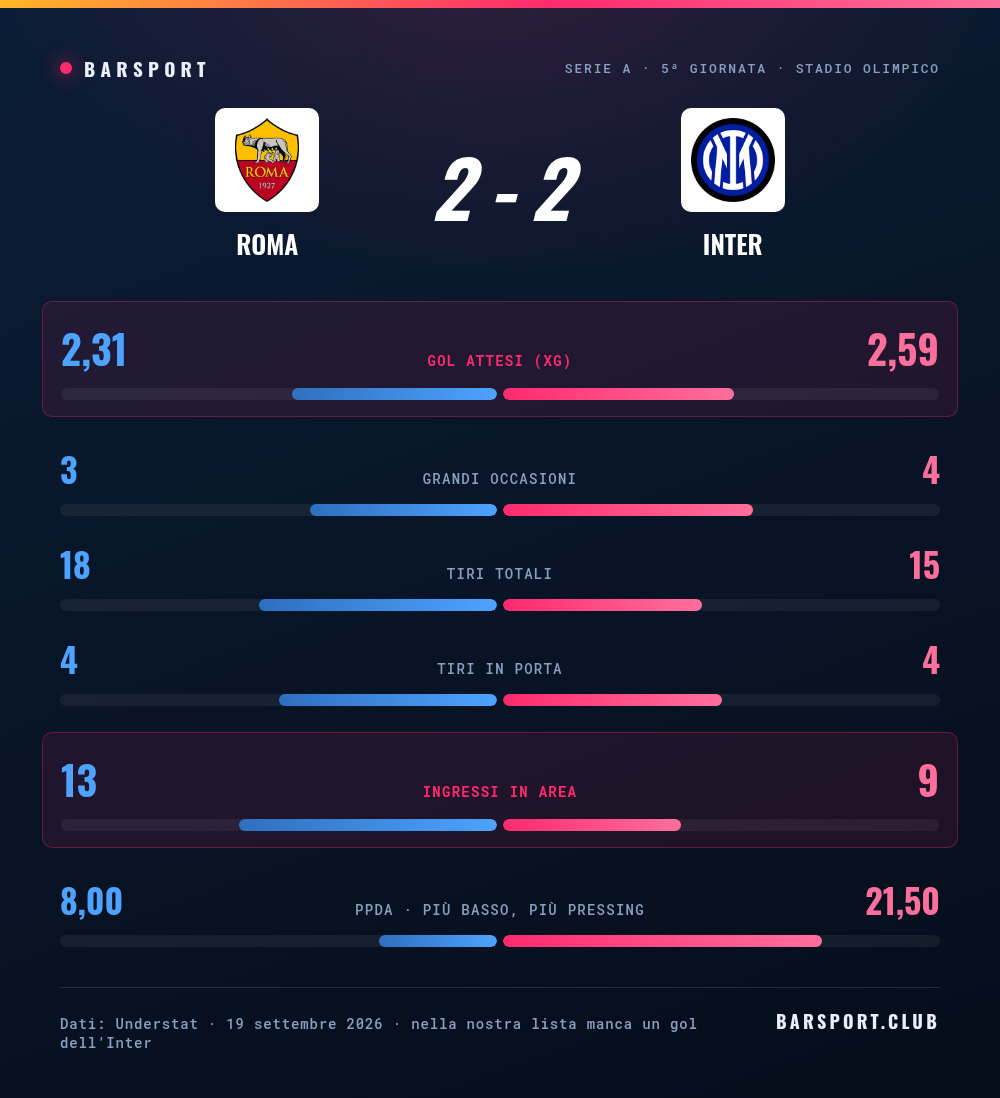
It ends 2-2 with expected goals saying 2.31 for Roma and 2.59 for Inter, and expected points 1.19 against 1.58. It is a match Inter deserved to win by a little, and that Roma pulled back level twice after having gone ahead first themselves.
Entries into the box are 13 to 9 for the giallorossi, and for Roma it is the normal figure for this start to the season. For Inter it is not: 9 is what the Roma defence had conceded in four whole matches.
The number: 1.32
One point three two is what the two chances Inter wasted in the same move, a quarter of an hour from the end, at 2-2, are worth put together.
A corner, a knock-down, the header from Lautaro Martínez from close range: 0.672, that is two times out of three it is a goal. The ball hits the post. On the rebound Akanji arrives for a certain finish, 0.650, and blazes it over. In the same assault there are also a header from Thuram worth 0.132 and a blocked shot worth 0.076.
Forty seconds that were worth, on their own, more than a goal and a third. To grasp the scale: in the whole of Thursday's match against Torino, Roma had produced 2.33 expected goals in ninety minutes.
How Inter got in where nobody was getting in
Roma pressed as always, PPDA 8.0, and for half an hour played the match it has been playing for a month: high recoveries, ball into the box, two goals from Kouadio Kone, the first worth 0.386 after five minutes and the second worth 0.536 shortly before the half hour.
Inter did the opposite: PPDA 21.5, that is it almost never went to meet Roma in their own half. It accepted staying deep, it let Roma stretch out, and it began to break out into open space. It is the reading that none of the first four giallorossi opponents had had, or known how to apply: against a team that comes to meet you twenty metres from your goal, the way to get into the box is not to build, it is to counter.
From there come the nerazzurri chances of the first half, the Bisseck shot worth 0.310 set up by Lautaro and above all the Lautaro miss worth 0.474 at the half hour, the biggest chance of the first forty-five minutes. And from there comes the goal that reopens the match right before half time, a left-footed strike worth 0.140 from a Thuram delivery.
In the second half the script repeats with one extra detail: Inter starts to hurt from corners, which are the simplest way to get into the box when the opponent concedes little from open play. The sequence of Lautaro's post starts from there.
What remains for Roma
The defensive record has not collapsed, it has been scaled back: after five matchdays Roma has conceded 5.56 expected goals and 18 entries into the box, and they remain the best figures in Serie A anyway. But half of those 18 arrived on Saturday.
Up front the discussion is a different one, and it concerns one player. Paulo Dybala has shot another five times without scoring, and has set up four chances for his teammates including the Mancini right-footed effort worth 0.450 at the half hour. For the season we are at 18 shots, zero goals, 1.86 expected goals, and 20 chances created for 4.21 expected goals: he is by far the leading creator in the league and does not yet have a single bonus to his name.
Roma stays on 13 points with 12.36 expected, that is it continues to collect almost exactly what it produces. Inter climbs to 13 points from 11.12, and has scored 15 goals in five matches.
The honest take
First, a hole in the data and we say it straight away. Our list of shots contains only one Inter goal, not two: the second one is missing. That is why you will not find here the expected goals value of the nerazzurri 2-2 goal, nor a sum of the shots that matches the match totals. The team data, which comes from a different source, remains reliable, and the result is 2-2.
Second, the opposite reading. One could say that nine entries into the box conceded in one evening against Inter is not a collapse but normality: Inter is the team that produces the most in Italy, and asking a defence to keep them to two balls into the box is asking too much. In this reading Roma played an excellent match and drew against the only team in the league at its level.
Third, our opinion. The thing that interests us is not the number itself, it is that the way of getting there was different: Inter did not beat Roma's pressing by playing against it, it beat it by giving up pressing in turn and waiting for the spaces. It is a copyable plan, and from Monday the next five Roma opponents have one more thing to study.
And then there is that forty-second sequence. A post and a missed tap-in are worth, in the count of chances, more than a goal and a third. The difference between a draw and sole top spot, on Saturday, was all there.
T.L.
Do you want to see how much each team really deserves its league position? The Meritometro compares real points and expected points. For those who want models and not headlines, there is the Nerd Zone.