 Foto: CAPTAIN RAJU · CC BY-SA 4.0 · Wikimedia Commons
Nine entries into the box in four matches
When two teams on nearly full points meet on matchday five the story is already written: big match, clash at the top, whoever wins puts their hands on the September title race. Roma and Inter have 12 points each, have scored 12 and 13 goals, and have each lost once in the strangest possible way.
What nobody will say, in the three days of build-up, is that this match pits against each other the two teams in Serie A doing the exact same thing in attack, and two opposite things when the other team has the ball.
The verdict, before kick-off
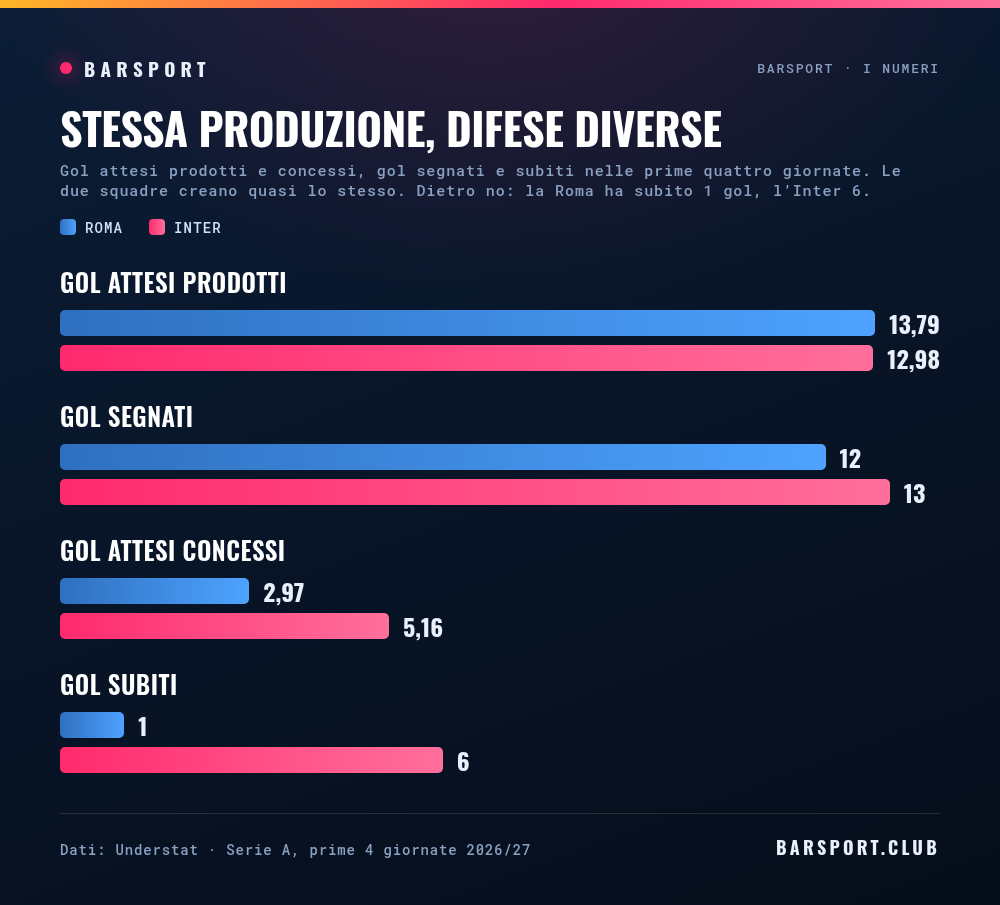
On expected goals the two teams are twins. Roma have produced 13.79 in four matches, Inter 12.98. Entries into the box are 53 and 55. They are the two highest values in the league, and they are practically identical.
At the other end of the pitch the story changes. Roma have conceded 2.97 expected goals in four matches and have conceded just one goal, with three matches closed out without conceding. Inter have conceded 5.16 expected goals and have conceded 6.
The number: 9
Nine entries into the box conceded in four matches. A little more than two per game.
An entry into the box, in our language, is the ball arriving in the last twenty metres in a central position: the moment when a team stops moving the ball around and starts to hurt you. Roma in four matchdays have allowed 9 in total. The second best figure in the league is 13, and it belongs to Inter. Genoa have conceded 49, Udinese 39.
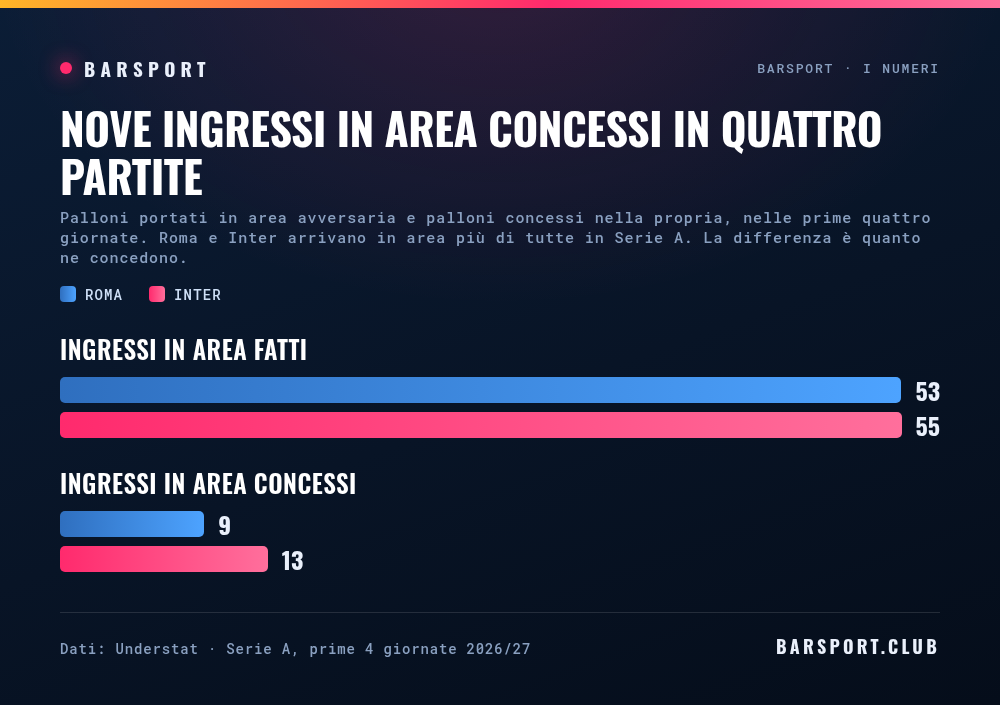
Put another way: opponents have entered Roma's box 9 times, Roma have entered theirs 53. It is a ratio of almost six to one, and it has not happened against four bottom of the table teams: in there are Fiorentina, Atalanta and Torino.
The how has been the same for four matchdays. PPDA 7.8, that is the number of passes Roma allow the opponent before going to disturb them: only Venezia and Frosinone press higher, and they do it out of desperation. The team pushes up, closes the distance forward and recovers the ball in the opponent's half. Anyone who tries to play out from the back against this Roma ends up making a mistake before reaching midfield.
Inter do the same thing at a different rhythm. PPDA 9.7, high pressing but not suffocating, and more trust in the quality of possession than in immediate recovery. Against Napoli they pressed at 6.9, against Monza at 12.0. It is a team that decides each time how high to push up.
The two defeats, which explain everything
Inter lost 1-0 at Cagliari creating 3.97 expected goals and conceding 0.32. It is the most upside-down match of the Italian season, we wrote about it at the end of August: 14 entries into the box against 2, and zero goals scored.
Roma, in reality, have not lost yet. They have 12 points from 12, and the gap with Inter in the table does not exist only because Inter stumbled in Sardinia. But Roma too have their off night, and it is last Sunday's in Turin: they won 2-0 with 2.33 expected goals, but for an entire half they stayed stuck at five entries into the box, their season low.
The expected points count puts the two teams in a slightly different light. Roma have 12 points from 11.17 expected, a gap of +0.83 which is almost noise: they are collecting what they produce. Inter have 12 points from 9.53 expected, +2.47, and inside that number there is the 5-3 against Udinese, in which they conceded three goals from 1.29 expected goals conceded.
Who scores, and how much it costs
Roma have a peculiarity that in September goes unnoticed and in November weighs heavy: almost all of their danger comes from two players.
Donyell Malen has scored 5 goals from 4.70 personal expected goals, with 16 shots. It is the cleanest return in the league, in the sense that he scores exactly what he creates, with no loans from luck. Paulo Dybala instead has not scored yet: 14 shots, 1.64 expected goals, zero goals. On the other hand he has set up 16 chances worth 3.48 expected goals in total, and they are the highest playmaker numbers in Serie A.
Inter spread it around. Lautaro Martínez has 2 goals from 2.99 expected, Marcus Thuram 2 from 2.50, Francesco Pio Esposito 2 from 2.31. Three forwards who produce a lot and cash in little, and a midfield that instead cashes in a great deal: Davide Frattesi has 3 goals from 1.75 expected, Hakan Calhanoglu has 2 from 0.09.
They are two different ways of being in credit. The Nerazzurri forwards sooner or later will score what they create, and on that day Inter will be frightening. Calhanoglu's 2 goals from nine hundredths of expected goal, on the other hand, are a loan that the league always asks back.
What to watch on Saturday
Three things, all measurable while the game is being played.
Inter's first ball into the box. If after half an hour the entries count is still stuck at one or two, it means Roma's block is doing what it has done for four matchdays, and then Inter will need a goal from outside or from a set piece.
The Giallorossi pressing on the Nerazzurri ball carrier. At 7.8 PPDA you go and take on the opponent in their own house, but Inter are the best equipped team in the league to skip past the first man: if Roma lose the ball twice in midfield, those 3.97 expected goals seen at Cagliari know very well where to go.
Dybala in the last twenty metres. Sixteen chances set up and no goals of his own: if Roma unlock it early, the match opens up and that kind of player becomes decisive. If instead it stays 0-0 after an hour, the risk is the one seen in Turin, with Roma entering the box and never finding the final pass.
The honest take
First, the data. Inter's 5-3 against Udinese has a list of shots that does not add up with the match total: we use the team numbers, the ones on individual shots from that game we do not. It should be said before, not after.
Second, the opposite reading, which is serious. One can argue that the 9 entries into the box conceded by Roma say more about the opponents than about them: Fiorentina are on 3 points, Torino on 3, and Atalanta at that moment were a team that almost never pressed. In this reading Saturday is the first real test, and a single figure is not enough to promote a defence.
Third, our opinion. Between two teams that produce the same, the one that concedes less starts ahead, and nine entries into the box in four matches is not a number that happens by chance: it is a block that shifts well and a line that pushes up all together. But Inter are the least suitable opponent to extend the run, because they are the only team in Serie A that gets into the box as much as Roma.
Saturday at 18:00, at the Olimpico. The question is not who scores: it is who gets there.
T.L.
Do you want to see how much each team truly deserves its league position? The Meritometro compares real points and expected points. For those who want models and not headlines, there is the Nerd Zone.