Bruno Guimarães came on at half time, and the Stadium of Light booed every touch he took. He had joined Arsenal from Newcastle in the summer, and in Sunderland that is not something people forgive. On 58 minutes he scored his first goal in his new shirt, from outside the box, in off the underside of the bar, and went to celebrate it in front of the people booing him.
Two minutes earlier Sunderland had had a penalty to go ahead.
The verdict, before the numbers
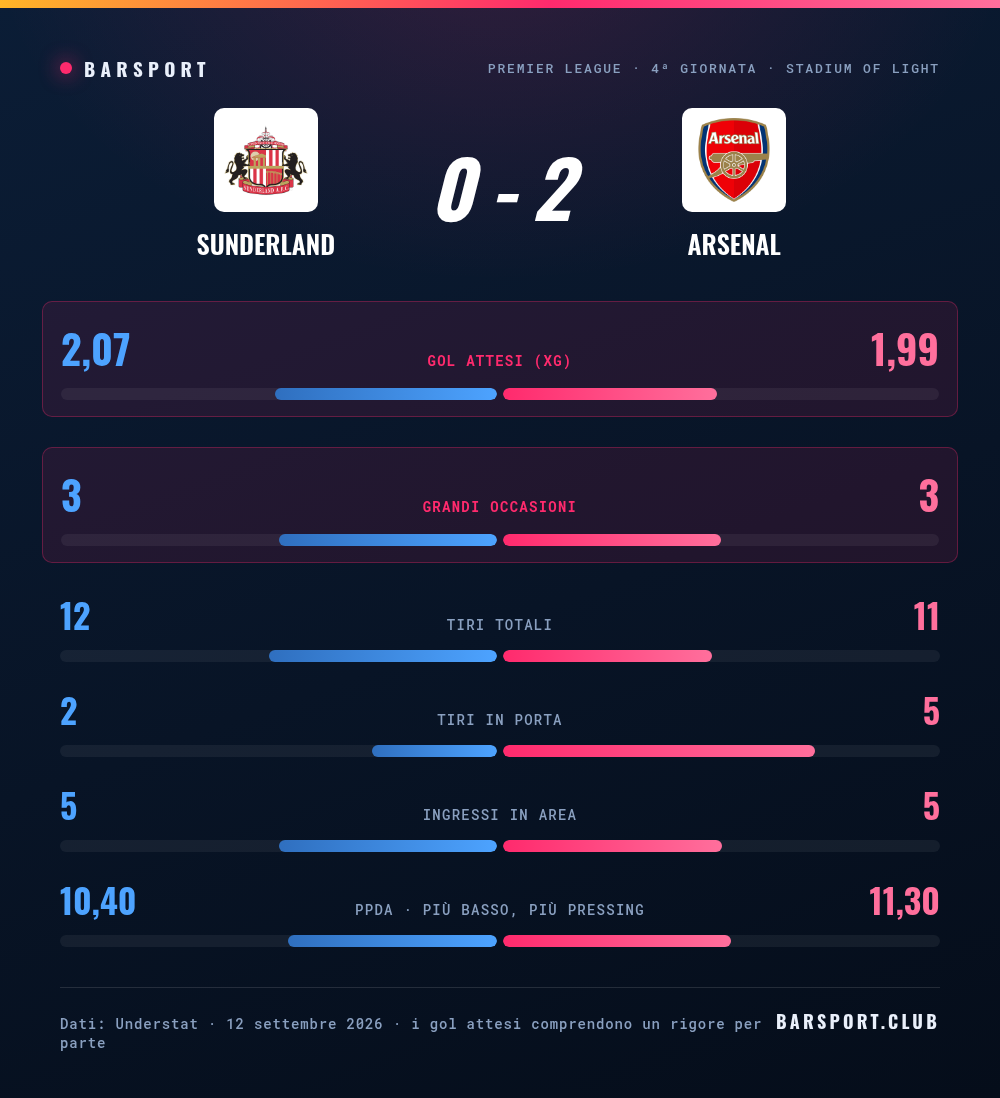
A draw would have been the fairest result. Expected goals read 2.07 against 1.99, but inside those are two penalties, one each, worth 0.76 apiece. Take them out and Sunderland are left with 1.31, Arsenal with 1.23. Expected points give 1.43 to the hosts and 1.30 to the visitors.
This was a genuinely even game, decided by a shot the model considers close to impossible and by a 97th-minute penalty. Arsenal stay on 12 points out of 12, three clear of Manchester City, who have a game in hand. But for the first time this season they won a game in which the opponent produced more.
The number: two games in one
If you only watched the first half, you watched Arsenal. 0.92 expected goals to 0.12, with the two best chances falling to Saka, released in behind by Rice and stopped by Roefs, and to Havertz, picked out by Ødegaard's cut-back after a neat move and blazing over. Sunderland shot 5 times in 45 minutes without ever being truly dangerous.
If you only watched the second half, you watched Sunderland. Penalties aside, 1.19 expected goals to 0.31. The two biggest chances of the night, penalties apart, both belonged to Nordi Mukiele, a defender: 0.49 and 0.48, one blocked by an opponent and the other saved by Raya late on.
In between came the two minutes. On 56 minutes Enzo Le Fée took the penalty and Raya pushed it onto the post. On 58 minutes Rice found Guimarães on the edge of the box: a touch and a shot into the top corner, 0.03 expected goals, a shot that goes in roughly once in 30. From there Arsenal held on, and in the 97th minute Saka finished it from the spot after a second booking for Reinildo.
How the two teams moved
Le Bris had said beforehand what he wanted: make the evening uncomfortable, be aggressive, win the second balls, break quickly. Sunderland did it in the most direct way possible. Long balls early to the centre forward, to hold it up with his back to goal, and then set pieces: Xhaka's whipped free kicks and long throws hurled into the box as if they were corners.
In the first half Arsenal answered with the ball. Saka drifting in from the right towards Tzolis, Havertz pulling wide to the left to free up the middle, Ødegaard attacking the space behind the line. The control was there, the goals were not, and Arteta said it clearly afterwards: Arsenal had really good spells without scoring, and at that point a team like this, once it decides to be physical and direct, suffocates you.
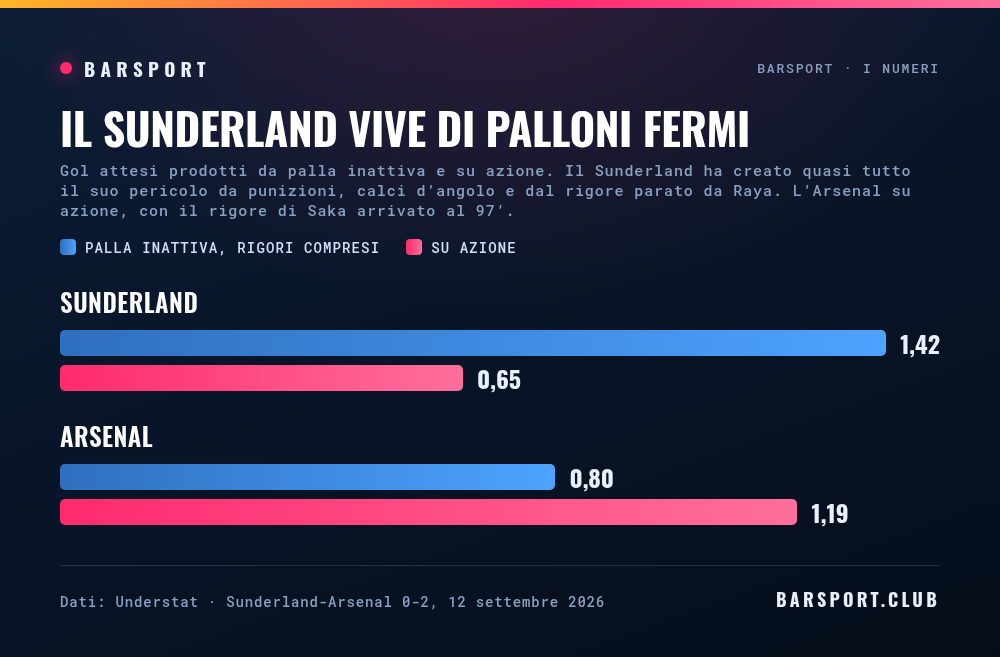
The second graphic explains the second half better than any description. Sunderland produced 1.42 expected goals from dead balls, penalty included, and just 0.65 from open play. Arsenal the reverse: 1.19 from open play, and from dead balls almost nothing but the late penalty. Both of Mukiele's big chances came from balls thrown into the box.
The penalty was the incident that dominated the post-match talk. Konsa and Ballard grapple in the box, the referee blows, VAR confirms. Arteta called the decision unacceptable at this level. Le Bris said his side had gone toe to toe with the champions.
In the second half it was above all Arsenal who changed. Arteta took off White and Lewis-Skelly for Timber and Guimarães, and a team that had kept the ball in the first half found itself defending its box against one high ball after another. Penalties aside, in the second half they shot 5 times for 0.31 expected goals in total. They stayed on their feet thanks to Raya, who besides the penalty commanded his area against the high balls and denied Mukiele the cleanest chance of the closing stages.
Our reading is simple: Arsenal won because their goalkeeper decided the game twice, and because a substitute converted the least likely shot of the night.
The season context
Arsenal are on 12 points from 9.11 expected, with 8 goals scored and 1 conceded. The luck margin is small: in the first three rounds they produced far more than Coventry, Aston Villa and Chelsea, and the points came as they should have. The win at Sunderland is the first one the numbers would not have given them.
Sunderland, on the other hand, collect less than they build. They have 4 points from 6.05 expected, and in 3 games out of 4 they have produced more expected goals than their opponent: against Fulham, at Brentford, and on Saturday against Arsenal. Their football is not pretty, but it produces, and against the champions it produced more than they did.
The honest bit
First, the penalties weigh a lot. Each is worth 0.76, and Sunderland's is disputed. Even removing both, though, the balance stays slightly in favour of the hosts: 1.31 against 1.23.
Second, 0.03 is not a verdict on Guimarães. The model measures how often an average shot from that position goes in, not how good the player striking it is. That shot, struck like that, goes in far more often than once in 30. It remains true that the game was turned by a chance nobody would have bet on becoming a goal.
Third, the reading opposite to ours, which is a serious one. You can argue Arsenal managed the game like champions: a first half under control, a goal when it was needed, and in the second half danger conceded almost entirely from high balls, where the model counts every scramble heavily but where Raya ruled the box. In that reading Sunderland's expected goals are volume more than real chances, and 2-0 tells the truth.
Our view sits in between. Sunderland found a way to trouble Arsenal, and it is a repeatable way: long balls, second balls, a crowded box. Arsenal found a way not to lose anyway, and that is a different kind of quality. But a draw would not have told the story of a different game.
On Saturday 19 Sunderland travel to Manchester City, Arsenal go to Brighton. There is only one question: how many more games like this the champions can win with their goalkeeper.
T.L.
Want to see how much each team really deserves its league position? The Meritometro compares real points with expected points. For those who want the models rather than the headlines, there is the Nerd Zone.