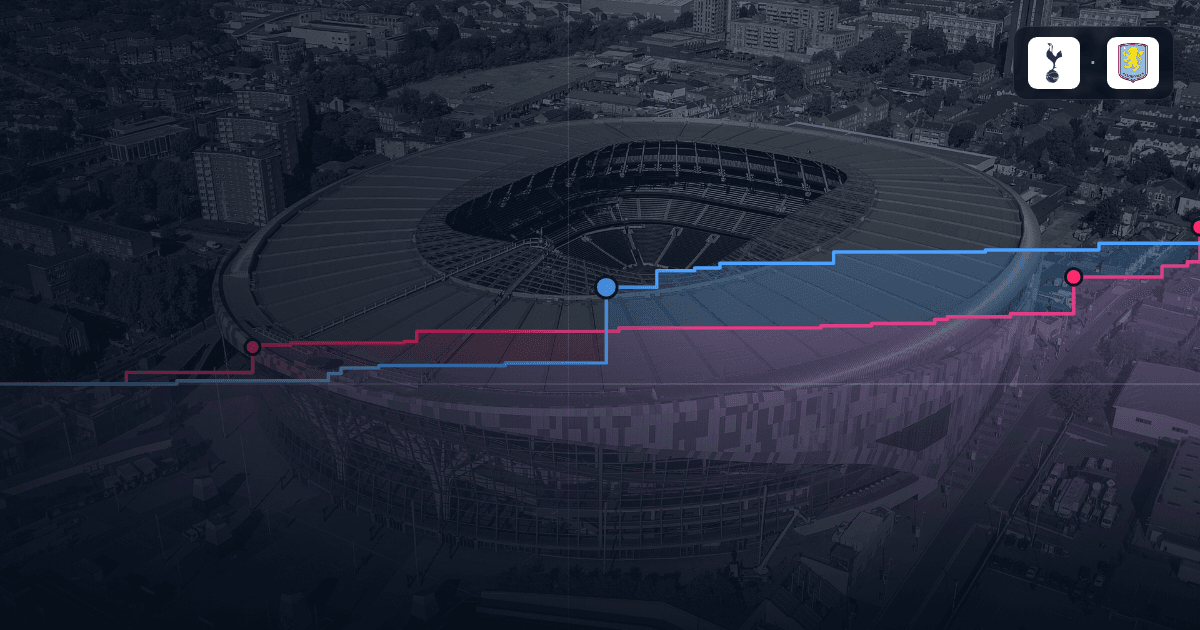
 Foto: Arne Müseler · CC BY-SA 3.0 de · Wikimedia Commons
The same expected goals, three goals of difference
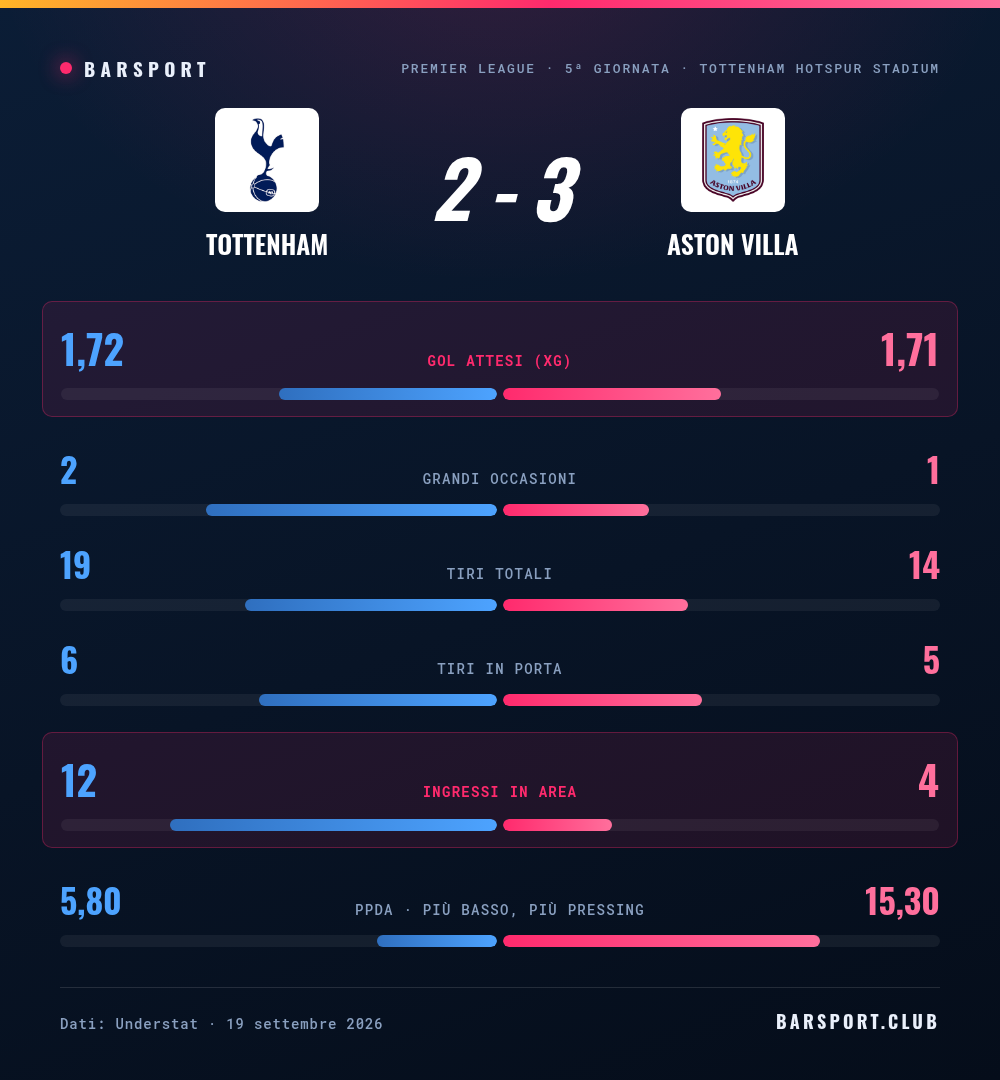
There are matches that seem made on purpose to explain what expected goals are for, and this is one of them. Tottenham and Aston Villa produced the exact same amount of danger, 1.72 against 1.71, and walked off the pitch with a 2-3 that tells a completely different story.
In between there is Villa going 3-0 up in half an hour of the second half and Tottenham scoring twice in the final quarter of an hour, the second deep in stoppage time, without having time to find a third.
The verdict, before the numbers
Expected points say 1.36 for Tottenham and 1.37 for Villa: the most exact draw you can measure. Shots are 19 against 14, box entries 12 against 4.
Tottenham had the pitch, the possession and the pressing. Villa had the good chances, and above all put away the ones that were not good.
The number: 0.84
Zero point eighty-four is what Aston Villa's three goals are worth, added together.
The first is the only real chance of their match: a left-footed shot from inside the box early in the second half, 0.703, the kind of ball that ends up in the net seven times out of ten. The second is a right-footed shot worth 0.116 from a rebound. The third, the one that made it 3-0, is a shot worth 0.020: two times out of a hundred.
Tottenham, on the same afternoon, built 1.72 expected goals with nineteen shots. That is an average of 0.09 per shot, which explains the match better than any narrative: Spurs kept arriving in the box, twelve times, and every time they finished the move from a difficult position or with the defence already set.
Their two goals, not by chance, come from the two best balls of the whole day: a right-footed shot worth 0.378 and a header from a set piece worth 0.357, the last one deep in stoppage time.
The pressing that did not produce the right effect
The most surprising figure is Tottenham's PPDA: 5.8. It is the most aggressive value of the entire Premier League matchday, and in general a number you rarely see. It means Spurs allowed Villa fewer than six passes before going to press them.
Villa responded with 15.3, meaning they barely pressed at all. They sat back, left the ball to their opponents and waited until they could win it back to break away.
All three goals tell the same story: two come from transitions with the home team stretched and unbalanced, the third from a loose ball in the opposition's attacking third. When you press at 5.8 and do not win the ball back, your defence is in the middle of the pitch, and at that point all it takes is one through ball.
It is the flip side of very high pressing, and it does not mean it is a mistake: Tottenham forced Villa to produce very little and pinned them in their own half for an hour. It means that the price of that choice, on the rare occasions it is bypassed, is a clean chance for the opponent.
What this match really says
That two teams can create the same amount of danger and come away with a 2-3 is normal, it is not a statistical scandal: over ninety minutes the noise is large, and the difference between two and three goals sits within the error of any model.
What is not noise is the way each of the two arrived at its number. Tottenham arrived there by accumulation, Villa with a single big chance and plenty of attempts from distance. Over the long run the first method is more reliable than the second, and indeed expected points put the two teams a hundredth apart.
Villa, though, have a characteristic that is becoming a signature. They scored three goals from 0.84 of shots here, and it is not the first case this season of them turning little into a lot. When it happens once it is a night; when it happens several times, before calling it luck it is worth asking whether it is the kind of chance that team goes looking for.
The first two goals of the season
There is a detail that makes the defeat heavier than the table suggests. Those two goals in the final quarter of an hour are Tottenham's first two goals of the season.
In the previous four matchdays: 0-3 at Brentford, 0-2 at home to Newcastle, 0-0 at Nottingham, 0-0 at home to Everton. Four matches, zero goals, and in three of those four Spurs had produced more expected goals than their opponent.
The balance after five matchdays is 2 points from 5.45 expected, with 2 goals scored from 5.82 expected goals. It is the biggest negative gap in the Premier League, and it has nothing to do with the play: 36 box entries in five matches is a figure for a team in the upper half of the table, not for one second from bottom.
The day Tottenham start scoring what they create, their table will change on its own. The problem is that day, on Saturday, had finally arrived, and Aston Villa in the meantime had scored three.
The honest point
First, the data. The sum of the shots matches the match totals for both teams, so there are no holes here. We keep the minutes loose: our source on shots does not precisely separate stoppage time, and we would rather write "deep in stoppage time" than be wrong by a minute.
Second, the opposite reading, which has arguments. You can say Villa played the right match: if you accept not having the ball and set up your counterattacks, three goals away from home are not an accident, they are the plan working. And you can add that Spurs, with twelve box entries and no chance above 0.38 until the eightieth minute, have a serious problem with the final pass.
Third, what we think. This is a match Tottenham will rarely lose again, and one Villa will rarely win again. For Spurs the work to be done is not the pressing, which works, but what happens after winning the ball back: twelve balls into the box and only one shot above 0.26 in the first eighty minutes are the definition of sterility.
T.L.
Do you want to see how much each team really deserves its league position? The Meritometro compares real points and expected points. For those who want models and not headlines, there is the Nerd Zone.