 Foto: TaraO · CC BY 2.5 · Wikimedia Commons
Troyes-Strasbourg 2-6: six goals from 3.52 expected, the biggest single-match gap in Europe
The verdict, before the numbers
At the Stade de l'Aube, Troyes lost 2-6 to Strasbourg, and for an hour it was not this match.
Antoine Mille had put Troyes ahead on 9 minutes. Then Jacobo Ortega on 40, Diogo Sousa on 42, Giovanni Reyna on 57. At 3-1, with half an hour to play, Troyes were still shooting. Then the collapse: Samuel Amo-Ameyaw on 85 and 88, Conrad Harder on 90+2. Jeremy Le Douaron made it 2-6 on 90+5.
Amo-Ameyaw had come off the bench.
The number: +2.48
Strasbourg scored six goals from 3.52 expected goals. The difference is +2.48.
We checked every match played so far in the big five leagues, team by team. It is the biggest gap of the lot. Second is Inter, four goals from 1.54 expected against Monza; third Werder Bremen.
How it happened matters more than the figure. There is not much to say about the first three goals: 0.53 for Ortega's equaliser, and Reyna's 3-1 comes off a shot deflected by Adrien Monfray. Those are normal goals.
The finish is not. The three goals in the last six minutes are worth, together, 0.44 expected goals. Amo-Ameyaw's two are worth 0.09 and 0.10 — from positions like that you score roughly once in ten. Harder's is worth 0.24.
Three times in six minutes, from three situations that on average produce less than half a goal in total.
How the two sides moved
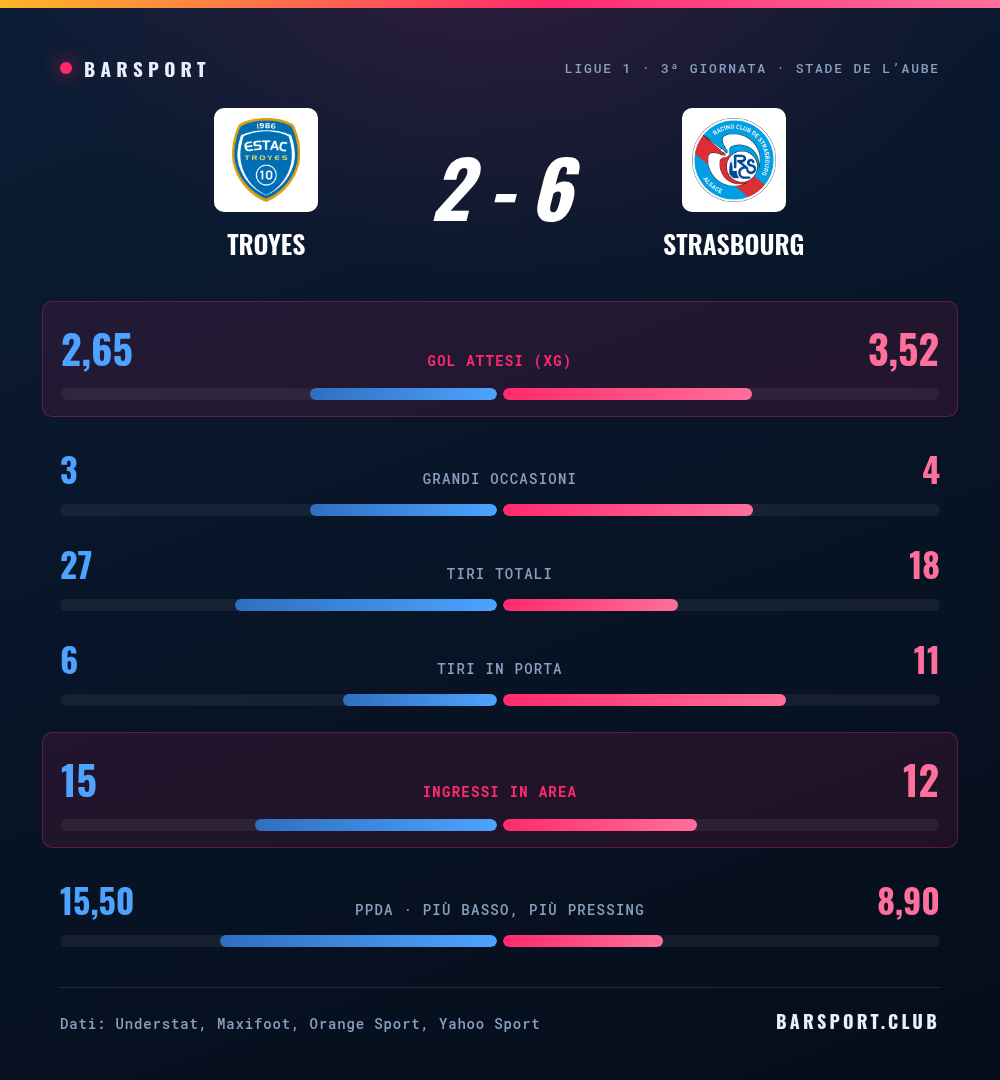
The first number is the one nobody expects after reading the scoreline: Troyes entered the box more often than Strasbourg. Fifteen entries to twelve. Twenty-seven shots to eighteen. They produced 2.65 expected goals to 3.52 — less, but not much less.
Orange Sport's report describes the same picture: Troyes ran the opening phase, Mille's ninth-minute goal came from a collective build-up, Monfray and Picard created further chances and goalkeeper Jorgensen kept Strasbourg upright. Our numbers agree: Monfray's 18th-minute effort, from a set piece, is worth 0.51 and is Troyes' second-biggest chance of the match.
The point is what Strasbourg do with the ball once they win it back.
Hugo Oliveira arrived in Alsace in the summer, Strasbourg's third head coach in nine months. He comes from Famalicão. The fullest analysis of his game model — the Football Coaches Lyceum's — puts three principles at the centre: aggressive counterpressing in the three-to-six-second window after losing the ball; "lateral traps to force play toward the wings, where pressure can be isolated"; and in attacking transition the instruction to identify the weak side immediately and progress vertically through minimal passes, using "the first five seconds" after the recovery.
On Saturday that third principle showed up three times in six minutes. The first two, less so.
Because this is where the sources contradict each other, and the contradiction is the interesting part.
The Strasbourg Europe knew was a pressing side. London Is Blue's analysis of Liam Rosenior's work — the coach who took the club into the Conference League before joining Chelsea in January — reports a PPDA of 11.8, ninth in Ligue 1, with an average pressing start distance of 44.3 metres from the opposition goal: as a Premier League side, that would have put them second behind only Manchester City. Eight high turnovers a game. Fourth-best expected goals conceded in Ligue 1.
Total Football Analysis, in a piece on that same Strasbourg's build-up, fills in the rest: goalkeeper receiving from the centre-back, foot on the ball, waiting for the opposition forward until physical contact and only then releasing the pass, to free the defender who has just played it. Deliberate provocation, De Zerbi style.
None of this resembles the Strasbourg of now. Their season PPDA is 17.26: thirteenth of eighteen in Ligue 1. Box entries conceded in three matchdays: thirty-two, against twenty-four made. The side that conceded fewer than almost everyone now concedes more than almost everyone.
Oliveira's model, on paper, calls for counterpressing and a mid-to-high block. Three matchdays of numbers say low block and late pressure. The two do not add up, and there is no point pretending they do. The simplest reading — and it is our reading, not a datum — is that three games are far too few for a new coach to have put his model on the pitch, and that in the meantime Strasbourg are winning with what they have: quick young players in transition, and a finishing rate that cannot repeat.
Saturday's finish says exactly that. Amo-Ameyaw came off the bench; Harder is a forward still being shaped. Orange's report puts it in almost the same words as ours: after the break the visitors switched "from passive defending to clinical finishing", and the substitutes struck at "a Troyes defensive structure by then hollowed out".
Troyes, on the other side, did not play badly. They are the promoted side that won Ligue 2 under Stéphane Dumont, voted the second division's best coach in May. In three matchdays they have twenty-six box entries made and twenty-four conceded: they are in credit, and only eight of eighteen Ligue 1 teams are. They have four points from 3.17 expected.
What they lacked on Saturday was the finish. Twenty-seven shots for 2.65 expected goals is 0.098 per shot: less than a tenth of a goal per attempt. Strasbourg, with nine fewer attempts in our table, reached 0.19 per shot. Double.
Eleven of Troyes' twenty-seven shots were blocked by a defender. Eight came from corners, and all eight together are worth 0.27.
The season context
Strasbourg have six points from 2.73 expected: +3.28, the third-biggest gap in Ligue 1 behind Monaco and Lille. Eight real goals from 5.57 expected. Seven conceded from 7.95 expected.
That second figure matters as much as the first. This is not a team that defends: it is a team that scores more than it creates and concedes roughly what it deserves. On matchday one they lost 4-0 at Marseille with 0.19 expected goals, the third-lowest figure recorded so far in the big five leagues.
Troyes have four points, and are the best-placed promoted side in Ligue 1.
The honest bit
There is a hole in our data, and we are saying so up front. Our shot table contains five Strasbourg goals; Strasbourg scored six. Diogo Sousa's 2-1 on 42 minutes is missing. Our source lists two saved shots of his, on 40 and 41 minutes, the second from a rebound, but neither is recorded as a goal.
The match total — the 3.52 this article is built on — comes from a different field in the same archive and is not affected: the sum of individual shots stops at 3.31, that is 0.21 short. That sits inside the tolerance of our automatic check, which compares the two figures and drops the match if the gap exceeds 0.4. The check compares sums; it does not count goals. It is the same flaw we found a week ago on Gladbach-Elversberg. We know it well now.
Consequently: the shot counts in the graphic above are one low for Strasbourg, and we are not publishing the expected-goal value of the 2-1 because we do not have it.
We verified the goal sequence against three sources — Maxifoot, Orange Sport and the agency report carried by Yahoo Sport — and they agree on all eight scorers and all the minutes.
Three matchdays are not a season. Saturday's +2.48 is a real number and a real record, but it is the record of a single match, and single-match records get broken every week. What interests us is not that: it is whether Strasbourg's PPDA comes down. If Oliveira's model is what his analyses describe, it has to. If it has not come down by October, it means the coach has changed his mind, or the squad is the wrong one for the idea.
We keep the running tally of results against performances in the Meritometro. Anyone who wants the raw numbers, without the story around them, will find them in the Nerd Zone.