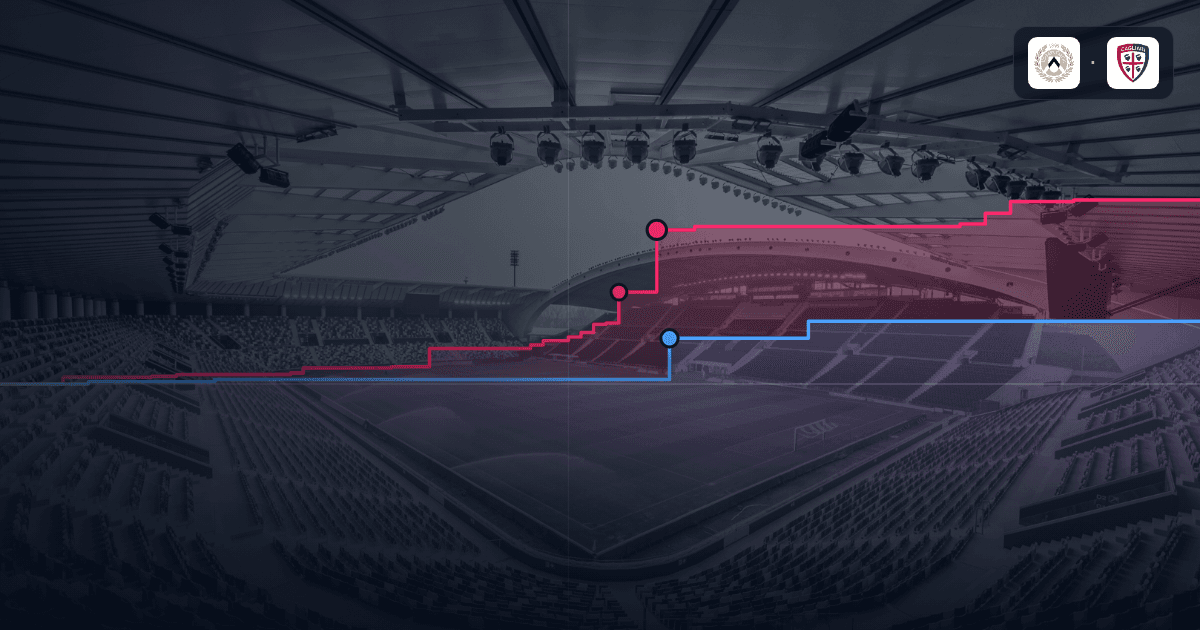
 Foto: Matteo.favi · CC BY-SA 4.0 · Wikimedia Commons
One entry into the box, one goal, three points
Seven days ago, closing the piece on Cagliari's win in Bergamo, we left a question open: how long does a team that gets into the box three times a match hold up.
The answer arrived on Saturday at lunchtime, and it is more extreme than the question. In Udine, Cagliari got into the box once. Once. They scored and they won.
The verdict, before the numbers
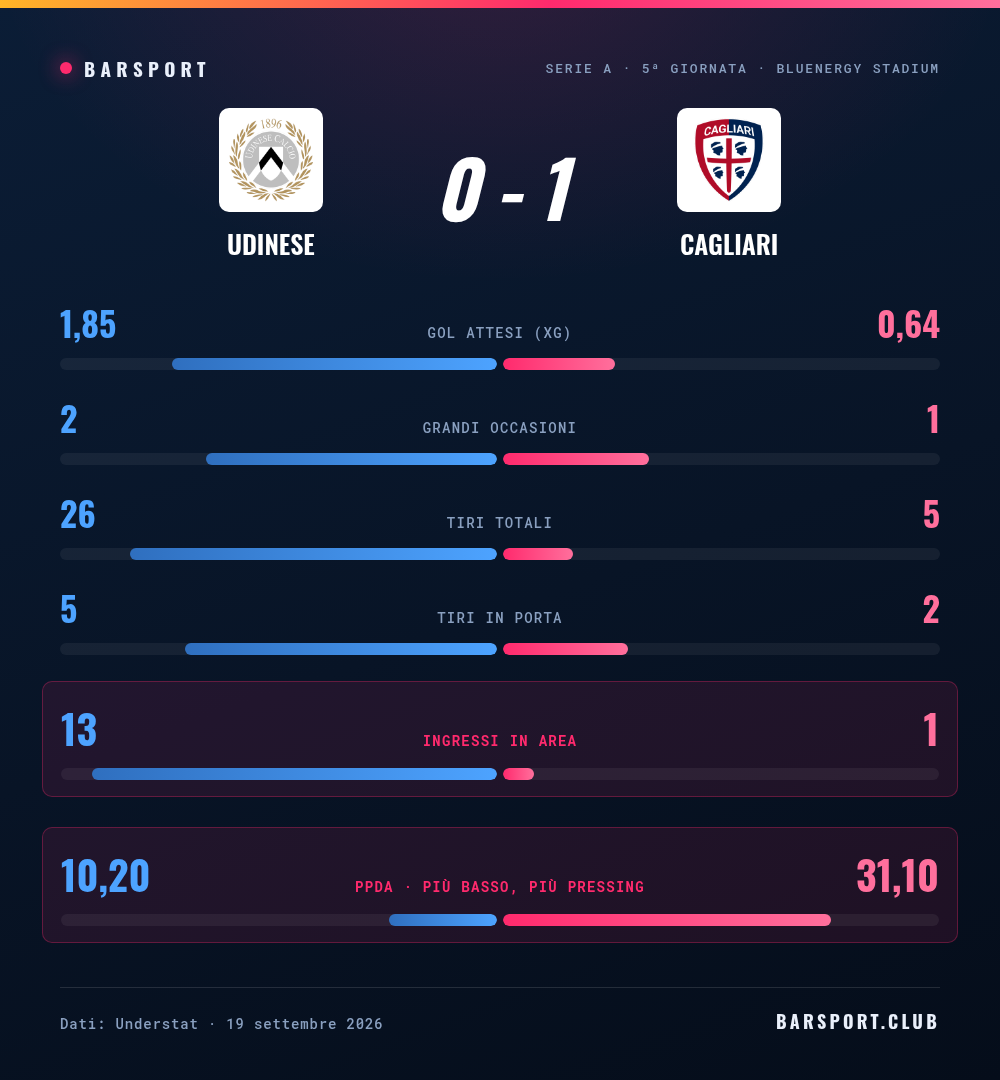
Expected goals say 1.85 for Udinese and 0.64 for Cagliari, expected points 2.31 against 0.48. Shots are 26 against 5, entries into the box 13 against 1.
It is the most upside-down match of the fifth Italian matchday, and the second most improbable result of the European weekend for how far the two sets of data drift apart.
The number: 31.1
Thirty-one point one is Cagliari's PPDA, meaning the number of passes they let Udinese play before going to disturb them.
To give a sense of scale: the league average sits around 13, Roma press at 8, and above 20 you are already in the territory of teams that wait. Thirty-one means that Cagliari, in practice, never left their own half to go and get the ball. They gave Udinese possession, the pitch and the boredom of having to do something with it.
It is a choice, not a surrender, and the proof is the kind of chances Udinese built. Twenty-six shots for 1.85 expected goals works out at 0.07 per shot, meaning one shot in fourteen. The two times the block opened up came either side of the hour mark: a right-footed effort worth 0.316 and above all a shot from a corner worth 0.555, the most dangerous of the match, saved.
Then, four minutes after that save, Cagliari went into the box once and scored: a left-footed shot from inside the area, 0.422, the only real shot of their ninety minutes.
The plan, and why it is not luck
It is worth looking at how Cagliari gets these results, because the word that will be used everywhere is "luck" and it is not precise.
The team defends with two narrow lines inside their own third of the pitch, gives away no depth behind and accepts being shot at from outside the box. All the danger the opponent produces comes from repetition: lots of low-quality shots, a few corners, the occasional scramble. When the match gets messy inside the box, Cagliari always has a man extra in there, because they have not sent anyone forward.
On the other side, the only constructed way out is vertical and immediate. In Bergamo it had been the ball behind the defensive line, in Udine it was a clean transition finished by the shot of the only player who had got into the box.
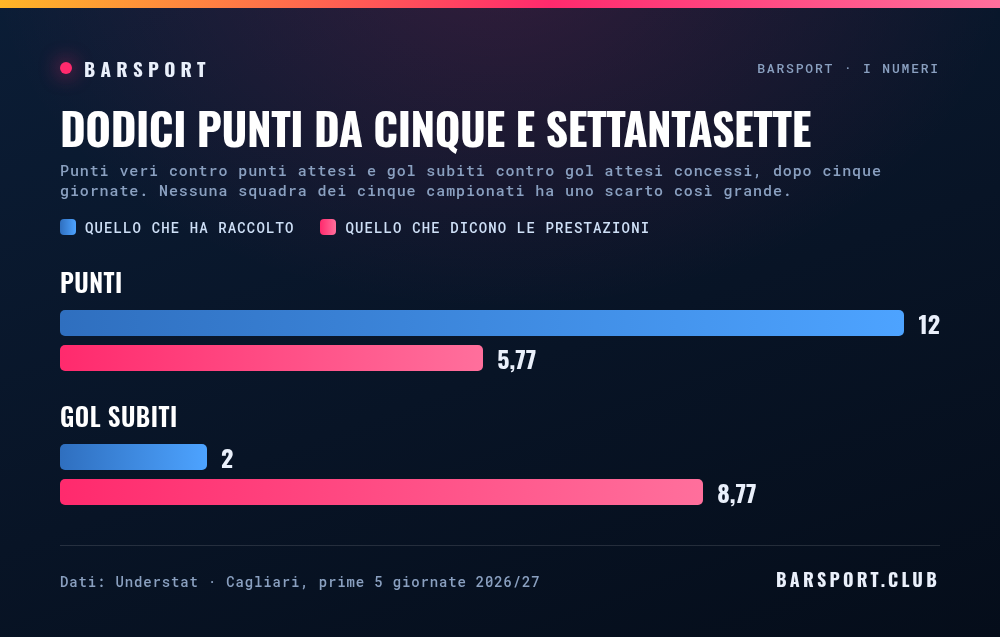
The seasonal tally of this way of standing on the pitch is impressive and unsustainable at the same time: in five matches Cagliari has made 13 entries into the box and conceded 51. They have scored 5 goals from 5.45 expected, so in attack they are perfectly on par. They have conceded 2 goals from 8.77 of chances given up, and the anomaly is all there.
Twelve points from 5.77
The gap between Cagliari's real points and expected points is +6.23. There is nothing like it in the five major leagues right now, and there was nothing like it at this point of the calendar last season either.
Two readings, both true. The first: six points more than the numbers would give them are, over the long run, a loan. Defences that concede 10 entries into the box per match end up conceding goals, and when they start conceding them the table drops fast.
The second, which is the one fans are right to claim: in the meantime the points are in the bank, and nobody takes them away. A team can perfectly well decide that this is its season, defend the box and win 1-0. It becomes a problem when you need to come from behind, because with one entry into the box per match you do not come back from anything.
Udinese, on the other side, leave Saturday with 4 points from 4.98 expected. Their problem is not their aim, it is the quality of what they build: 38 entries into the box in five matchdays and 7.08 expected goals, meaning plenty of balls carried inside and very few turned into real chances.
The honest point
First, the data is clean: the sum of the shots matches the match totals for both teams, and the goal is there.
Second, the opposite reading. Those who defend Cagliari say that xG does not measure the value of a defence that forces the opponent to shoot from outside: if Udinese reaches 26 shots but the best one is worth 0.55, maybe the credit belongs to the Sardinian block and not to chance. It is a serious argument, and the way to test it is to wait: if after ten matchdays Cagliari is still conceding 1.75 expected goals per match and conceding half a goal, then the excuse of chance no longer holds.
Third, what we think. Cagliari's plan is good and well coached, and the way they arrive at the few chances they build is not random. What is random is the rest: two goals conceded from almost nine of chances given up. The question from seven days ago remains open, but now it has a more precise number attached: how long does a team hold up that gets into the box two and a half times a match and concedes ten.
After the break, on 11 October, Cagliari host Juventus, who so far have conceded fewer expected goals than anyone in Italy.
T.L.
Do you want to see how much each team really deserves its league position? The Meritometro compares real points and expected points. For those who want models and not headlines, there is the Nerd Zone.