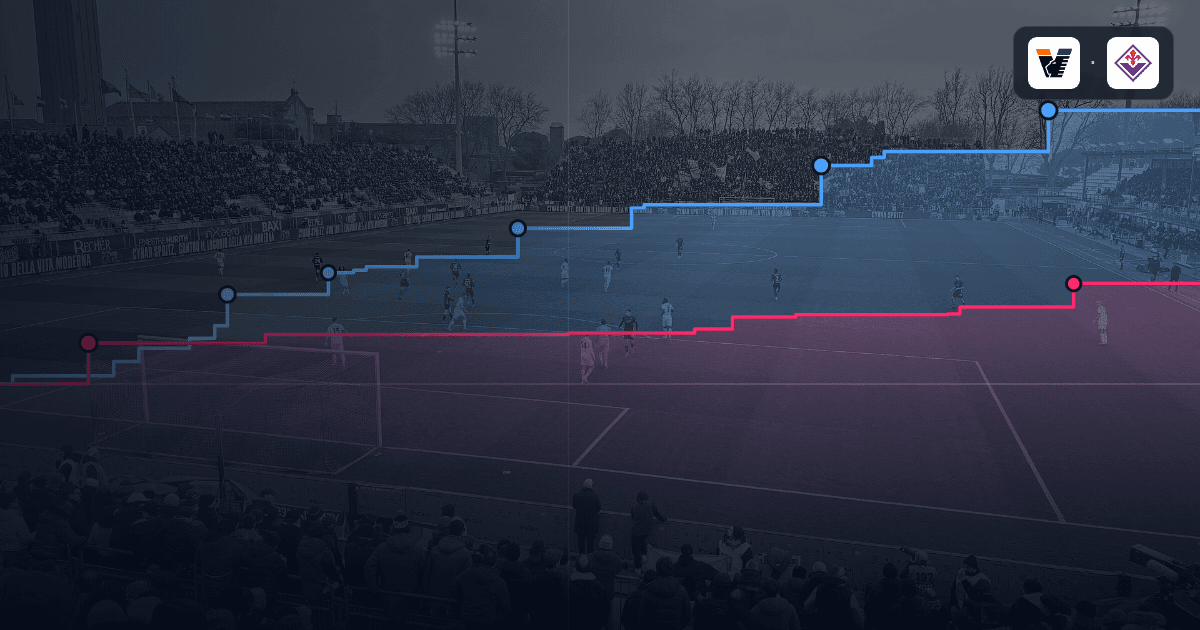
On Friday night at the Penzo two teams turned up with exactly the same record: 3 games, 3 defeats, 0 points. Fiorentina arrived having scored 1 goal in 270 minutes and having sacked Fabio Grosso, with Paolo Vanoli recalled to the bench and a thousand purple shirts making the trip to the lagoon to see how it would go. Venezia arrived bottom of the table, on a night that at Sant'Elena already felt like a relegation six-pointer played in September.
Ninety minutes later one of the two had 3 points and 4 goals. The other is still on zero, the only Serie A side there alongside Genoa.
The verdict, before the numbers
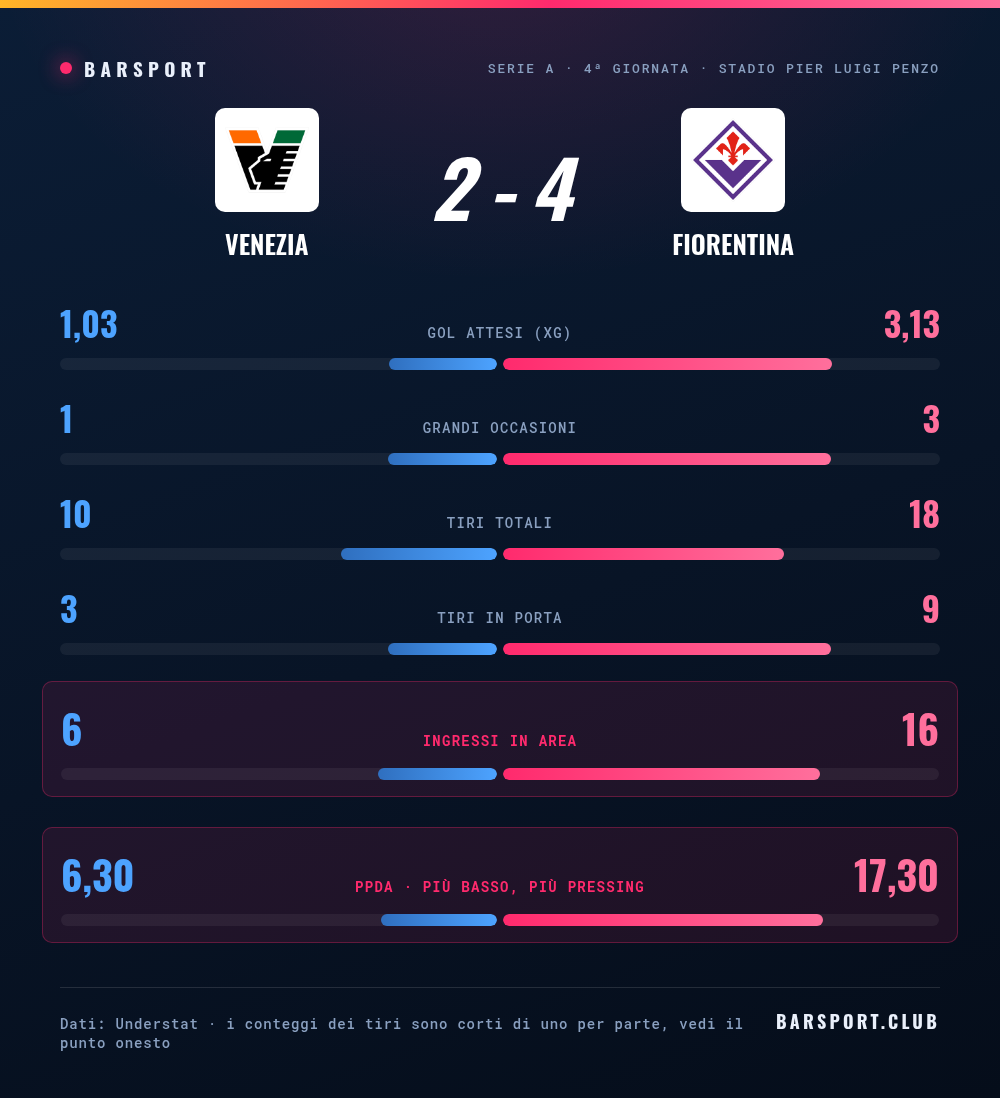
Fiorentina won a game they deserved to win, and it is worth saying straight away, because the rest of this piece will complicate that sentence. 3.13 expected goals against 1.03. 16 box entries against 6. 19 shots against 11, half of Fiorentina's coming before half time. This is not a 2-4 stolen on the break from a side that was pushing, it is a game in which one team consistently had more of the pitch than the other.
The question is how they turned that pitch into goals. Because inside it there is one night that will not repeat itself, and a mechanism that very much can.
The number of the match: 0.061
On 22 minutes Venezia were in front. Busio opened up for Akor Adams, who finished into the far corner. It is worth 0.09 expected goals, a shot that on average goes in less than once in ten. It was also the first shot on target of the match.
Then came the sixty seconds. On 29 minutes Franco Mastantuono equalised with a low left foot from outside the box. On 30 minutes he did exactly the same thing again. The two shots together are worth 0.061 expected goals: 0.025 the first, 0.036 the second. Translated: the model reckons the first goes in roughly once every 40 attempts, the second roughly once every 28. Both left his boot a minute apart, from the same patch of grass, a little over 20 metres from Stankovic's goal.
For scale: in those sixty seconds Fiorentina produced less statistical danger than John Yeboah had produced on his own on 7 minutes, with a 0.42 header from a set piece that went wide. That was Venezia's biggest chance of the night. It stayed their only one.
The third Fiorentina goal, by contrast, is worth what it looks like. On 66 minutes Fagioli released Mateo Pellegrino, on the pitch for three minutes in place of Beto, and the Argentine went away on the counter: 0.40 expected goals, a real chance, the only one of the four built and finished by the book. On 84 minutes Mastantuono completed his hat-trick from a ball that bounced back to him on the edge, and on 86 minutes Hainaut made it 2-4 from a Haps cross, long after the game was decided.
How the two teams moved
Vanoli turned up with a 4-2-3-1 Fiorentina had never used, pushing Arthur Atta up behind the striker. Ndour and Fagioli sat in front of the back four, Beto led the line, Njie went at people on the left looking for the byline, and Mastantuono had licence to come inside from the right. Fagioli touched the ball 78 times, more than anyone else on the pitch, and played the deep-lying role that last season, under the same coach, had been the bet that paid off.
The number that explains everything else, though, is a different one: PPDA, how many passes a team lets the opposition make before going to disturb them. Fiorentina 17.3, Venezia 6.3. Fiorentina, in other words, chose barely to press at all. They gave Venezia the ball, got compact, and waited. Across the first three rounds they had alternated: 19.1 at Roma, 4.4 against Frosinone, 15.1 against Torino. On Friday they chose the most patient version, and for the first time this season it hurt somebody.
Stroppa's Venezia did the opposite, as they always do: 5.5 PPDA on the opening day, 4.6 at Frosinone, 6.3 on Friday. A 3-5-2 that sends the two central midfielders onto the man in possession and pushes the wing backs, Hainaut and Sagrado, up to shut off the flanks. It works as long as the first press bites. When it is beaten, what is left behind is exactly the kind of space that was on show all evening: an unguarded edge of the box and the midfielders still running back from the other half.
That space is Mastantuono's goal. The movement is always the same, and repeated inside a minute it becomes almost a demonstration: Jiménez overlaps outside and pins the Venezia wing back, the Argentine tucks inside onto his left, and finds twenty free metres in front of him where a 3-5-2 with its midfielders pressing has nobody. In the first three rounds the same movement had never produced a clean shot. On Friday it produced two in sixty seconds.
The same applies in reverse to Venezia's goal: it comes from a transition with the Fiorentina back line out of position, which is the flaw they have carried since the opening day. It happened only once at a moment when it could hurt, and that is the difference from the previous three games.
The season context
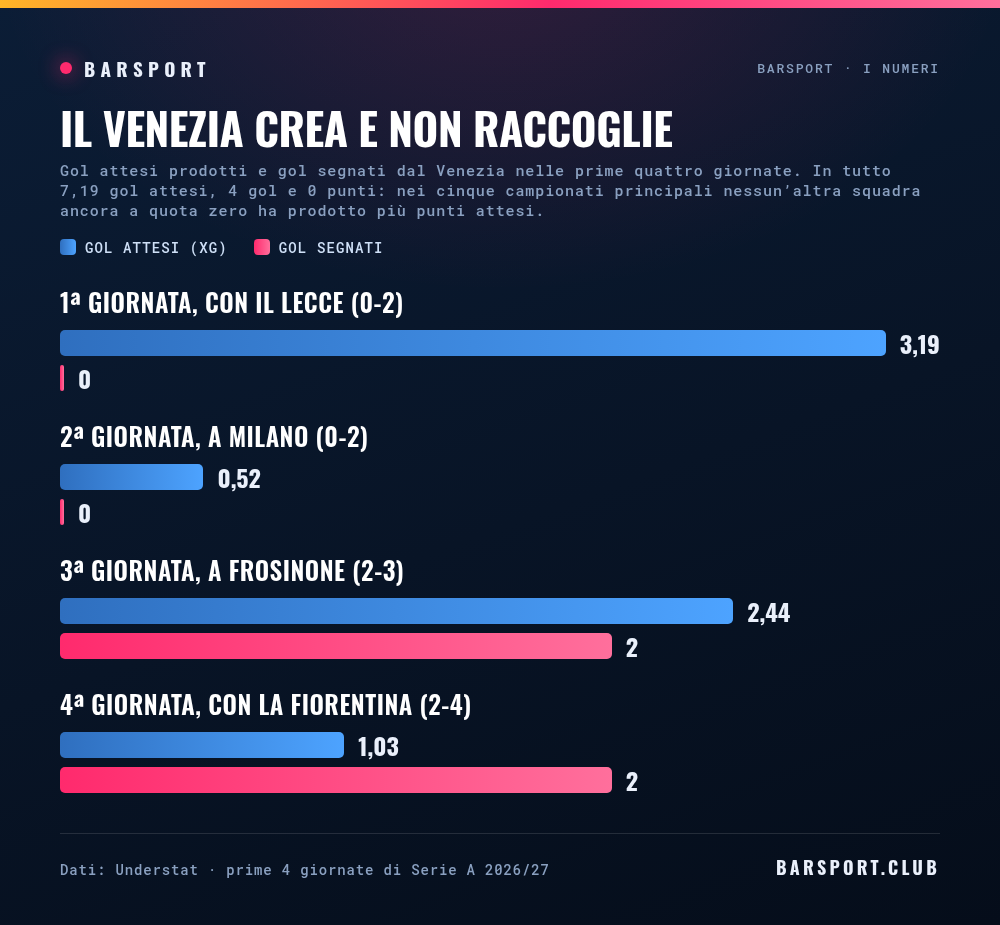
The bill Venezia are paying can, for once, be quantified precisely. In 4 rounds they have produced 4.09 expected points and collected 0. In the big five leagues no other side still stuck on zero comes close: Coventry are on 3.35, Fulham on 3.24, Genoa on 1.79. On the opening day Venezia built 3.19 expected goals against Lecce, the second highest figure of the entire Serie A round behind Roma alone, and lost 0-2.
It would be comfortable to stop there and call it bad luck. The numbers say something else too: 10.59 expected goals conceded in 4 games, 34 box entries conceded against the 18 they have made. Venezia are not a team that creates a lot and gets punished by incidents, they are a team that concedes a lot and has so far been paid nothing back by its own attack. 7.19 expected goals produced, 4 goals scored.
On the other side, Fiorentina remain a building site. Their box entries round by round read 3, 15, 3 and 16: two games in which they barely touched the opposition box and two in which they laid siege to it. With 5.73 expected points and 3 real ones they are still in credit, but almost all of that credit is Friday night.
The honest bit
First of all a hole in our data, and it needs saying openly. Our shot list does not contain Mastantuono's third goal. The provider records only one shot per player per minute, and on 84 minutes it kept the save and dropped the goal. As a result the counts in the first graphic are one shot short on each side, 10 and 18 where the official statistics say 11 and 19, and we are not publishing an expected-goals value for that goal because we do not have one. The match totals, 1.03 and 3.13, come from a different field and are reliable.
Second: 0.061 does not mean Mastantuono simply got lucky. The model estimates the average probability of that shot from that position, not the probability of that shot at that player's feet. A clean left foot from just outside the box is worth a great deal more to someone who can strike it, and the Argentine struck it beautifully twice. What the number says is something more cautious: if Fiorentina stage exactly the same game against Napoli, the most likely outcome is not 4 goals.
Third, the reading opposite to ours, which is defensible. You can argue the 4-2 is not a statistical accident but proof that Vanoli changed something real: 19 shots and 10 on target is a lot, 10 attempts by half time is an enormous amount for a team that had scored once in the previous 270 minutes. If you create 3.13 expected goals you are not winning by chance, you are winning with margin. In that reading the two shots from distance are the decoration, not the cause.
Our view sits in between. The volume is real and it is new, and it comes from a specific tactical choice, giving up the ball and waiting, which against a side that presses high worked immediately. The conversion, on the other hand, cannot be repeated, and no model supports it. The two things coexist: Fiorentina deserved to win, and won by far more than they deserved.
The calendar now says everything. On Saturday 19 Venezia host Lazio, on Sunday 20 Fiorentina host Napoli at the Franchi. The question for the next round is a blunt one: how much of Friday night was Vanoli, and how much was a twenty-year-old's left foot on a good evening.
T.L.
Want to see how much each team really deserves its league position? The Meritometro compares real points with expected points. For those who want the models rather than the headlines, there is the Nerd Zone.