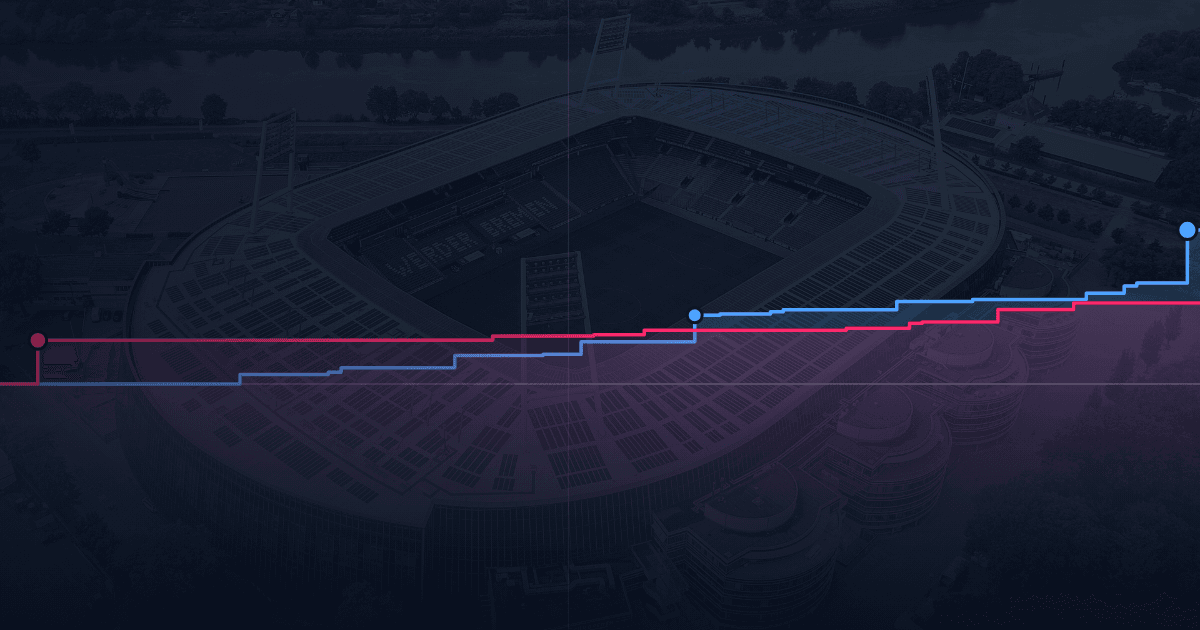
 Foto: Arne Müseler · CC BY-SA 4.0 · Wikimedia Commons
Werder-Leipzig 3-1: Leipzig's one goal was worth more than Werder's three combined
The verdict, before the numbers
At the Weserstadion, Werder Bremen beat RB Leipzig 3-1 on Bundesliga matchday two.
Dinkçi scored on four minutes, Füllkrug on 68 with a header from a corner, Grüll on 80 with a volley. Baku pulled one back on 95. In between, a penalty awarded to Leipzig and then taken away by VAR: goalkeeper Hein had touched the ball before Nkunku.
Werder arrived off a 4-1 defeat at Freiburg. Leipzig off a 3-0 win over Mönchengladbach. On paper there was no contest. On the pitch, by the data, there wasn't one either: Leipzig ran the game.
One goal against three
Take the four goals of the match and look at what each one was worth.
Dinkçi, 4 minutes: 0.449. A ball won very high up, Chuki slips him through, a finish from close range. It is the only goal of the afternoon that came from an actual scoring chance.
Füllkrug, 68 minutes: 0.020. A header from a corner. Two hundredths, because it came from distance: twice in a hundred, a header from there finds the net.
Grüll, 80 minutes: 0.054. A bouncing ball, controlled and volleyed into the bottom corner. Five hundredths.
Baku, 95 minutes: 0.544. The only big chance Leipzig built in ninety minutes, from a Maksimović cross.
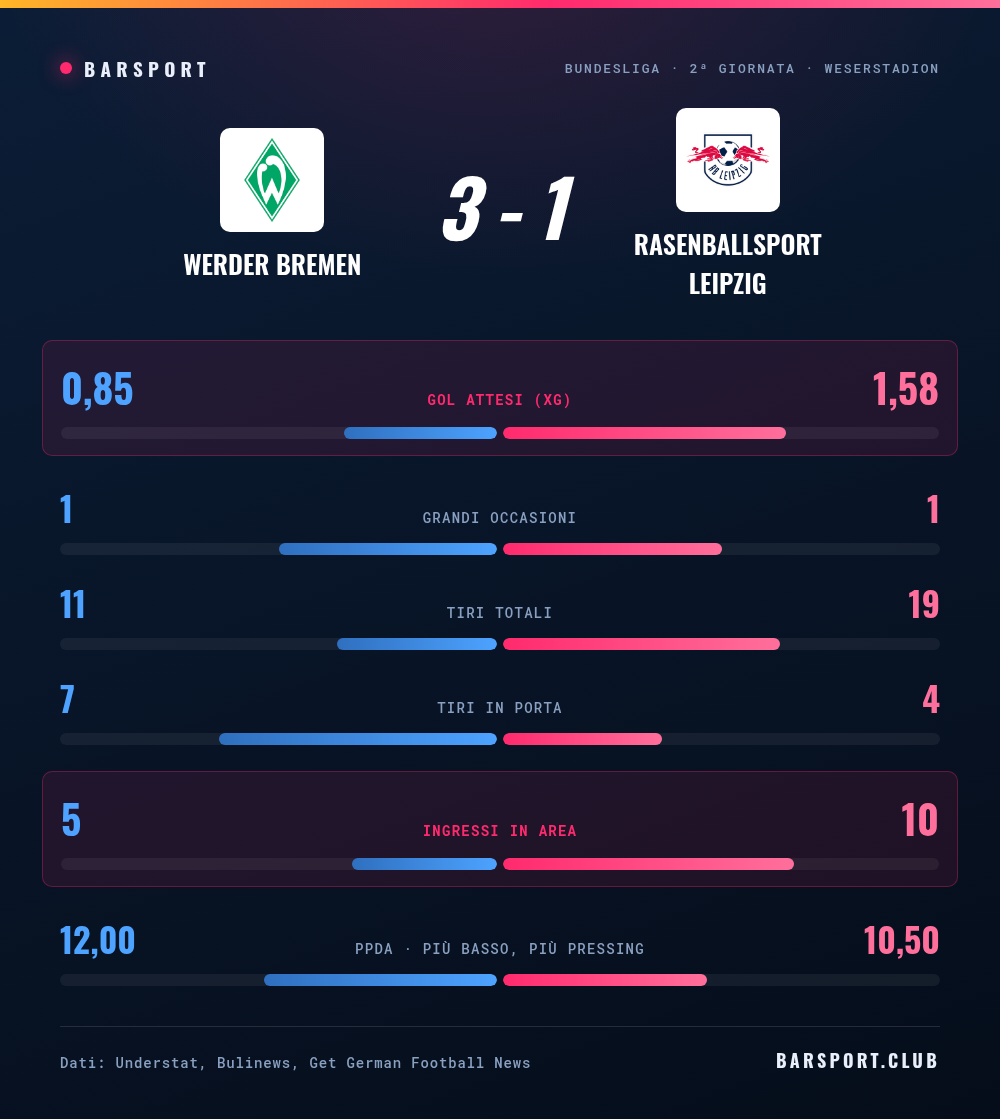
So the sum is this: Werder's three goals are worth 0.523 expected goals between them. Leipzig's lone goal is worth 0.544. One is heavier than three.
And that is not an accounting curiosity: it is the match. Leipzig finished on 1.58 expected goals to 0.85, ten box entries to five, 1.96 expected points to 0.77. They hit the bar through Nusa and had one cleared off the line. They did everything required to win a football match, except score before stoppage time.
How the two sides moved
We read four analyses. Two of them, written before this match, describe precisely how it ended — and they are the most interesting, because they are not prophecies: they are the same structures, observed in pre-season.
Demichelis' Leipzig is a team built around the centre. Tactical Football Analysis, in an April piece on his Mallorca, describes an "obsessively central" 4-4-2 diamond in which the base drops between the centre-backs and the full-backs supply the team's only width, pushing high and wide. At Leipzig the shape has changed — Get German Football News' season preview describes a 4-3-3 with attacking full-backs and a positionally disciplined six — but the principle has not: density in the middle, width delegated to the full-backs.
That same preview, from 25 August, contains the warning. In the Leeds friendly, it writes, when the English side bypassed Leipzig's compact central block, Henrichs and Finkgräfe were repeatedly exposed as Leeds attacked quickly into the channels; the opening goal came from exactly such a sequence. And on the Bayern dress rehearsal: six minutes of excellent football, then nothing. "The remaining question is how often Demichelis can make those six minutes resemble ninety."
Thioune's Werder, on the other side, presses high and leaves itself open. The Bremen season preview describes a nominal 4-2-3-1 that defends as a 4-4-2, with Chuki stepping up alongside the striker in the first pressing line, full-back Deman pushing aggressively forward and the winger alternating between holding width and moving inside. And it notes the flaw, in the coach's own words after the Auxerre friendly: Werder lacked "sufficient will to defend in transition".
Sunday's opening goal is that structure working: a high turnover, Chuki through the middle, Dinkçi in front of the keeper. Thioune described exactly that afterwards — a ball won up top, then the through pass. The midfield that produced it — Chuki, Reis, Regeer — had known each other, again his words, for three days.
Our reading, which is an opinion and not a fact. Werder's flaw — coming apart after losing the ball — went unpunished, because Leipzig got into the box ten times and built almost nothing out of it. Leipzig's flaw — high full-backs, channels open to the counter — was punished after four minutes. Then the match turned on a corner and a break: the two situations in which a side that holds the ball and the territory is most exposed.
We are not saying Werder deserved it: the numbers say the opposite, and we have just printed them in a graphic. We are saying that the way they won was predictable, and had been predicted.
Season context — two matchdays, not a season
Werder have three points from 1.18 expected points in two games. They have scored four goals from 1.80 expected.
Before anyone writes "the luckiest team in the league": no. We checked all eighteen. On the gap between real and expected points, Bremen are fourth — behind Elversberg (+3.89), Borussia Dortmund (+3.23) and Freiburg (+1.86). On the gap between goals and expected goals they are second, behind Elversberg.
Leipzig, on the other side, have three points from 4.69 expected. On matchday one they beat Gladbach 3-0 producing 3.76 expected goals: that was a real win. Two matches, two Champions-League-level performances, one full return.
The honest bit
Two matchdays are nothing. Every gap between real and expected points you have read above carries a margin of error that makes it, for now, a curiosity and not a diagnosis. We will use them again in ten matchdays, when they will mean something.
The tactical analyses we used are pre-season pieces, not reports on this match. They describe how the two sides had organised themselves in the summer and in friendlies. That the mechanisms seen on Sunday match the ones described is a verifiable fact; that the match went this way because of them is our interpretation, and it could be wrong.
Three of the four sources on these two teams come from the same outlet. Get German Football News is by far the most detailed on German football, but when three readings out of four carry the same byline, the comparison between sources gets weaker. We say so because it is true, not because we like it.
The minutes are those of the German press and the full-time report. Understat, as always, lists them a minute earlier: in our raw data Baku's goal is on 94.
We keep the running tally of results against performances in the Meritometro. Anyone who wants the raw numbers, without the story around them, will find them in the Nerd Zone.